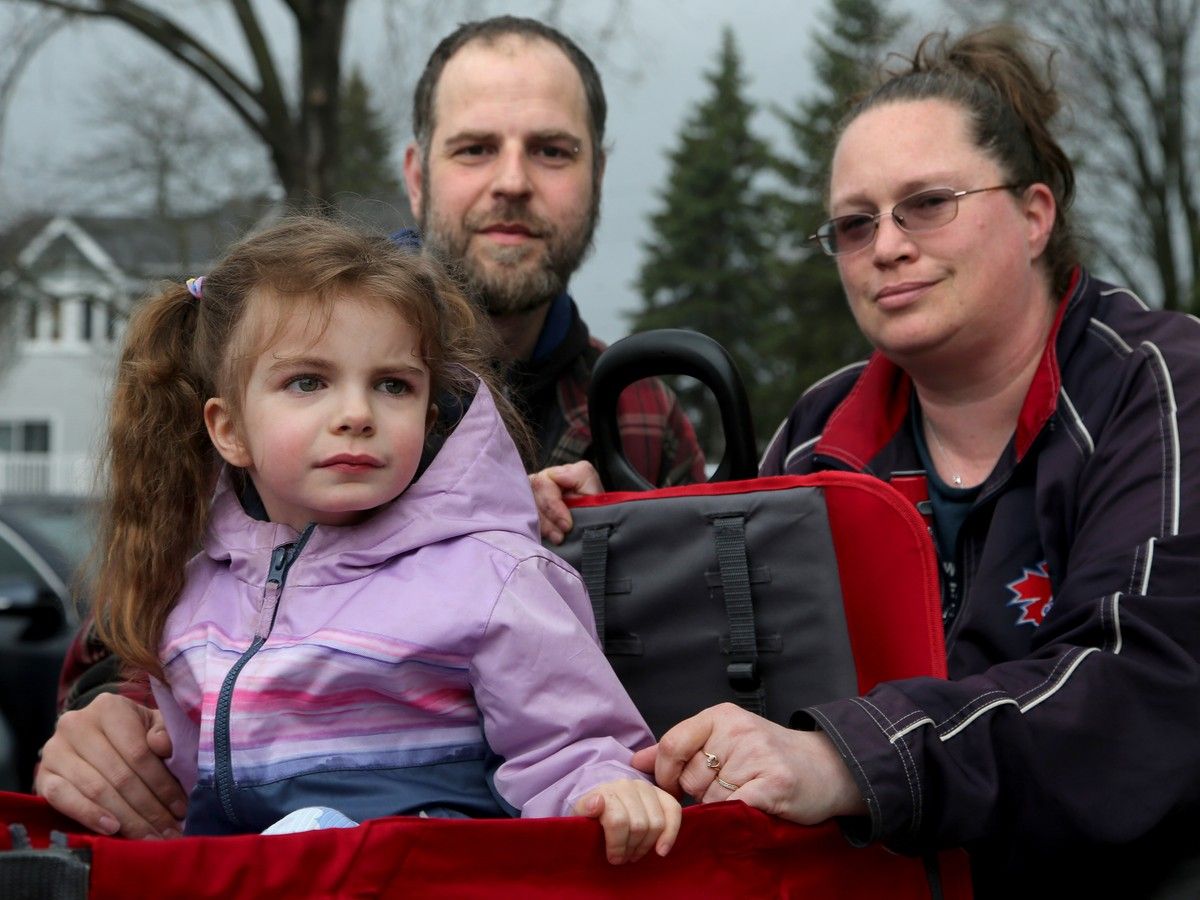
Jennifer and Andrew Nickerson’s precariously constructed life had been teetering for months. It crashed to the ground in March when they found themselves living in a city shelter.
Andrew was laid off in March 2024. The couple left their Kanata townhouse in June 2025 to live with Jennifer’s mother, Geraldine, who had been diagnosed with cancer. Jennifer has been on mental health leave from her job as a legal assistant with the federal government since last September. Geraldine died in December, and the couple learned in March that their family of six could not remain in Geraldine’s subsidized townhouse.
That was when another major brick was pulled from the Jenga tower that was their life. The Nickersons learned their daughter Arizona, four years old, who has autism and other disabilities, would likely only qualify for 25 per cent of an education assistant when she enters senior kindergarten next September.
Before she entered junior kindergartern last September, Arizona had one-on-one support at daycare.
Without a full-time education assistant, she hasn’t been able to attend school full time. Which means her parents have been unable to work full time.
“I never though that life would get to this point,” said Andrew. “I always thought we would get to a point where we couldn’t move one step forward.”
The Nickersons’ situation ended up in Question Period at Queen’s Park this month, when NDP education critic Chandra Pasma, the MPP for Ottawa West-Nepean, charged that the province has failed students like Arizona.
Education Minister Paul Calandra responded that the province has
appointed supervisors
to school boards struggling with their finances and is channelling money back into the classroom. (According to a report from the Ontario East Regional Internal Audit Team, which provides independent assessments for school boards, the OCDSB
spends 25 per cent more
on special education than it receives from the provincial government.)
The OCDSB supervisor has put a
student-first model
in place, said Calandra. “They are reviewing every single budget item with one singular focus to plow more money back into the classroom, to eliminate waste and duplication, to stop the infighting that’s happening between trustees, and to ensure that the students, parents and teachers have what they need to ensure the best possible outcomes.”
But for families of children who need full-time classroom support, the question is not waste and duplication, but a child’s
right to a full-time education
.
Arizona, who attends Arch Street Public School, needs full-time support for safety reasons, said Jennifer. She can become dysregulated easily and overwhelmed by loud noises.
“She’ll cover her ears, she’ll cry,” said Jennifer. “She’ll self harm, punch herself in the head. She’ll pinch herself. She’ll hit you. The EA will just remove her from the situation and calm her by singing to her. She loves to sing. So they sing to her calmly, and that will bring her back to base level.”
A few years ago, the Nickersons were in a good place. At 30, Jennifer didn’t have a high school diploma. She got her equivalency, completed a two-year law clerk program at Algonquin College, then embarked on a one-year paralegal program. After she was certified, she landed a job with the federal government.
“It was a very hard but very rewarding journey,” said Jennifer. “I thought I would be able to give my kids the world and more.”
Andrew worked at the call centre for 11 years. The family bought a van. There were trips to Disney and employment benefits to help provide care for Arizona, who uses a feeding tube and also has a visual impairment.
Their Kanata rental townhouse had cost $2,250 a month. After they lost Geraldine’s townhouse, Jennifer found that rental options large enough for the family would cost at least $2,800. That would leave about $600 for the rest of the month including food, medication, supplies for Arizona and other necessities, she said.
“Everything kind of happened so fast. And when my mom passed away, it was like everything came crumbling down. I just felt like I lost control,” she said.
“I’ve been in contact with social workers. I’ve been in counselling, seeing my doctor regularly because of my state of mind. And it’s all because one little girl can’t go to school all day.”
Adjusting to life in the shelter, a former retirement home, has been difficult for Arizona, said Jennifer. Their two-room unit is equipped with a microwave and a refrigerator. Arizona doesn’t have her own room. Her chief chief delights are her tented bed, music, trips to the local park and the Youtube singer Ms. Rachel.
“Arizona is struggling hard with this transition, because she doesn’t have her own space,” said Jennifer. “She’s cooped up in a room. She’s not sleeping. It’s affecting her mentally. She’s self harming more. She’s showing more these aggressive behaviours.”

While Arizona qualifies for a full-time spot in an autism class or at Clifford Bowie or Crystal Bay, the OCDSB’s two schools for children with multiple exceptionalities, its unclear so far whether there will be a space for her, said Jennifer.
The Ontario Autism Coalition’s 2023-24 special education survey found that six per cent of all special education students were completely excluded from school, even though they were entitled to attend. About 38 per cent of students on modified schedules were attending for reduced hours because schools did not have enough resources to support the student safely full-time, according to the report.
Pasma said the Nickersons’ situation is the only case she knows of where a family was forced to move to a shelter — but there are cases where families fear losing their home.
“It affects the family’s entire life,” she said.
Andrew Nickerson has been looking for work. He estimates he has applied to 100 jobs in sales, marketing and call centre jobs and has been interviewed for 10 jobs with no offers.
I has been hard going public with their story, he said.
“It is very scary to have her story out there. This is Arizona’s story. But this is for all children like her who only get 25 per cent, and for parents who have to jump through rings of fire.”
In some ways, Jennifer considers herself lucky. She has only praise for the staff at Arizona’s school. There are children have have more severe health issues than Arizona.
“But then I think about it, and I say, she deserves just as much as they do, said Jennifer. “She deserves just as much as any other child in this world.”
The Nickersons are on a wait list for affordable housing, but it could take three years, said Jennifer. They’re also still waiting for a spot for Arizona in one of the specialized schools or classes she qualifies for.
“Then maybe, maybe, just maybe, we’ll be able to afford a home and bring our life back to the way it used to be. Before everything came tumbling down.”
Related
Our website is your destination for up-to-the-minute news, so make sure to bookmark our homepage and sign up for our newsletters so we can keep you informed.