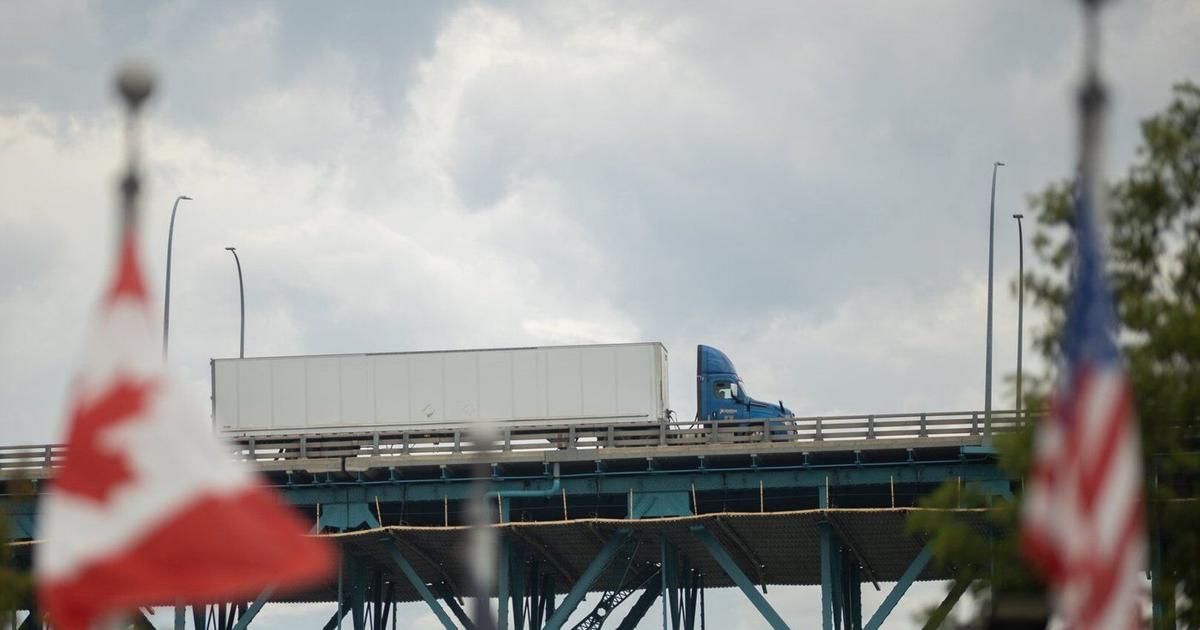
OTTAWA – Economists are warning that a re-escalation in the trade war with the United States puts Canada’s burgeoning economic recovery at risk.
The U.S. imposed 50 per cent tariffs on roughly $28 billion worth of Canadian goods over the weekend after trade talks fell apart. The tariff targets, which include cement, honey, alcohol and textiles, amount to roughly five per cent of Canada’s exports to the United States.
Trevor Tombe, economics professor at the University of Calgary, said in an interview that machinery and electronics industries will take a sharp hit as billions of dollars of their U.S. exports are targeted in the new tariffs. Proportionally, the furniture and textile sectors will also see substantial impacts as nearly half of their exports to the U.S. are covered by the new duties.
Exporters scaling back production in response to tariffs could result in around 50,000 job losses across targeted industries, Tombe estimates. Another 35,000 jobs could be affected through the supply chain, though he cautioned there’s currently a lot of uncertainty around both of those figures.
Tombe said the direct impacts of the tariffs will be felt most acutely in British Columbia, followed by Ontario and Quebec. Economic pain won’t hit all at once and will instead play out over the coming months, he said.
While some industries are expected to struggle under the weight of the new tariffs, most economists weighing in since the duties were first threatened last month have argued that Canada’s economy can absorb the hit from a macro perspective.
Bank of Montreal expects the new tariffs will carve half a percentage point off Canada’s economic growth as business investment and confidence take a hit.
Before negotiations imploded on Friday, Canada’s economy had been showing signs of a rebound. Early reports from Statistics Canada have real gross domestic product on track for solid growth in the second quarter of 2026, coming off a pair of small contractions in the previous two quarters.
“Unfortunately, this breakdown comes just as growth looked to be finding better momentum. Although businesses had been showing signs of looking past tariff headlines, this would be the toughest action since the spring of 2025,” said BMO senior economist Robert Kavcic in a note to clients over the weekend.
Bradley Saunders, North America economist at Capital Economics, said in a note to clients Monday that the new tariffs push Canada closer to a recession, particularly if the United States ramps up attacks in response to Ottawa’s own retaliation.
Saunders said he estimates Canada’s effective tariff rate — the average duty facing a Canadian good crossing the border — has now nearly doubled to 5.6 per cent from 2.9 per cent previously. Other economic firms had varying estimates of the new effective tariff rate on Monday, but most put it in the mid-to-high single digits.
“Either way, the upshot is that Canada’s relative tariff advantage over other economies has taken a dent,” Saunders said.
Prime Minister Mark Carney has pledged to retaliate with dollar-for-dollar tariffs starting Sept. 8.
Canada initially targeted a range of U.S. goods with 25 per cent retaliatory tariffs for six months in 2025 but dropped the bulk of them last September.
A Bank of Canada analysis found that retail prices on affected items rose roughly six per cent compared with non-tariffed goods, with prices returning back to pre-tariff levels roughly three months after the counter-tariffs were dropped.
It’s not yet clear where Canada will target its tariff response this time around.
Kavcic said the latest trade uncertainty is likely to reinforce the Bank of Canada’s decision to remain on hold. While counter-tariffs can stoke inflation, Kavcic argued those pressures would likely be offset by weaker growth in the trade war.
In a social media post Monday morning, U.S. President Donald Trump threatened to raise existing tariffs on autos to 50 per cent and extend equivalent duties to auto parts starting Jan. 1, 2027.
Flavio Volpe, president of the Automotive Parts Manufacturers’ Association, said in a social media post that such a move would shut down auto production in both Canada and the United States, given the number of times a part crosses the border before it’s installed in a vehicle.
Economists say the extent of economic harm will depend on the degree of fiscal stimulus from Canadian governments in response to the new U.S. duties.
Finance Minister François-Philippe Champagne told reporters in Montreal on Monday that the federal government plans to support affected workers and businesses for as long as necessary. He was set to meet with his provincial counterparts later in the day to discuss a collective response to tariffs.
Both Saunders and Kavcic noted that there will likely be knock-on effects to the renegotiation of the Canada-U.S.-Mexico agreement, known as CUSMA. Businesses are now more likely to restrain investment decisions amid further uncertainty around the future of free trade in North America, they argued.
Tombe agreed that uncertainty could cause a “much larger economic hit” than the tariffs themselves.
“The pace of economic growth has slowed largely for Canada because of uncertainty rather than tariffs. And right now that uncertainty has just ratcheted right back up again,” he said.
This report by The Canadian Press was first published Aug. 24, 2026.