“This is how the story of a great chess grandmaster usually begins,” Jordan Himelfarb writes in “Interregnum” (House of Anansi), his book about the game. “A parent or teacher discovers an exceptional mind: a memory of shocking precision; a special intuition for geometry; a gift for logic and abstraction.
“When they are introduced to the game at four or five or six, fluency comes quickly,” he continues. “When that talent is cultivated, others are revealed: monastic discipline, fierce competitiveness, myopic focus. Chess, for the child, becomes everything. They are transfixed by its beauty, lured by its depth, compelled by the contest. Family, friends, hobbies — all life beyond the board begins to recede.”
With comprehensive historical precision and a flair for dramatic storytelling, Himelfarb, head of the Toronto Star’s editorial board, surveys the history of chess players vying for the World Chess Championship.
The book begins with Norwegian grandmaster Magnus Carlsen declining to defend the world title he held for a decade, launching an intense competition among the world’s best players for the coveted honour.
The book’s even-handed exploration also includes the “supposed link between chess genius and mental illness,” the many reasons for chess’s prominence in popular culture and the role Vera Menchik and Nona Gaprindashvili played in breaking down gender parity barriers for a “mind sport” that boasts more than 600 million players worldwide.
Himelfarb, a former editor at This Magazine, won a National Newspaper Award for his 2025 story about 18-year-old world chess champion Gukesh Dommaraju.
What did you last read and what made you read it?
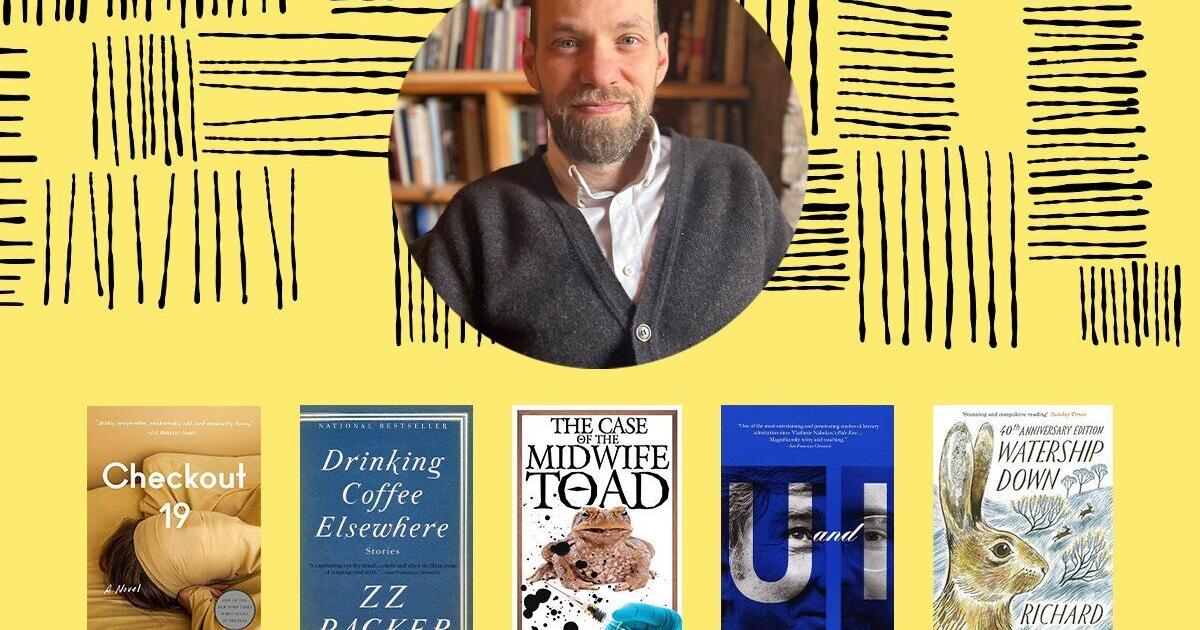
The novel “Checkout 19” by Claire-Louise Bennett, a tribute to the power of literature. Apparently, the book was highly anticipated, though not by me; I’d never heard of Bennett. Rather, I was intrigued by the cover blurb — “elatingly risky” — and took a risk that turned out to be elating.
What book would your readers be shocked to find in your collection?
It may surprise some that, while writing my chess book, I read not only everything I could about chess, but also a lot of poetry. I wanted to find a way to explain technical chess concepts without disrupting narrative or alienating readers unfamiliar with the game. Poets such as T.S. Eliot and Louise Glück, both of whom I quote in the book, offered inspiration, not so much in their lyricism, but in their compression — the way they explain by stealth.
When was the last time you devoured a book in one, or very few, sittings?
I blitzed through ZZ Packer’s short story collection “Drinking Coffee Elsewhere” after discovering the book’s funny and profound title story last year. It’s been more than two decades since Packer published her debut and we’re still waiting for a followup. I’m now like one of those frustrated George R.R. Martin fans. Aren’t I entitled to my stories?
Who’s the one author or what’s the one book you’ll never understand, despite the praise?
Easy: Anaxagoras of Clazomenae. Socrates, Plato and Aristotle all sang his praises. But come on: Every substance contains all other substances? Plants are conscious? Hands are the source of human intelligence? Sorry, I’m not impressed.
What’s the one book that has not garnered the success that it deserves?
Arthur Koestler’s “The Case of the Midwife Toad.” A riveting investigation, a sociology of science, and a timely warning about the dangers of blind partisanship. This book deserves to be back in print. Let’s hope the rightful re-emergence of Rachel Ingalls’s novel “Mrs. Caliban” — the story of an affair between a suburban housewife and a fugitive frogman — suggests you can’t keep a great frog book down.
What book would you give anything to read again for the first time?
It would be a betrayal of Nicholson Baker’s ingenious “U and I” to reread it. The U is Baker’s hero, John Updike, but the book isn’t really about his work; it’s about how writing takes on new life in a reader’s memory. I haven’t read “U and I” in 25 years, yet I still often think of Baker’s description of meeting his idol — a perfect comedy of humiliation. At least, that’s how I remember it.
When you were 10 years old, what was your favourite book?
“The Hitchhiker’s Guide to the Galaxy.” It was when the bureaucratic Vogons became exasperated watching humans panic over Earth’s imminent destruction — “there’s no point in acting all surprised about it” — that I first discovered the singular pleasure of laughing while reading.
What fictional character would you like to be friends with?
I’d like to be the spare on a trivia team with J.D. Salinger’s Glass family.
Do you have a comfort read that you revisit?
Josephine Tey’s “Daughter of Time,” the greatest detective novel ever written. A hospital-bound inspector, bored out of his mind, becomes obsessed with the case of Richard III’s murdered nephews. Gripping, charming, romantic — and an insightful bit of historiography. As my bubbe used to say, “What could be bad?”
What was the last book that made you laugh or cry?
The John Ashbery poem “Sleepers Awake” recently made me laugh, though, as is often the case with Ashbery’s writing, I’m not entirely sure what he’s talking about (“A philosopher should be shown the door, but don’t, under any / circumstances, try it”). As for crying — and speaking of chess books — I assure you that, when I finished Sally Rooney’s latest novel, “Intermezzo,” I was not crying. You were crying.
What is the one book you wish you had written?
“Watership Down.” I read my eight-year-old daughter a passage from “Interregnum” and she said it was “wonderful” but just one thing: I should put it in plain English so readers could understand. Excellent advice, humanely delivered. Yet I did not hear her complaining about clarity of language during our recent reading of Richard Adams’s mind-bogglingly brilliant bunny epic, which, by the way, contains an entirely invented rabbit lexicon. But whatever.
What three authors living or dead would you like to have a coffee with?
I don’t drink coffee or anything else hot or uncarbonated. But I’d love to have an ice-cold Diet Coke with fellow DC addict Joan Didion; get checkmated by Nabokov while he holds court on the flight patterns of butterflies; take Edith Wharton’s fortune at the bridge table (I guess she’ll just have to write more books!). And since I miss my Giller-winning friend Sean Michaels, I’ll include him as a bonus, even if it would mean joining him at his Mile End haunt, Café Olimpico, for a — ugh — coffee.
What does your definition of personal literary success look like?
In the short term, I’d be satisfied knowing that at least a few readers with no prior interest in chess read my book and were compelled by the beauty of the game, moved by the human drama, maybe even inspired to set up the pieces and play. (J.K. Rowling-like sales would be nice, too.)
Error! Sorry, there was an error processing your request.
There was a problem with the recaptcha. Please try again.
You may unsubscribe at any time. By signing up, you agree to our terms of use and privacy policy. This site is protected by reCAPTCHA and the Google privacy policy and terms of service apply.
Want more of the latest from us? Sign up for more at our newsletter page.