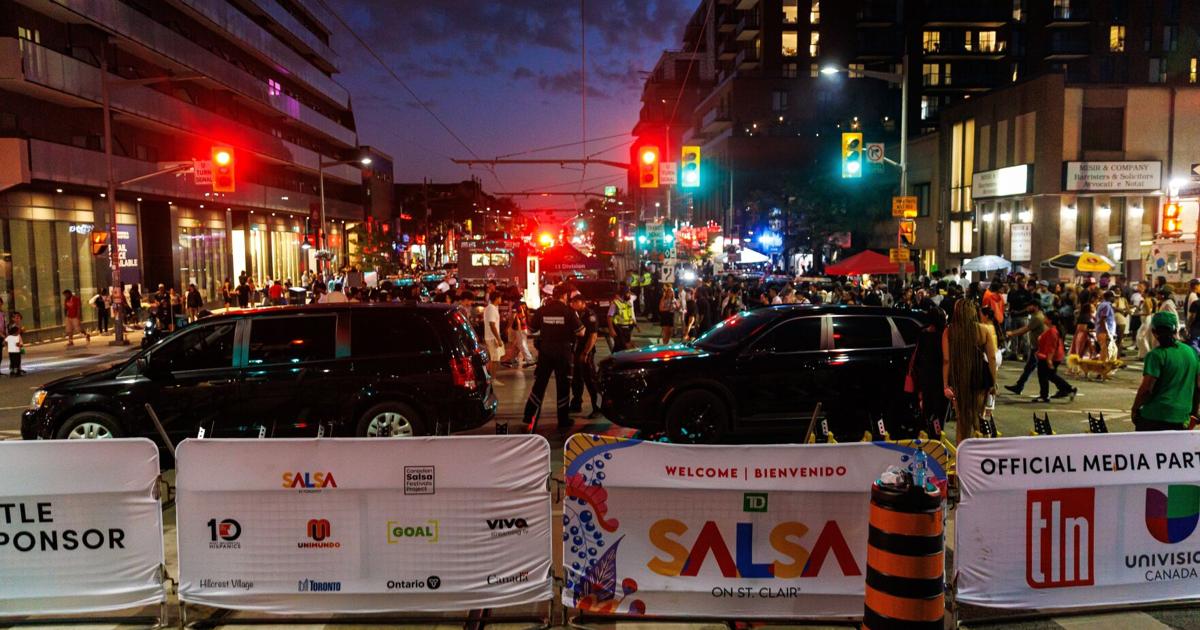
The organizer of Salsa on St. Clair vows to continue with the popular street festival, even though a major backer has ended its sponsorship in the wake of a deadly shooting earlier this month.
The local Hillcrest Village Business Improvement Area voted last Thursday to “discontinue its sponsorship” of the festival that has run for 21 years, according to a letter obtained by the Star sent to Canadian Salsa Festivals and TLN Media Group, the St. Clair festival organizers.
“We have been proud to sponsor and host this event for many years,” the letter said, signed by Heather Hannah, the BIA chair. “However, the Board believes the festival has outgrown both the neighbourhood and the capacity of our BIA.”
The BIA’s move follows the shooting on July 11 that left two people dead and five injured. Police have yet to make an arrest or even release details on possible suspects.
Hannah’s letter pointed to surveys done among its membership of local businesses over the past few years, that have shown a “significant decline in support” for the festival.
“Some of our larger restaurants and businesses have gone so far as to choose not to open during the event,” the letter continued. “Support among local residents has also declined markedly.”
The letter gives no further details, and Hannah declined to comment.
In an emailed statement Tuesday shortly after the Star broke the news of the BIA’s decision, TLN president Aldo Di Felice wrote: “The invasion of the festival by reckless criminals on July 11, 2026 resulted in horrific scenes of violence, chaos and lasting trauma. It comes as no surprise therefore that the BIA businesspeople would so respond in the wake of such a tragedy.”
Di Felice’s statement said TLN has since met with Mayor Olivia Chow’s office to “ensure the continuation of the festival.”
Chow’s office confirmed Tuesday that “the mayor assured the organizers that the city can work with them to make sure Torontonians can continue to enjoy the festival next year.”
Shortly after the shooting, Di Felice told The Globe and Mail in an email there had been a declining police presence at the festival, pointing to the city’s “increasing indifference” and “declining support” for safety measures. A few days later, he threatened in an online statement to withdraw support for the festival if the city didn’t ramp up its policing.
However, Toronto police said in a statement that the number of officers at the festival was “consistent” with previous years, including a command post.
What next for St. Clair festival?
Withdrawing support for a street festival is a rare move for a BIA, said John Kiru, executive director of the Toronto Association of Business Improvement Areas, especially for long-standing events, “so when it does happen, there (must be) a compelling reason.”
“It’s either because the event has become too expensive, the BIA doesn’t see the return on its investment or enough businesses have raised concerns,” he said.
Organizers can relocate, or apply for permits to hold the festival in the same location, but city council has the ultimate say, Kiru said.
Local Coun. Josh Matlow (Toronto—St. Paul’s) said the festival is unlikely to return to St. Clair West since the BIA has made it “very clear” where it stands.
“We will focus on other ways to support our merchants and celebrate our Latin American community,” said Matlow.
Khaled Lashin, a regular Salsa festival goer and dancer, said he’s relieved the festival may return because it is his “vacation away from home” and the “happy” atmosphere during the day can be contagious.
“I’m very sad and worried this might not be the case next year,” he said, questioning whether a new location or increased security would take away that feeling.
“But I understand the inconvenience for people living and working there,” Lashin added.
Ending sponsorship ‘right call’
Vito Tomasicchio, co-owner of Nodo Restaurant, which is part of the BIA, said parting ways with the festival is the “right call” for the neighbourhood.
“I’ve been there for 12 years, so I’ve seen the festival grow and I’ve seen a change after COVID,” said Tomasicchio. “After six o’clock … the customer base definitely gets younger. A little bit more aggressive. There’s more circles of groups and less people dancing.”
There are police stationed every year, “but the problem is, you’re dealing with some brazen people. How do you manage overconsumption and over-aggression?” said Tomasicchio, recalling some fights on the street in recent years, including in 2024 when a man fired a gun during a fight after someone cut in line. No one was injured in that incident.
Tomasicchio said his restaurant stays open and tries to “make the best out of it,” but he also noted some potential downsides for other local businesses that choose to close during the event.
“Someone could go to the LCBO and get themselves a cooler. Then I got to deal with the crap that potentially comes in my venue. And I can’t make the sales,” he said. “What’s the point of opening?”
Festival a ‘huge headache’ for some
Nick Genova is co-owner of the popular gelato shop Bar Ape, which is also part of the BIA. Genova, who’s lived in the neighbourhood for years, said he’s chosen to stay closed during the festival for a few years. They tried to reopen two years ago, but quickly said “never again.”
“Most of the businesses I know do not do well during the festival and it’s a huge headache so they just close,” Genova said by email.
In his case, he wrote, “Business was slow and the added stress of dealing with people who had been drinking all day was just something we never signed up for.”
The city has increased overall festival funding from about $2 million in 2022 to more than $4 million in 2026, according to Pat Tobin, the city’s general manager of economic development and culture.
However, the number of festivals receiving support has also soared — from 36 to 137.
For the Salsa festival, this year the city gave organizers $200,000, up slightly from last year’s $197,957 and double the $100,000 in 2022.