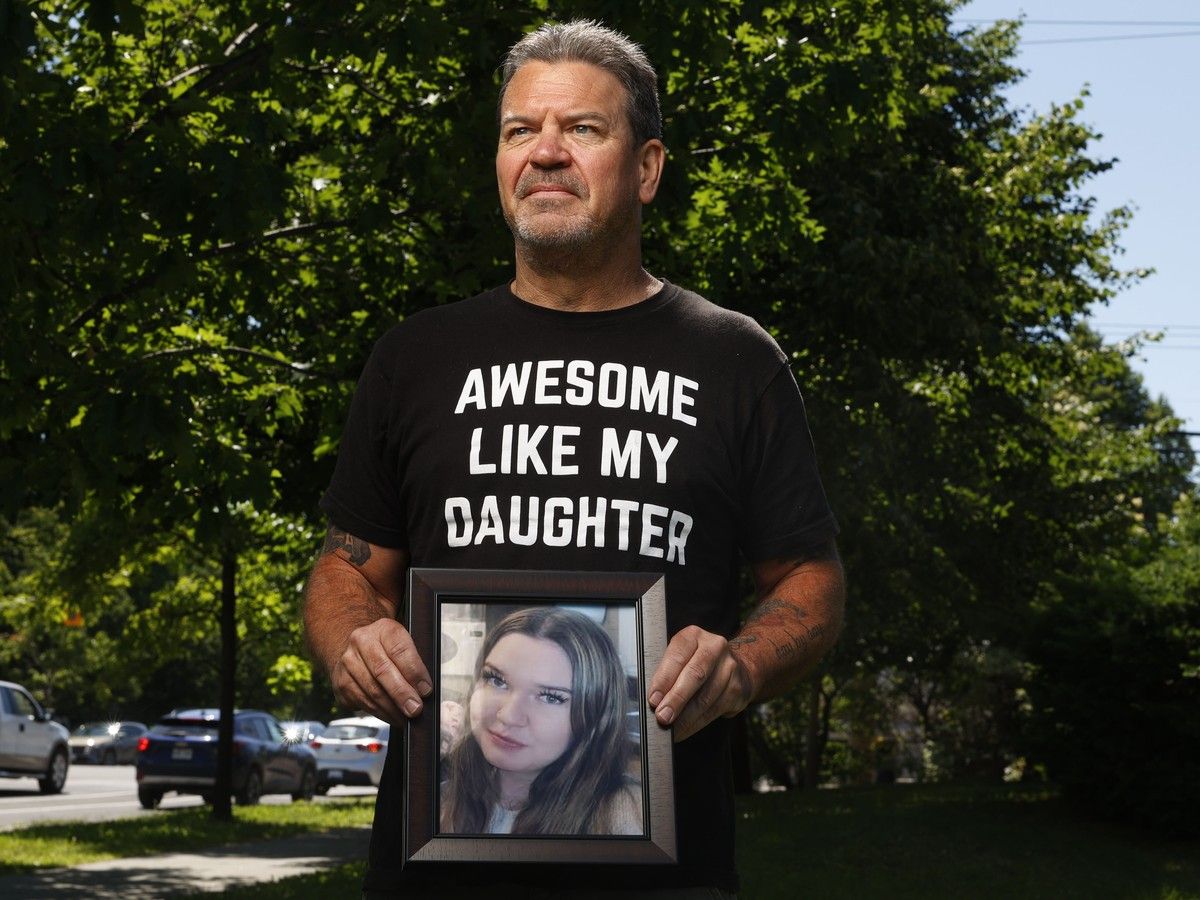
Kevin Williamson remembers the exact moment his world came crashing down.
On March 17, 2025, months of unanswered questions about his daughter’s constant fatigue, unexplained pain and unusual discharge finally started making sense.
The cause was a 7.2-centimetre mass on Kaley Williamson’s cervix that doctors warned would be difficult to treat.
The diagnosis was bewildering for the 21-year-old from Orléans, who spent most of her days training and competing at the cheerleading gym with her two stepsisters, while working toward her dream of becoming a personal support worker or helping children.
But instead of planning for the future, she spent the next 15 months up against the fight of her life, undergoing chemotherapy and other treatments, often spending weeks on end in the hospital. She died on June 7, 2026, at the age of 23.
Now, her father is determined to ensure her legacy lives on by spreading Kaley’s message to everyone who will listen.
“Know your body.”
“If the doctor says that it’s fine, don’t worry about it, say, ‘Well, no. Let’s take a minute and think about this for a second here,’ and use Kaley as an example,” Williamson told the Ottawa Citizen.
For Kaley, the cervical cancer diagnosis was even more shocking considering she’d received the Human Papillomavirus (HPV) vaccine in high school, which protects against the virus strains linked to the vast majority of cervical cancers.
After noticing something wasn’t right, Kaley asked her doctor for a Pap smear in November 2024, but the test came back negative. She returned to her doctor in March after noticing unusual discharge and odours, but was prescribed antibiotics for what was believed to be a yeast infection.
“And she came home two weeks later, and she said, ‘It’s not better,’” Wiliamson recalled. “And that’s when they found the mass in the ER.”
Gynecologists told the family a mass of that size would usually take two-and-a-half years to develop, while Kaley’s appeared to have grown within a matter of months.
“Especially in Kaley’s case, she had a negative Pap smear, so when she went back, why would they even think cancer? It wouldn’t be a thought, but it has to be a thought,” Williamson said.
Cervical cancer is among the fastest rising cancers in Canada. An estimated 1,700 women in Canada will be diagnosed in 2026, with an estimated 450 deaths from the disease, according to a report in the Canadian Medical Association Journal.
But the good news is that, through vaccination and regular screening, this cancer is “almost entirely preventable,” according to Dr. Anna Wilkinson, a family physician and general practitioner oncologist at The Ottawa Hospital.
Doctors are also getting more effective tools to detect cervical cancer in its early stages.
As of March 2025, around four months after Kaley asked for her Pap smear, health-care centres across Ontario started administering a primary HPV test to screen for cervical cancer, with screening taking place every five years instead of three.
While Pap smears look for cell changes in the cervix and can miss abnormalities up to half the time, Wilkinson said the HPV test is about 96 per cent sensitive and looks for cancer-causing HPV strains and cell changes, detecting a problem before it grows.
“I often refer to it as we used to look for the smoke from the fire, and now we’re looking for the actual flames itself,” Wilkinson said.
But given Kaley was just starting chemo by the time these changes were introduced, Williamson is now just left with a series of what-ifs around whether it would have been a difference-maker for his daughter.
What if Kaley had been able to get the improved HPV screening, and what if it had caught the cancer the Pap smear might have missed?
Williamson said there’s an even more concerning what-if for future young women, now that the minimum screening age has been increased from 21 to 25.
What if other 21-year-old women find themselves with symptoms like Kaley’s, and are now told they don’t qualify for cervical cancer screening until they’re 25?
“They’re saying 25 now to check for cancer,” Williamson said. “Well, I disagree and I think the screening should be done sooner.”

The higher minimum screening age doesn’t raise major alarm bells for doctors like Wilkinson, considering “the numbers were so low in the early 20s that it doesn’t make sense to screen everyone.”
“The reason is that it takes quite a long time for that HPV virus that’s sitting there in the cervix to cause enough changes that it becomes a precancerous lesion,” she said.
While she said wasn’t familiar with the details of Kaley’s case, she added about one per cent of cervical cancers aren’t caused by the HPV virus and may behave differently.
About two weeks before she died, Williamson recalls how Kaley was dedicated to take a trip they both knew she didn’t have the energy for.
She wasn’t strong enough to walk and was delirious from the pain medication as Williamson transported his daughter from bed and into the passenger seat of the car.
She was on the highest doses of pain meds allowed, yet she was always hurting as the tumours had spread onto her nerves.
“It was a trip from hell,” Williamson recalled.
But the four-hour drive to the Princess Margaret Cancer Centre in Toronto was something Kaley was determined to do.
While there was the chance she’d be admitted into a clinical trial, Kaley knew it was likely doctors would tell her she wasn’t strong enough. The main reason she wanted to go, Williamson said, wasn’t for herself.
She gave the research team her consent to conduct blood work and a biopsy, so that they could study her unusual case and help save other young women in the future.
“Kaley said, ‘If they find one thing that can help one woman or girl, that’s why I (am going).’”
We sat in a bustling Tim Hortons in Orléans during the lunchtime rush as Williamson sat down to share Kaley’s story and uphold his duty to spread her message.
Tears welled in his eyes throughout the conversation, especially as he recalled the hardest parts of his daughter’s fight and the moments that will stick with him.
He was often fighting tears, especially as he recalled the final days of his daughter’s life and the memories that stick with him.
“She didn’t want anyone to see her struggle, so she put on this brave face. ‘I’m OK.’ She said that a million times, but it’s hard.”
Near the end of our conversation, a man approached our table as he waited for his coffee after overhearing parts of what Williamson had shared with me.
“Are you Kaley’s dad?” he asked Williamson, explaining that his wife was a friend of the family as he offered his condolences.
As the man left, Williamson shrugged his shoulders and looked at me with a hint of pride in his eyes.
“She wanted her message out there, and I guess it’s working.”
How can I get screened?
All people with a cervix are encouraged to get screened for cervical cancer every five years while between the ages of 25 and 69. A family doctor, nurse practitioner or midwife can all book appointments for an HPV screening.
Those without family doctors can also use Health811 to find a clinic nearby that performs HPV screenings, or use the Ottawa Hospital’s Champlain Screening Outreach Program.
“Screening is so important because when we find early changes on screening, the treatments are very minimal compared to if you aren’t screened and a cancer develops,” Wilkinson said.
If you’re informed of an abnormal result, Wilkinson encourages everyone to ensure they attend the follow-up appointment for further testing and follow the recommended steps.