

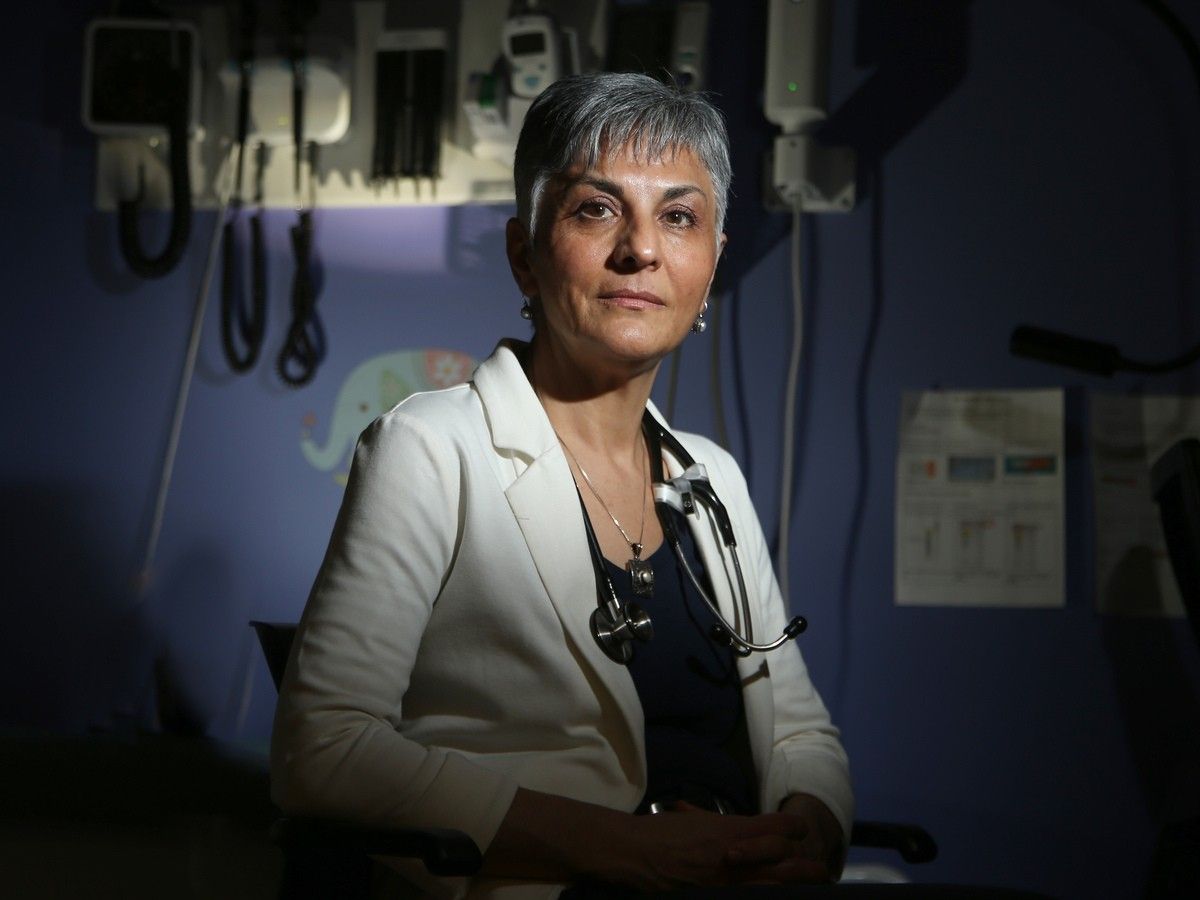
Unwanted. Uncared for. Unloved.
Those were the cornerstones of what Parisa Rezaiefar had felt before eventually leaving her country in 1992. That year, after coming to Canada as a refugee, she remembered vividly the Persian man — a doctor — who had treated her.
She needed dental care and she received it free of charge. Rezaiefar said this was thanks to the Canadian government’s Interim Federal Health Program, or IFHP, through which refugee claimants could receive medical care while awaiting enrollment into provincial or territorial health programs.
In that moment, Rezaiefar felt the opposite of what had been familiar.
Wanted. Cared for. Loved.
Rezaiefar said Canada’s early investment in her health influenced her entire career path and the country’s generosity was baked into the fabric of her professional and personal identity as a medical professional.
The Ottawa-based doctor, who now works at a refugee clinic, says she worries that her story may not continue to replicate much longer.
The federal government’s new co-payment model for IFHP, effective May 1, will require refugees to pay $4 for each eligible prescription medication (filled or refilled) and to pay 30 per cent of the cost on all “supplemental” health products and services, including dental care and counselling.
IFHP, which provides “limited and temporary” health care coverage to those who don’t yet qualify for provincial care, covers “basic” and “supplemental” medical costs.
The invisible cost of comorbidities
In a statement, IRCC spokesperson Danielle Hickey said co-payments would only apply to “supplemental” health services. The basic health benefits, including visits to doctors, ambulance services and vaccinations, will continue to be fully covered, she wrote.
Hickey added that the cuts — part of Prime Minister Mark Carney’s Budget 2025 — were meant to support the “sustainability” of the program and that the co-payments would help reduce financial pressures amid “growing demand.”
However, local experts and advocates say this could be harmful to low-income refugees living with multiple medical conditions.
“The people who are making these decisions are people who’ve never lived a day in a refugee’s shoes,” said Syed Hassan, executive director of the Migrant Workers Alliance for Change.
Hassan said he was concerned that
refugees
would simply not be able to afford their medical expenses once the change takes effect in May.
“It might feel like it’s only $4, but, if you think about what happens if you’re managing diabetes and other chronic diseases and you need five or six medications, that comes to $20 to $25 every month.”
Rezaiefar regularly witnesses cases of multiple medical conditions, called comorbidities, in her exam rooms.
She gave the example of a patient who fled Myanmar after experiencing genocide, forced displacement and sexual violence, alongside her two children.
“Now for us to think $20 per prescription may look modest, but, for a mother who has to choose between picking up a pair of shoes for her child so that she can go to school, that’s a lot of money,” Rezaiefar said.
She worries that this generation of refugees to Canada will not receive the same care she once did.
“When I asked kids what they want to be when they grow up, they say, ‘I don’t know,’ and I say to them, ‘You know, I used to be a refugee, too,” she said. “You should see the way their eyes get bright.”
Dental care: A supplemental service?
Yin-Yuan Chen, an associate professor at the University of Ottawa’s faculty of law, said the government’s use of the term “supplemental” in this context could be misleading.
Under the criteria column of the IFHP
Dental Benefit Grid
(2025), many of the services covered say that those services “are limited to emergency relief of pain or infection only.”
Chen said those terms could lead people to help justify the government’s decision to make these cuts.
“I think the term supplemental can in of itself be very deceiving,” Chen said, adding that it could play into the assumption that dental care for instance was a luxury service.
Hassan echoed that sentiment, adding that the co-payment model would effectively exclude refugees from the care they needed. The membership-based non-profit, which helps organize non-permanent residents across Canada, joined many organizations across the country in speaking out against the new model.
A downstream impact in the long run
IRCC spokesperson Hickey said the changes being introduced to the IFHP “are expected to generate meaningful savings,” adding that IRCC predicted $126.8 million in savings for 2026-27 and $231.9 million onwards.
Hassan argued that the projected savings were a drop in the bucket in the broader context of things.
“It is incredibly tiny,” Hassan said, adding that the consequences, however, could be massive.
Hassan said refugees were likely to skip doctor’s orders to refill their prescriptions for medication if they were short on money, which could land them in a hospital emergency room.
“They will get sicker and sicker,” he said. “And that will put them into the provincial emergency rooms, and that’s where it’s being dealt with.”
Louisa Taylor, executive director of Refugee 613, an independent and local non-profit welcoming and helping refugees settle, said the costs would download from the federal government to the provinces in the long run.
“Policy makers will tell you that they’re doing this to save money, but you’re not saving money if you’re creating downstream impact,” Taylor said. “You’re just shifting who pays the money.”
She added that, though not every refugee needed IFHP support, “the ones who are most vulnerable and have the most complex medical needs and need the most support” will be the ones bearing the brunt of the change.
Déjà vu or legal precedent?
In 2012, the Harper government made similar cuts to the IFHP program.
The Federal Court of Canada ultimately ruled that those cuts were “cruel and unusual treatment” of refugees. The move was later reversed by Justin Trudeau’s Liberal government under the argument that the cuts violated the Charter of Rights and Freedoms.
“The current co-payment policy faces the same constitutional vulnerability,” read a media release by the Migrant Rights Network published in February this year.
On Feb. 24, the Conservative Party of Canada tabled a motion in the House of Commons that called on the Carney Liberal government to review the health-care benefits available to asylum claimants and to restrict benefits for those whose claims have failed.
“Enough is enough. We can’t allow foreign criminals to take advantage of our system, false refugee claims to overwhelm the services that you pay for,” Opposition Leader Pierre Poilievre said in a video.
Poilievre cited a recent report from the Parliamentary Budget Officer saying that
total IFHP costs would reach
almost $1.0 billion in 2025‑26 and would rise to more than $1.5 billion by 2029‑30.
The POB’s February report did not consider the co-payment model, and its predictions were “dependent” on demand for the program.
Hassan argued that the medical cost for refugees under IFHP was only a fraction of the average Canadian’s per person cost in the province.
“IFHP is incredibly cheap in terms of
health care
… It’s cheaper than the provincial program, and it’s much cheaper than having someone go to the hospital,” Hassan said, adding that he believed there was there a misconception that refugees disproportionately infringed on the health-care system.
In 2024-25, it cost the federal health program an average of $1,645 per asylum claimant and $347 for overseas resettled refugees, a POB report said. The yearly average estimate for a Canadian citizen in 2025 was $9,626 according to the Canadian Institute of Health Information.
Rezaiefar was only on IFHP for three months, but that was back in the early 1990s. Now, according to her, it can take more than a year for a refugee to go through that same process.
“That is at least 18 months on IFHP coverage,” she said, adding that delays in the judicial system could explain the increase in costs for the federal health program.
“I saw that the government cared for me,” Rezaiefar said. “I learned that, when we are cared for, we have a tremendous responsibility towards the ones who cared for us.”
Of 107,802 asylum claimants in 2025, Canada accepted just over 50,000, according to IRCC’s open-source data. As of Dec. 31, 2025, a total of 299,614 cases were pending.
Related
- Ottawa River flood risk rises as city closes some roads
- Get ready to say goodbye to the Peace Tower’s green roof
Our website is your destination for up-to-the-minute news, so make sure to bookmark our homepage and sign up for our newsletters so we can keep you informed.

