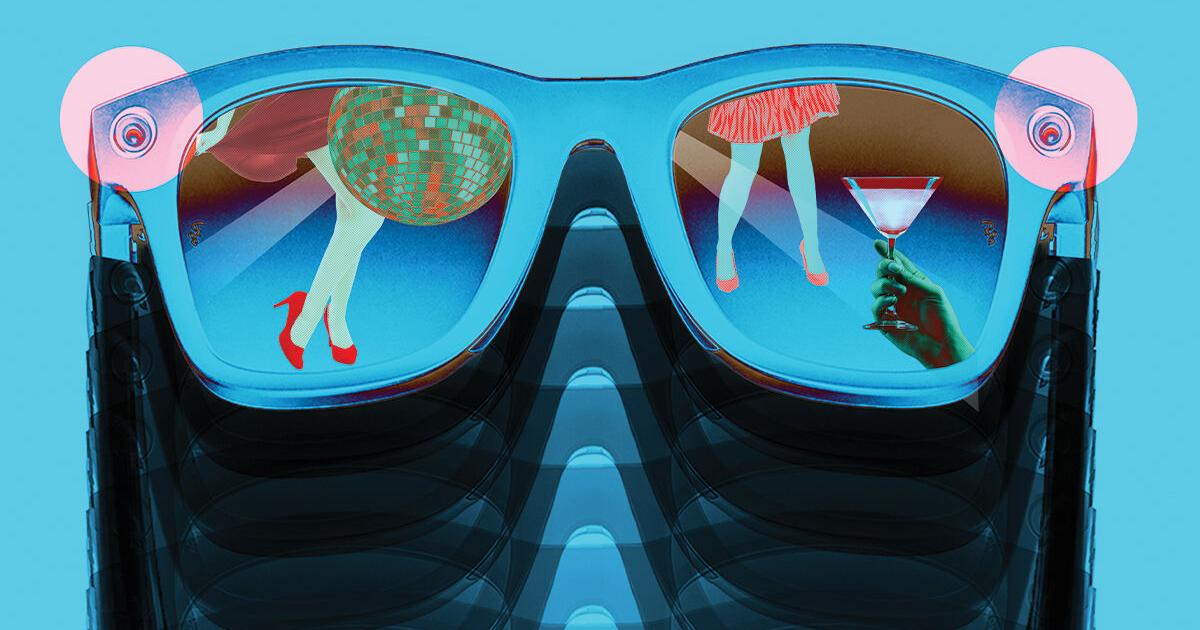
One incident was enough to convince Wiggle Room owner Takin Nateghi to ban smart glasses from his downtown Toronto club.
Over the summer, a partier arrived at the west-end venue with the glasses. He set them on a table, pointed them at himself, and began live-streaming his moves on the dance floor.
“They were breakdancing, two-stepping and shuffling,” Nateghi told the Star.
Nobody seemed to notice that night, but days later Nateghi stumbled across the footage on Facebook. He said it showed him how easily someone wearing the glasses could record others without their knowledge.
“They weren’t doing it to be sneaky,” he added, “But it did get me thinking: ‘You could easily do it and nobody would be the wiser.’”
Nateghi says he wants Wiggle Room to be a place where revellers can let loose without worrying that footage of them will turn up on social media. In September, he announced on Instagram that smart glasses would no longer be allowed inside the venue.
He also equipped his security staff with ZuckOff, a smartphone app that uses Bluetooth signals to detect nearby smart glasses. The name is a jab at Meta CEO Mark Zuckerberg, whose company makes the Ray-Ban Meta and Oakley models.
“People should know if they’re being recorded,” Nateghi said. “That’s what it comes down to.”
But that’s getting harder to guarantee, he acknowledged, as smart glasses become more affordable — an entry-level model now costs less than $500 — and celebrity partnerships with the likes of Kylie Jenner and Blackpink’s Lisa have made them more mainstream.
Meta says it has sold more than nine million pairs since launching its glasses in late 2023, easily making the company the leader in the technology. Samsung is expected to enter the market with its first model before the end of 2026. Technology research firm IDC forecasts total unit shipments will grow 26.3 per cent in 2026, then accelerate to 40.5 per cent growth in 2027.
Smart glasses are marketed for their hands-free communication features, which allow people to make phone calls, listen to music, get real-time navigation assistance and more, but their ability to discreetly capture photos and videos has drawn criticism. Unlike smartphones, which can usually be observed recording their subjects, smart glasses resemble ordinary eyewear, but for a small camera in the corner of the frame that can be hard to detect.
Manufacturers say that an accompanying indicator light on the frame signals when the device is recording, but users have found ways to circumvent the safeguard by covering the LED light with tape or simply breaking it.
The risk of privacy invasion has prompted other Toronto venues to act. As a precaution, Lloyd Warren, owner of Queen West’s Ground Control, recently banned the glasses at his dance bar, fearing patrons could be recorded without their knowledge.
“This Christmas, a lot of people are going to get smart glasses as a gift, so they’re going to become very pervasive,” he said.
A global privacy debate
The technology is attracting regulatory scrutiny in Europe, where privacy concerns are prompting calls for restrictions on smart glasses use. On Oct. 5, Norway’s government called for a temporary ban on the devices in certain settings, including doctors’ offices, changing rooms and cultural venues like nightclubs, as it considers national regulations.
In Canada, a spokesperson for the Office of the Privacy Commissioner told the Star it has “commenced an investigation into Meta glasses following the receipt of a complaint.” The representative declined to elaborate, but said the investigation would examine whether Meta has adequate privacy protections governing how it collects, uses and discloses images and audio captured by the devices.
Meanwhile, stories of how the glasses are being used to invade people’s privacy proliferate. Last year, a man entered a Toronto massage parlour wearing the glasses and harassed employees while recording, later posting the videos on Instagram. Videos widely shared on TikTok have shown men approaching women while wearing the glasses, flirting and conversing with them before posting the footage without their permission.
Toronto resident and frequent raver Mariel Lepra says it’s “genuinely scary” to consider how that could play out in a dance club and finds it especially concerning for women.
“It’s just something else to think about,” she said. “‘Let’s make sure no one spikes my drink and that I’m in a group.’ Now you have to think about being recorded even if a phone isn’t pulled out.”
Privacy lawyer David Fraser said the Criminal Code includes narrow provisions dealing with voyeurism, but that private business can generally set their own rules regarding smart glasses, the way many already enforce dress codes. Patrons who refuse to comply can be asked to leave, he said.
“They can’t take your smart glasses, or your phone, or demand that you delete any footage,” he said. “You’re simply trespassing.”
Fraser also cautioned against inciting a “moral panic” around smart glasses.
“We need to be careful about waving our fist in the air and saying, ‘There ought to be a law,’ because that can often lead to collateral consequences,” he said, drawing a parallel to the emergence of camera phones in the early 2000s.
“Some people called for cameras on phones to be banned, but we haven’t seen the mass destruction of privacy that some predicted these technologies would bring.”
‘No cameras’ events ban more than smart glasses
Some Toronto venues have gone further than banning smart glasses, prohibiting photography altogether.
When queer dance party YumYum launched last year, its organizers introduced a “no cameras” rule, covering the front- and rear-facing lenses of everyone’s phone with stickers at the door. Complex19, the venue that hosts the party, has since adopted the rule across all of its events.
At Natural Born Sinners, a recurring erotic literary and social event, co-organizer Faith Alexandra Marie was inspired by Berlin techno nightclub Berghain, which bans photography.
“It allows people to be more in the moment,” Marie said.
Nateghi isn’t convinced a blanket ban on photos fits Wiggle Room’s culture.
“We’ve never had an issue with people distracting others because they’re constantly taking selfies,” he said.
For that reason, he said, his smart glasses ban is unlikely to expand to cover all cameras.
“That’s taking it too far,” he said.