

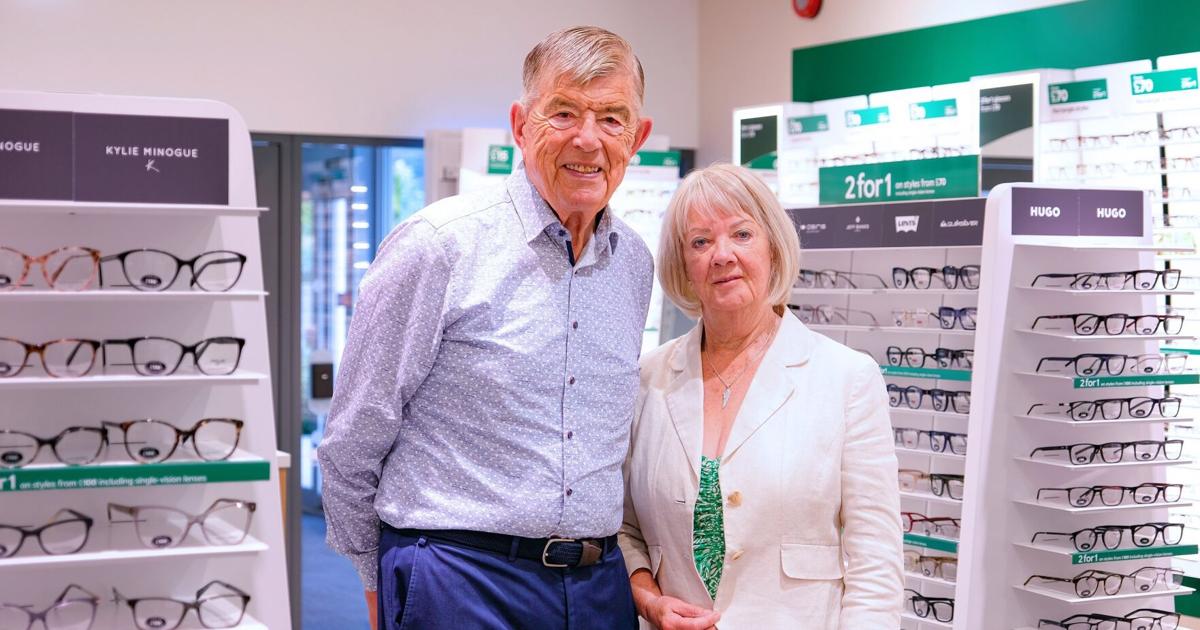
The brand may be relatively new to Canada, but Doug and Dame Mary Perkins have been telling people why they ‘Should’ve gone to Specsavers” for more than four decades.
And it’s made them billionaires.
The husband-and-wife team behind one of the world’s most iconic eye-care brands first met in Wales as optometry students at Cardiff University in 1962. The two have been married, registered opticians, and business partners since 1967.
That year, the Perkins acquired Mary’s father’s optometry practice in Bristol and grew it into a regional chain of 23 locations before selling the business in 1980 and taking three years off to study the industry and ownership structures.
“We spent a lot of time in the States, because they were advancing the franchise scheme, but that was something that worked better for restaurants,” says Doug. “We knew that we had to be very generous with our colleagues so that they would stay for 20 years and enjoy running their business.”
In 1983, Doug and Mary launched Specsavers as a joint-venture model that splits ownership of each location between an optometrist and retail director that run it day-to-day, and the head office that provides back-office and marketing support.
That structure, coupled with deregulation in the United Kingdom, paved the way for Specsavers to become the country’s largest optician chain. Next came Ireland in 1990, the Netherlands in 1997, Nordic nations from 2004 to 2007, and Australia and New Zealand in 2008.
Then in 2021 Specsavers acquired B.C-based Image Optometry, dipping its toeinto the North American market.
In just five years, the brand has expanded to more than 270 Canadian locations, thanks in part to a partnership with Loblaws, and a viral marketing campaign that includes blurry, upside-down and misprinted billboards with the tagline,‘Should’ve gone to Specsavers.’
“People will shout it at a referee at a soccer match,” Mary says. “It’s become more of a joke as time goes on.”
Today, Specsavers has nearly 3,000 locations in 10 countries, with 50,000 employees, 50 million customers and revenue topping $8.5 billion last year.
The Star spoke to the Perkins remotely from the Specsavers headquarters in their hometown of Guernsey — in the British Channel Islands — about the brand’s enduring appeal among customers and optometrists, the opportunity they see in Canada, and plans to expand — into hearing.
How did you first meet?
Mary: We met at Cardiff University in 1962 in an optics course. At the time it was very unusual for women to be in that course. In those days they didn’t let girls take advanced sciences, but I was lucky enough to get in, because that’s where we met.
Why optometry?
Mary: Back in 1949 they didn’t have enough optometrists, so they created a scheme where people could be taught in night school, which my father did for four or five years. As a teenager, I used to help him and got to know his patients, and that’s why I studied optometry.
Doug: I’m the son of a policeman, but I had worked in a drugstore when I was young, and so my first choice was to become a pharmacist. I didn’t know much about optometry, but at the last minute someone told me about it, and I decided to go to optometry school instead. That obviously altered the course of my life completely.
Did you always want to start a business?
Doug: After we met and got close, we visited Mary’s father often and decided we would start our own business as soon as we were qualified, in 1967.
We worked our socks off to expand it to 24 stores, and during that time we learned the industry inside and out. What we discovered was that the people who were sharpest on the business end were able to expand by providing a service people believed in.
When did you launch Specsavers?
Doug: We sold our first business in 1980 and took three years to investigate what kind of business we wanted to create.
We spent a lot of time in the States, because they were advancing the franchise scheme, but that was something that worked better for restaurants. In optics, operators were completely unsatisfied with the franchise agreement.
We knew that we had to be very generous with our colleagues so that they would stay for 20 years and enjoy running their business. We wrote up a partnership agreement from the beginning to make sure we gave them a fair deal, and that’s the origin of Specsavers
Mary: Back then there was a law in the U.K. saying that if you had an optometrist practice you had to use your own name above the door; you can’t use a name like Specsavers and there was no advertising whatsoever.
We were very concerned that people weren’t having proper eye-care on a regular basis — which is important, especially as you get older — because you couldn’t tell people these things through advertising. It was also very expensive, and there were no offers or discounts.
Doug: Prices were going up all the time, and then in the early 1980s Margaret Thatcher looked at all these professions and said there’s too much protectionism and allowed advertising. We owe her a lot to her for bringing affordable prices and advertising.
Our aim has always been to make sure optometrists are spending their time looking after customers, not doing administration, like buying supplies, marketing and managing taxes. With us, they don’t have to do any of that.
Speaking of advertising, tell me about the ‘Should’ve gone to Specsavers’ campaign.
Doug: It was actually invented in this office 20 years ago, and like an addiction we can’t give it up.
Health advertising can be a bit scary and sometimes boring. We try to inject a little bit of humour into it while trying to influence people to just take reasonable care of their eyesight.
What do most people not know about eye-care?
Doug: How long have you got?
People didn’t expect to live as long as they do now, and it’s impossible to go that long without eye problems. The main thing is recognizing things like glaucoma, which is a symptomless condition, before it’s too late and you start to lose your vision.
The eye is the window to the body, and you can detect many conditions with the equipment available today before they start to cause trouble.
Mary: There’s a lot of concern about short-sighted myopia, especially in children, but there are now techniques to stop it from getting to a stage where you can barely see without glasses.
Why did Specsavers come to Canada?
Mary: I admit we didn’t come over ourselves, but we sent a great team to do research, and it felt so right. Canadians treat eye care like they do in the U.K., and we knew we could offer the same things — affordable eye-care and a partnership model.
Doug: We finished with Australia and New Zealand in 2012 and decided we had to do a little more preparation before coming to Canada, which was only five years ago.
There are a lot of people who don’t care for their eyes as they should, particularly with an aging population, and that’s a great concern.
Like every country there are people that don’t have the financial resources, and we’ve got a plan (Community Vision) for people that don’t have money for glasses, which is a very important model for us.
There is also a shortage of optometrists in Canada, because there’s only two universities (Waterloo and Montreal) where you can study. A lot of people who are interested in optometry train in the United States, so we’re recruiting Canadians through the back door, but that’s one of the limitations we have to get over to provide a full scope of care and expertise.
How did the partnership with Loblaws materialize?
Doug: We had a close connection with some of the leaders of Loblaws, and they thought a lot of Specsavers.
We wanted to get over the first phase of our expansion first, but we kept talking to them and it was obvious there was a win-win situation there. We’ve done alliances with them across a significant number of stores, and I think that relationship has been so successful and great for customers.
Mary: We try to be embedded in the community, and we do have some partnerships with supermarkets in the U.K. as well, but generally we’re off the street, in the community, making it easy for customers to find us.
What are your plans in Canada?
Mary: We’ve still got quite a lot of work to do in Canada. We want to be in the community helping people — rich and poor, young and old — get eye care, and in the U.K., we have audiology partners as well.
Doug: Our future is very much about advancing optical care with new things that will be introduced in Canada. People expect us to be rolling into a new country every year, but we have no aspirations to do that.
What we want to do is provide a program that genuinely changes lives through better sight and hearing. We’ve just started in Canada, but that should give you a clue as to where we’re going.
Into audiology?
Doug: Affordable hearing care remains an issue because there’s a restriction in the number of suppliers, which puts prices up.
Everybody will have some kind of hearing loss as they age, and it could become very expensive, which is worrying because poor hearing causes all sorts of well-being challenges, including depression. But there are high-tech solutions emerging, so there may be better times to come.

