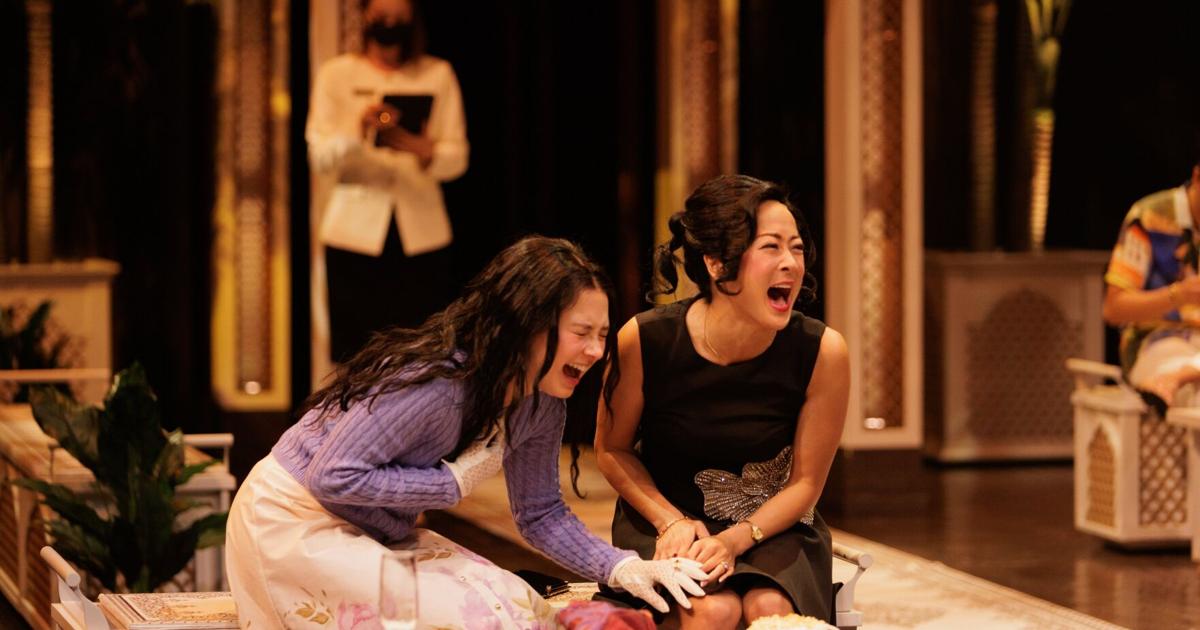
STRATFORD—“The Tao of the World,” the new social satire that opened on Thursday at the Stratford Festival’s Tom Patterson Theatre, will no doubt draw comparisons to “Crazy Rich Asians,” the 2018 blockbuster rom-com. Both are set in Singapore. Both follow the trivial pursuits of the country’s filthy rich. And both employ a kind of popcorn humour that makes a story set in East Asia easily digestible for Western audiences who’d probably be hard-pressed to locate the tiny city-state on a world map.
But that’s really where the similarities end.
Whereas “Crazy Rich Asians” offers little substance beyond that popcorn comedy, “Tao,” written and directed by the remarkably talented Jovanni Sy, delivers far more. Wildly ambitious and oftentimes equally uproarious, this play takes the traditional structure of a comedy of manners (it’s specifically inspired by William Congreve’s “The Way of the World”) and breaks it into smithereens before reassembling these pieces into a whole new creation.
This is social satire filled not only with acerbic wit, but also with a venomous, deadly bite. If “Crazy Rich Asians” merely toys with the ultra-rich like a cat playing with a ball on a string, “Tao” skewers them like juicy morsels of chicken satay, and grills them to a char atop an open flame.
Sy’s reimagining of Congreve’s “The Way of the World” follows the various sexual entanglements of Singapore’s upper crust. Arabella (Agnes Tong), the story’s primary narrator and the scion of a large fortune, has her eyes set on Edward (Angus Yam), a notorious playboy and Southeast Asian movie star.
That Arabella is already married to a British expat named Trevor Flynn (Tim Campbell) is of little concern. Rather, her main obstacle is the fact that Edward has no interest in her whatsoever. He’s instead eyeing Arabella’s cousin, Millicent (Heidi Sy Damayo). And all that Edward needs is Arabella to convince her family’s matriarch, Lady Helena Yu (Manami Hara), to approve his union with Millie.
There are, of course, other complications. It turns out that Millie’s puritanical father dictated in his will that his daughter’s $80 million inheritance would be distributed only if she remains a virgin until she’s married. And in a flashback, Arabella reveals that Edward once had a run-in with Helena Yu that didn’t end well for the young man.
Also in the fray are Jackson (Derek Kwan) and Devan (Karthik Kadam), Edward and Arabella’s respective besties, who get roped into their friends’ dirty schemes and who themselves are a romantic couple, trying to navigate a society with few rights and protections for the LGBTQ+ community.
Much like Congreve’s original play, Sy’s thick plot is as tangled as a hoard of jewelry haphazardly strewn about. At times, it’s even difficult to discern who is crossing and backstabbing whom.
But in his staging, Sy does a fine job of clearly presenting all these various threads. Ming Wong’s extravagantly varied costumes capture Singapore’s cosmopolitan, cultural mosaic. Sophie Tang’s lighting designs effectively slice the Tom Patterson Theatre’s elongated thrust stage into smaller sections, where mini-scenes and asides can play out. And Lorenzo Savoini’s scenery is surprisingly versatile, turning the stage from a five-star hotel into a spa, into an underground club — even if his designs look more like what you’d find in India than Singapore.
Some spotty accent work aside, the cast delivers the kind of broad, buffoonlike performances you’d expect from a comedy of this type. Michael Man, playing a doctor whom Lady Helena wants to set up with Millicent, chews up the scenery in one particularly steamy scene. Kwan, too, delivers a brilliantly physical performance that sees him disguised as a Taoist monk. And Tong, as Arabella, balances self-awareness with pompous self-entitlement.
That most of the characters carry themselves with this kind of brattishness makes sense. Sy’s play is really about the hypocrisy of the ultra-rich — how they make the rules but also break them in the same breath.
What’s most compelling about “Tao,” however, is how Sy subverts the form and style of a traditional comedy of manners. About partway through the second act, the narration, told almost exclusively from Arabella’s perspective up until this point, switches dramatically. Here, “Tao” transforms a show about the upper class into one about the stratification of society more broadly and about those on the underbelly of this world, whose hard labour allows the rich to live the lives that they lead.
When this narrative shift occurs, Nadine Villasin and Nestor Lozano Jr., in two very small but very key roles, lend a gravitas that counterbalances the rest of the comedy.
I found their scenes to be the most effective of the show. In these moments, the production cracks wide open. It’s Sy at his most audacious.
But a consequence of this change in the narration — whether intentional or not — is that it forces the audience to reconsider the entire play. And, at least for me, this process exposed some of the flaws in the first act, which, in comparison to Act 2, feels far more conventionally structured and takes a few too many artistic liberties, twisting historical and cultural facts for no apparent reason.
Maybe I’m too sensitive because I’m originally from Singapore. (Our propensity to clutch pearls can be chalked up to the fact that Singapore culture is so rarely portrayed, and portrayed accurately, in popular media.) But since seeing “Tao” on opening night, I’ve been asking myself the same question: Who is this show for?
The only answer I can come up with is that I don’t think Sy’s play is meant for me or other Singaporeans. “Tao,” for one, could likely never run in the country due to a few too many unflattering references to a certain politician. But most importantly, Sy has said that the Singapore he depicts in “Tao” was always meant to be a proxy for Canada. I agree.
“Tao,” I believe, is meant for those who see Singapore as a mirage, as a Southeast Asian utopia. For these audiences, Sy shatters a myth that for many Singaporeans has already long been shattered. And for these audiences, I think this act of looking at another culture and society so different from theirs can, hopefully, prompt a frank introspection of the world they live in and their place within it.
Error! Sorry, there was an error processing your request.
There was a problem with the recaptcha. Please try again.
You may unsubscribe at any time. By signing up, you agree to our terms of use and privacy policy. This site is protected by reCAPTCHA and the Google privacy policy and terms of service apply.
Want more of the latest from us? Sign up for more at our newsletter page.