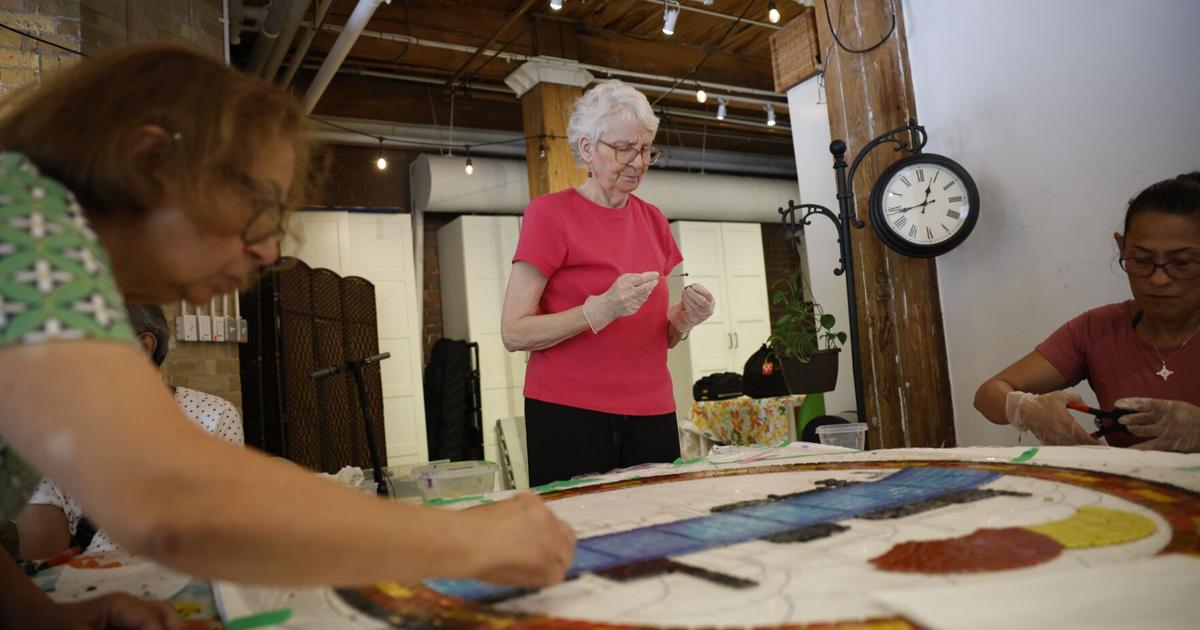
Retiree Brenda Wootten smiled as she slotted the coloured mosaic tile into place. All around her, the arts workshop buzzed with activity as her peers sanded down chips of ceramic and pieced together patterns for the project soon to become a permanent art installation on the Esplanade.
As a teenager, Wootten dreamed of becoming an artist — a passion that earned her acceptance into an arts college. But her parents weren’t having it. “Back then, it was not the thing to do,” she told the Star. “And over time, that part of me died.” Now at age 69, after a busy career with the Salvation Army that took her all around the world, Wootten has finally found time to reconnect with the arts via Jamii, a not-for-profit in the Esplanade neighbourhood. And she’s having the time of her life.
“I don’t feel my age — I actually feel younger,” Wootten said, laughing. “It just brings out who I truly am, which was buried for so long.” Rediscovering herself has also kindled a new group of friends. “When I come here, it just regenerates me, because there are people here who actually care about me,” she said. “We check in on each other. This is a community I would not have survived without.”
That may not be an exaggeration. Recent studies suggest people who frequently create or appreciate art may have a lower risk of mortality and even a slower rate of biological aging, among other health benefits. In fact, since the early 2000s, researchers have been trying to clarify the connection between our engagement with the arts and culture and our physical and mental well-being.
Kate Dupuis has spent the past decade studying it. “The benefits are myriad, and they’re across all domains of well-being,” said Dupuis, the Schlegel Innovation Leader in Arts and Aging at the Sheridan Centre for Elder Research.
“We know that any type of opportunity where you are exploring and engaging in a creative activity that brings you meaning and purpose can be very powerful to support your health.”
A creative ‘lifeline’ for the community
Nestled near the Distillery District, the Jamii Hub is a keystone of the local community that has hosted movie nights and potlucks as well as dancing, singing and visual arts workshops for the past four years.
While the weekly workshop Wootten attends caters to older adults, Jamii hosts events for all ages, allowing every generation to meet and learn from each other, said Isorine Marc, who founded Jamii in 2011.
“I’ve been in the neighbourhood for 17 years and I’ve never felt like I’ve belonged to the community,” said retiree Mamie Armaly. Until she started coming to Jamii three years ago, that is; now she’s there every week. “It gives you an opportunity to engage with people from preschool, elementary school, all the way up to our age.”
Armaly said the visual arts workshops, which rotate artforms each month, from mural-making to watercolours, clay-work and beading, keep her brain continuously engaged and learning.
“We’ve done so many projects,” she said. “Taking that leap and not worrying about whether it’s good enough, or beautiful … it gives me a sense of great joy.”
Marc said many participants have told her the programs are a “lifeline” in their retirement years. “For us, the arts are a tool for social connectedness and togetherness,” she said. “There’s a need for it. We see the change that it brings to people and how it maintains their health: mental health, physical health, spiritual health.”
As a not-for-profit, Jamii runs on donations and grants. But Dupuis said community programs like this are crucial and should be funded like a form of health care.
“We do not have the social supports currently, here in the city or in the province of Ontario, to support people the way that we should,” Dupuis said. “Engaging in arts and creativity, engaging in opportunities for cultural exploration, these are key pieces of supporting the health and well-being of our aging population.”
Arts and longevity
In her research, Pia Kontos, a senior scientist at UHN’s KITE Research Institute, has found that regular engagement with arts and culture exposes us to many important elements for health and well-being, including “connection with others, movement, emotional and creative expression, meaning and joy.”
She added that “the key is to embrace creativity without a fear of failure. There’s so much value in the process of arts engagement, regardless of what the outcome is.”
That may result in measurable health benefits. A landmark 2019 study that followed more than 6,700 adults over 14 years found that people who engaged in the arts — like attending concerts, museums, exhibitions — every few months or more, had a 31 per cent lower risk of dying than people who did not partake.
Even participating on an infrequent basis, like going to the theatre once or twice a year, was linked with a 14 per cent lower risk of dying. This was independent of socioeconomic, health or demographic status, according to the paper.
More recently, a study published in May involving more than 3,500 adults suggested a link between regular arts and culture engagement and slower biological aging. People who did an arts activity every week appeared to age four per cent slower than those who rarely participated, according to one of the epigenetic clocks used in the study — a measure of age-related changes in one’s DNA. Even engaging in the arts at least three times a year was linked to a two per cent slower rate of aging.
This association was stronger for adults aged 40 and above, and was independent of health and behavioural factors like income, education level, BMI and smoking.
The arts may also improve our quality of life. A 2019 study that tracked more than 3,100 people over 10 years found that people who frequently and consistently engaged in the arts reported greater happiness, life satisfaction, self-realization and a sense of control among older adults.
“A lot of this is correlational data,” Dupuis noted. “But it’s really interesting because in a lot of the large-scale research, even if you control for things like location and socioeconomic background … you do still see huge benefits from engaging in arts and creativity.”
Why art is good for your health
Part of the benefit of participating in arts programs like Jamii’s comes from the social aspect. Connection with a community can help bring a sense of purpose and support, and loneliness poses health risks comparable to smoking 15 cigarettes a day, according to the U.S. Surgeon General.
But you don’t need to join a group to benefit from the arts. “There’s benefits to all creative self-expression, including when it’s done solo,” Kontos said. So long as it’s something you enjoy and find meaningful, it can improve and enrich — and maybe even extend — your life.