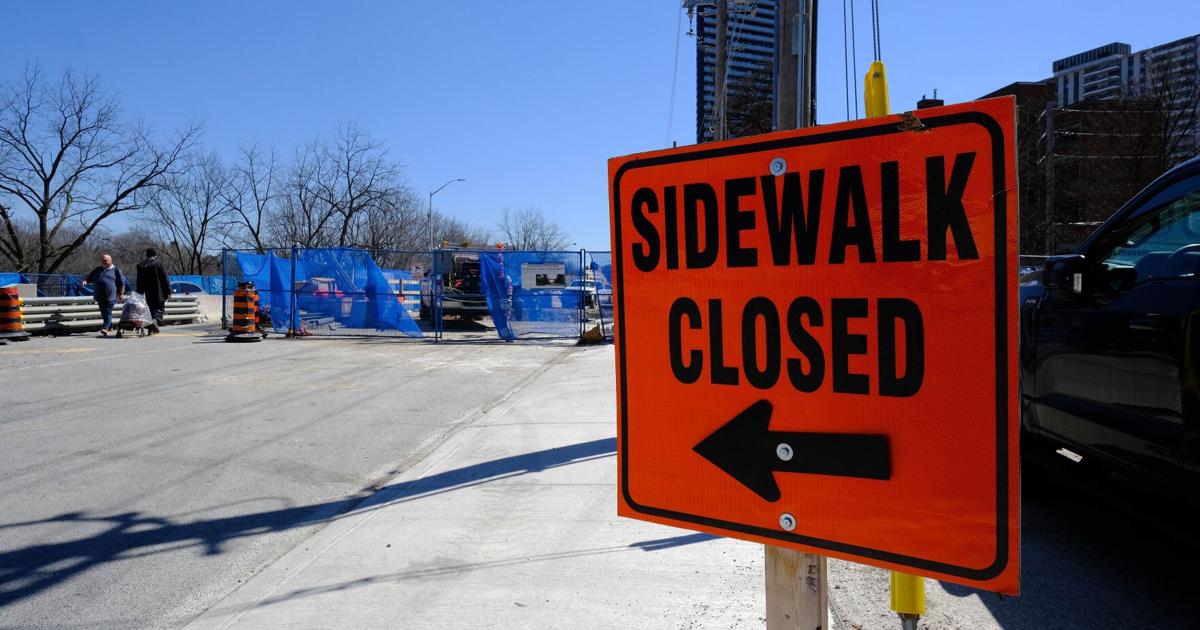
Jackhammers shatter the morning peace and heavy machinery rumbles down your street.
This scene is no longer an occasional nuisance; it is the summer baseline for Torontonians as residential renovations choke our city’s landscape.
While city council wrestles with macro-gridlock, we ignore a massive, unpriced economic drag on our local economy: the hyperlocal gridlock caused by private residential construction.
When a luxury home renovation shuts down a lane, blocks sidewalks, or chokes a residential artery for months, it is a classic market failure. Delivery vehicles are delayed, remote workers lose productivity to localized disruptions, and small businesses suffer from throttled local access.
Right now, affluent homeowners and private contractors are socializing these economic costs while privatizing the real estate upside.
Jane Jacobs proved neighbourhoods are deeply interdependent ecosystems
The late Jane Jacobs, in “The Death and Life of Great American Cities,” proved that neighbourhoods are intricate ecosystems where private and public spaces are deeply interdependent.
Disruptions in one part of the ecosystem inevitably affect the productivity of the whole. The economic impact is quantifiable: lost worker hours, supply chain friction at the final mile, and diminished quality of life all carry hidden costs that ripple through the economy.
The Toronto Region Board of Trade notes that traffic congestion costs the Greater Toronto and Hamilton Area a staggering $44.7 billion annually in economic and social losses, including $10 billion in direct lost productivity. Micro-blockages on residential streets are a silent contributor to this macro crisis.
Our current system of paltry, static municipal fines and easy permits fails because it treats a billionaire’s mansion and a modest semi-detached upgrade exactly the same. The penalty is simply viewed by big contractors as a minor cost of doing business.
To date, city planners have only tinkered at the margins of this problem. While Europe has long embraced “day-fines” — where traffic penalties scale progressively with an offender’s income — and global cities use congestion pricing to charge for spatial friction, municipalities have completely failed to apply these principles to private, luxury real estate footprints.
Toronto presently charges static, flat linear-metre utility fees for lane occupations. For a custom-built mansion, these flat rates are a paltry rounding error in the budget. What is needed is a novel policy blueprint that bridges the gap between progressive taxation and market accountability.
Toronto needs to levy construction disruption fines on property tax assessments
The fix requires embracing true free-market principles by levying construction disruption fines proportionate to, and directly on, property tax assessments — escalating sharply for repeat offenders.
First offence, 50 per cent of annual city property taxes. Second offence, 100 per cent. Third offence, 200 per cent.
Under this model, a $20,000 annual tax bill for a luxury home could mean a swift $10,000 fine, skyrocketing to $40,000 for serial disrupters who hold a neighbourhood hostage.
This would create an immediate, powerful financial incentive for homeowners and project managers to optimize their timelines, co-ordinate deliveries, and minimize public disruption. To ensure absolute equity, public infrastructure agencies like Metrolinx should be held to parallel, robust financial penalties for contractor delays that choke local business zones.
Critics may claim this will chill home improvements or progress. But the goal isn’t to halt growth — it’s to incentivize efficient, considerate, and market-friendly planning. By aligning financial consequences with the actual socio-economic impact of the construction, it would encourage innovation in quieter, speedier, and less disruptive building technologies.
Toronto aspires to be a world-class economic hub. But when private renovations are permitted to paralyze local commercial and residential flow with zero financial accountability, we fall short. Wealth-proportionate, escalating fines correct a glaring market failure — respecting community needs, generating targeted local revenue, and ensuring that progress does not come at the absolute expense of urban livability.
As Jane Jacobs famously observed of urban design and balance: “Cities have the capability of providing something for everybody, only because, and only when, they are created by everybody.”
It’s time our local renovation policies reflected that collective responsibility.