

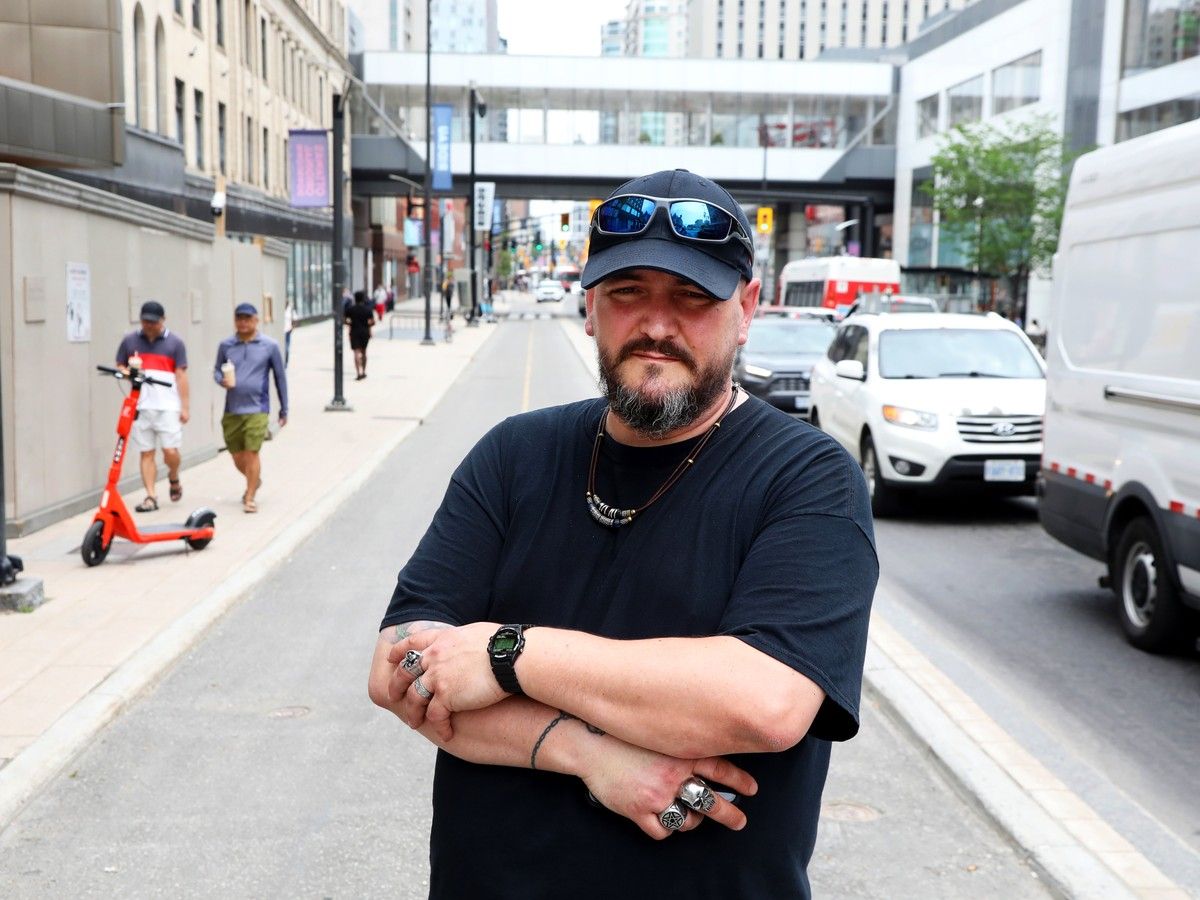
Paul Charette had just finished a locksmithing job at the Rideau Centre and was returning to the van he’d parked outside when he first encountered the sinkhole.
It had opened up, a giant, yawning maw , between him and the company car, a dark blue Dodge Caravan.
Charette had rolled the van to a stop in front of what was then a Chapters, on the north side of Rideau Street just east of Sussex Avenue.
Now that van was poised on the very lip of the spreading abyss.
It was June 8, 2016 — 10 years ago.
What unfolded in the ensuing minutes would make headlines around the world.
“They were starting to block the road,” remembers Charette.
He called his then-boss, Michel Kiwan, owner of First Choice Locksmith , and told him about the sinkhole.
According to Charette, Kiwan urged him to retrieve it quickly.
“Go get the van, go get the van, don’t lose the van,” Charette remembers Kiwan telling him.
He set out for the vehicle but says he was stopped by the fire marshal.
“I waited for him to leave, then I started walking towards the van,” Charette says. “That’s when I got stopped by, like, four police officers along with the marshal.”
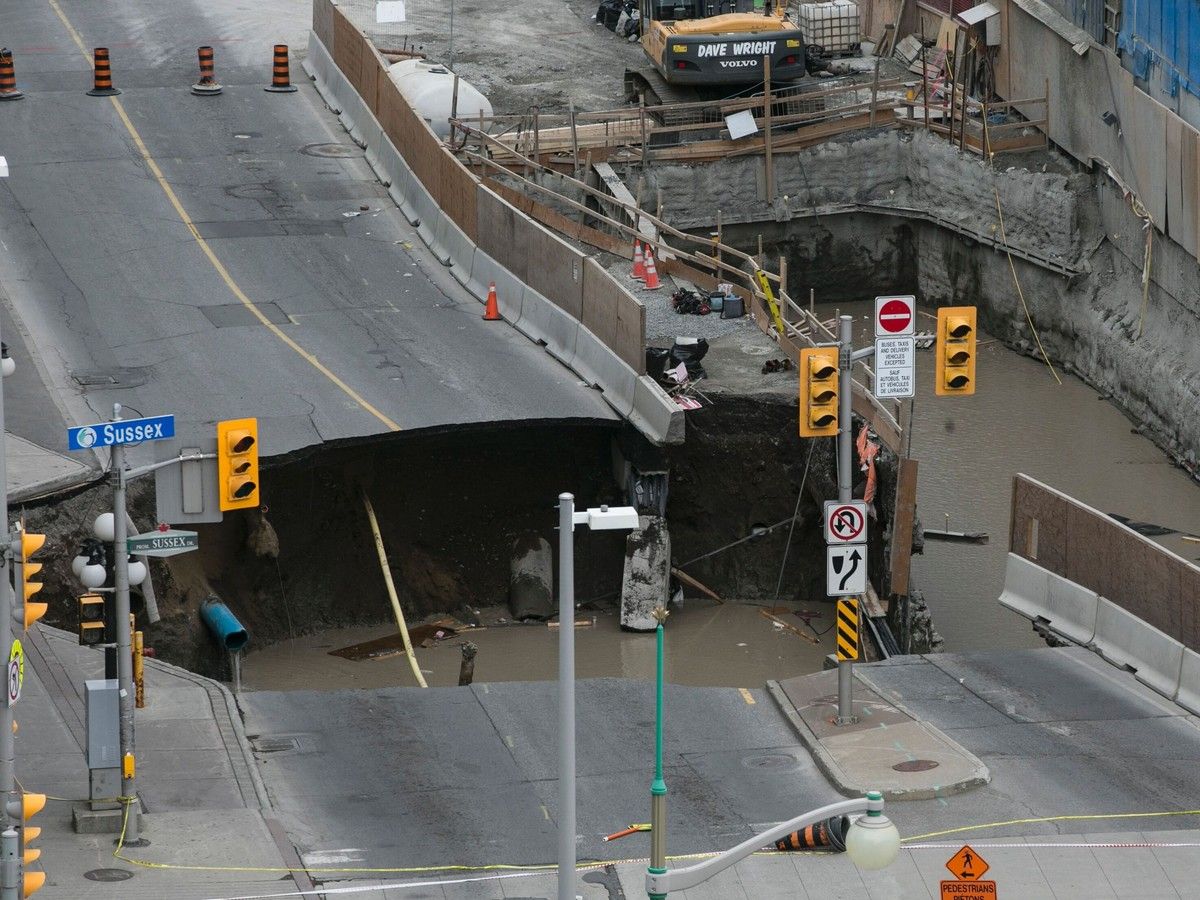
Over the course of the morning the sinkhole eventually grew to stretch from between 45 Rideau St. and 47-57 Rideau St. on the north side and between 10 Rideau St. and 50 Rideau St. on the south, spanning the whole of the street’s 25-metre width and measuring some 20 metres in length.
It was fast.
Within minutes it had sucked down the van and the life Charette had lived inside it. He’d spent the better part of 13 years working out of it and its predecessor. It was transportation and his mobile workshop.
“My whole life was in there,” he says.
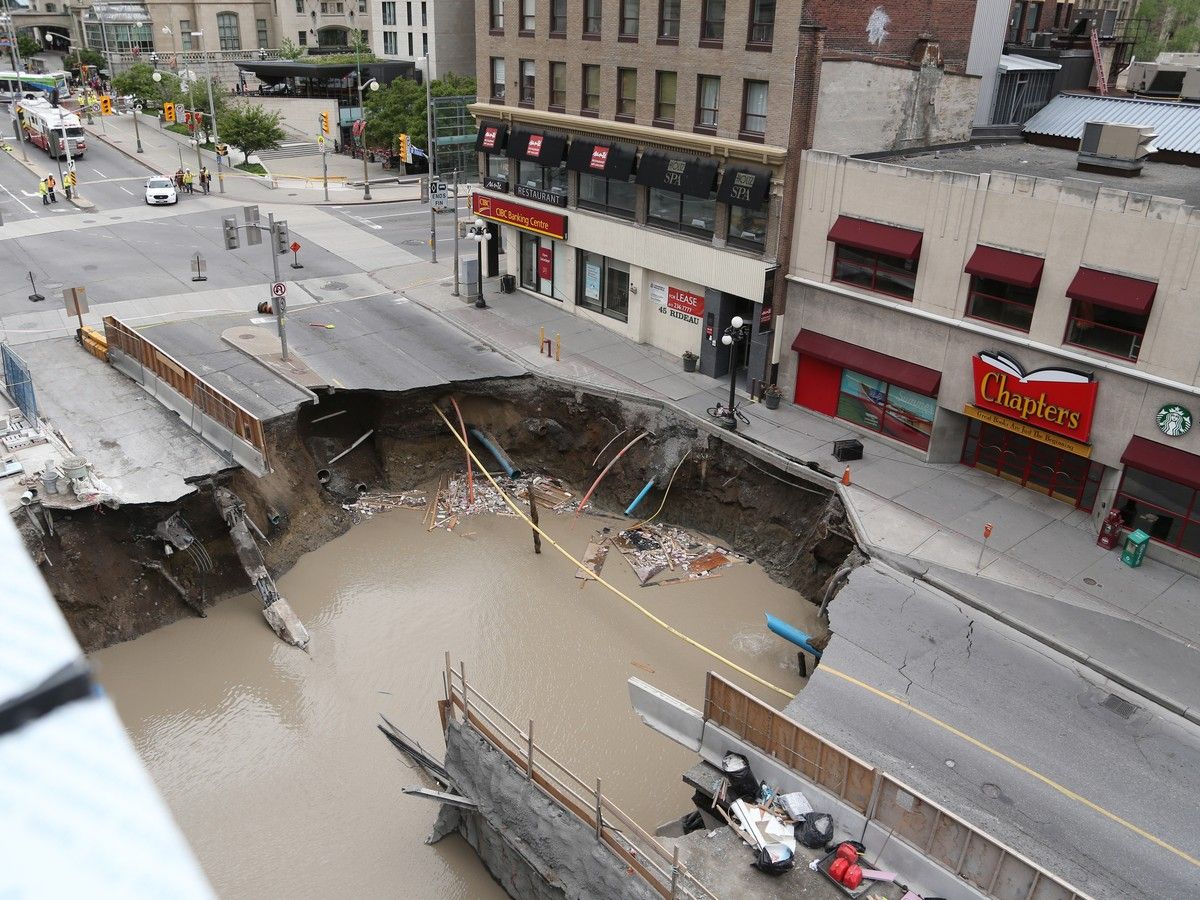
He saw it drop from where authorities had pushed him, across Sussex outside Milestones restaurant.
As he watched the sinkhole spread and the road collapse under the weight of the van, Charette felt helpless. He did all that was left for him to do.
“I was there with the remote with the keys and I was pressing the alarm,” he says.
A bystander behind him asked what he was doing. “I’m like, ‘That’s my van!’ ”
They both watched it disappear. Charette was sounding the van’s alarm and remembers shouting:
“It’s gone! It’s gone!”
The whole mess remains down the hole today, encased in cement, an accidental time capsule dedicated to just one man.
Charette’s wallet is there. Five pieces of government-issued ID.
“If they dig that up in 100 years, they’re probably gonna find it,” he says.
Images of the Rideau-Sussex intersection, taken from above and showing a jagged doorway into Ottawa’s underworld rather than workaday Rideau Street, circulated globally.
But for this city it was not exactly unfamiliar territory.
And a decade later, we still live with the spectre of what lies beneath us and the mysterious holes that sometimes appear to show us what is there.
Ottawa is sinkhole country — a city built atop the dry bed of an ancient sea, undergirded by limestone, sensitive clay and sand.
“The Ottawa Valley is known to be prone to sinkholes,” says Yasser Korany , a forensic engineer based in Toronto.
That tendency is due to a unique set of geological characteristics that includes a base of limestone, which is prone to dissolving in water.
Layered atop that limestone is an accumulation of quick clay, also called Leda clay, created while this area lay below the ancient Champlain Sea .
The salt from that sea binds Leda clay together, keeping it solid. But introduce fresh water to it and it will quickly liquefy, Korany says:
“And by liquefy, I mean it will have the consistency of hand soap. And that could also happen with exposure to vibrations.” The kind of vibrations associated, say, with construction.
Then there are the pockets of sand within this layer of clay that give a neighbourhood near the Rideau Centre its name — Sandy Hill — and that also lead to instability when exposed to water.
It is precisely this sandy soil that a city report released in late 2016 suggested caused the Rideau-Sussex sinkhole.
Construction of the O-Train’s Rideau Station West Entrance disturbed sandy soil already under groundwater pressure and undermined a water main, causing it to rupture. The consequent flow of water washed away more of the sandy soil supporting the road.
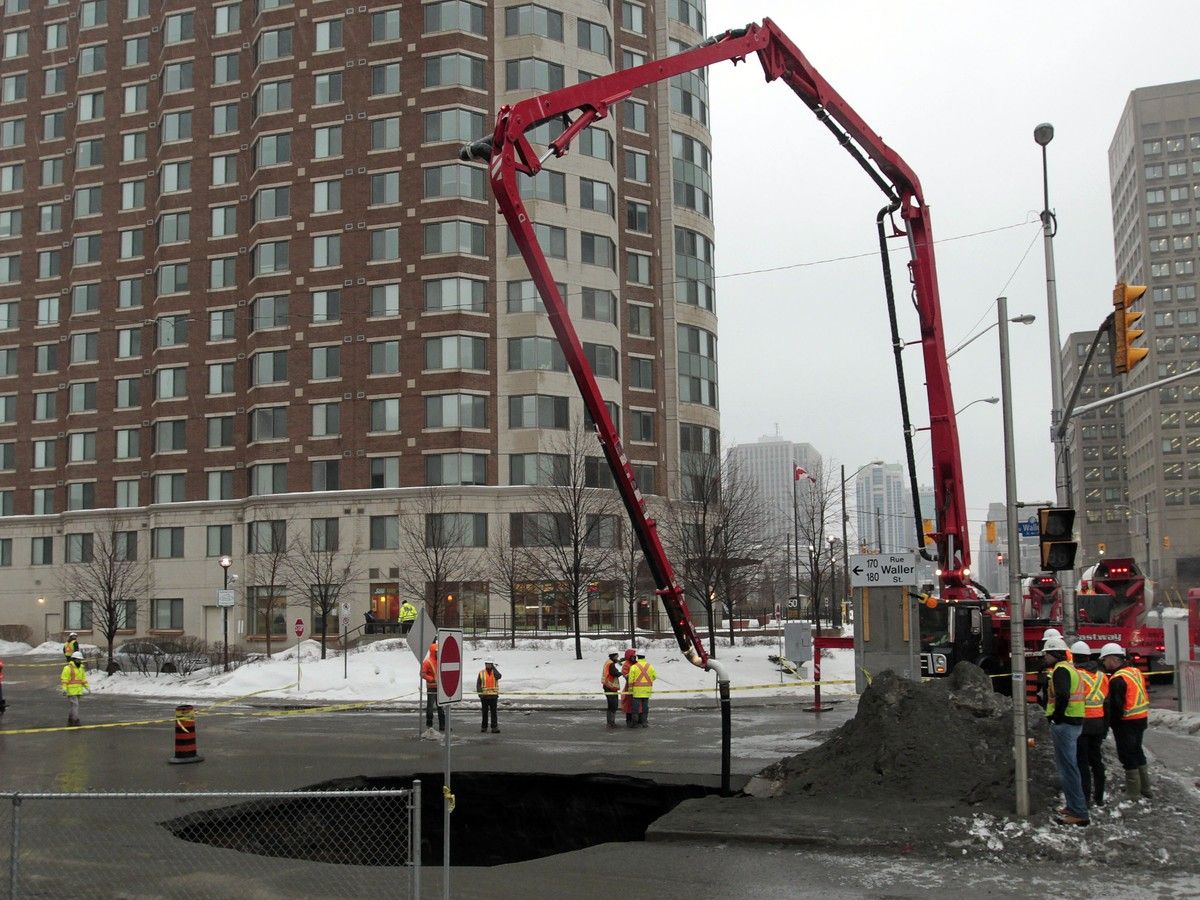
It wasn’t the first sinkhole associated with Ottawa’s beleaguered LRT. An earlier one, dubbed “The Waller Gobbler” by the Ottawa Citizen , took place in 2014 on Waller Avenue near Laurier Avenue.
These events and an earlier Ottawa sinkhole from 2012 have convinced one man — Juan Pedro “J.P.” Unger — to swear off using Ottawa’s underground light rail system entirely.
“I’m never going into that tunnel,” says Unger. “Frankly, I do not have faith in the city, its inspections and maintenance and infrastructure. If that can encapsulate my feelings about it.”
Unger has every reason to be skeptical: he is the survivor of the 2012 sinkhole event.
On Sept. 4 of that year, Unger was on his way to pick up his daughter from her school near where they live in Orléans. He was gearing down after exiting Regional Road 174 using the eastbound Jeanne d’Arc Boulevard off-ramp.
Up ahead he saw what appeared at first to be a section of new asphalt.
Wait — he’d used the off-ramp the day before and there had been no fresh patch.
Unger tried to change lanes but the off-ramp was congested.
“I was doing maybe 40 km/h going down to 35. Then when I’m very close, I get enough of an angled view and I start seeing this sort of pink orange of clay.
“Oh,” Unger thought. “That’s a really bad pothole.”
A second later Unger’s Hyundai Accent had tipped into what was later identified as a major sinkhole created following the collapse of an old and failing culvert below.
“It dove in and fell into a hole, like vertically ,” he says.
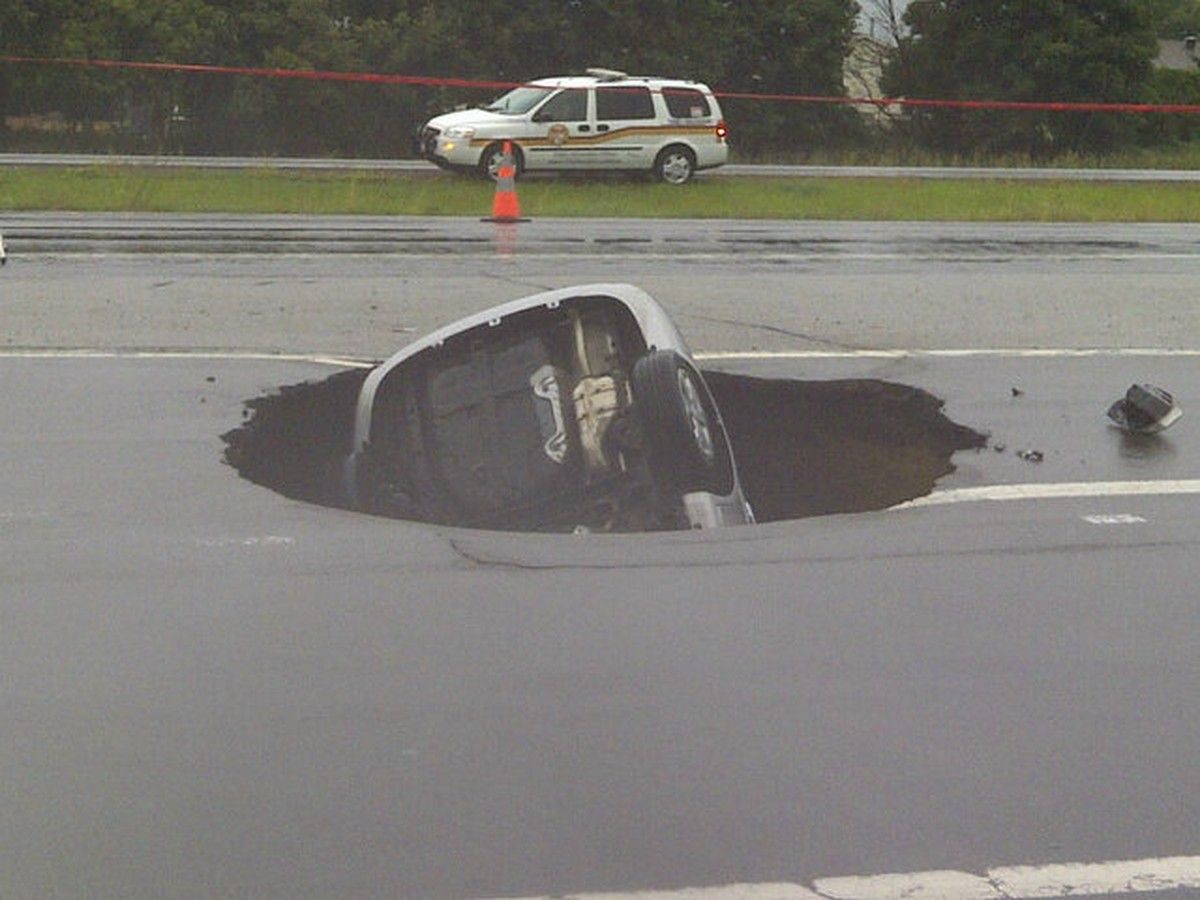
Unger was facing downward, hanging from the Hyundai’s seatbelt and shoulder harness. The hole was still too tight a squeeze to allow the car to continue plummeting — but for how long?
“I couldn’t see a bottom — it was just a dark, dark cave, basically, beyond the hood of the car.
“I could see the water from the surface of the road, and the rain, and the rainfall in the car, just sort of falling into this dark void underneath.
“And I thought, ‘Oh God, how deep is that? I have to get out of this car.’ ”
But he was terrified that a second car would fall in after his.
“Then I started hearing voices — not celestial voices, but voices of people out there saying, ‘Hey, anyone there, are you OK?’ ”
It was at that point he opened the driver-side door and unharnessed himself from the seatbelt straps.
“I started climbing up — I opened the door vertically, it opened and I just climbed. I don’t know, pure adrenalin.”
Two men on the surface of the road above took his hands and pulled him up.
By the time the paramedics were through with him, Unger remembers, the car had already disappeared completely into the hole.
Authorities recovered it some days later . It had by then fallen many metres and been carried away by what Unger describes as “an underground river.”
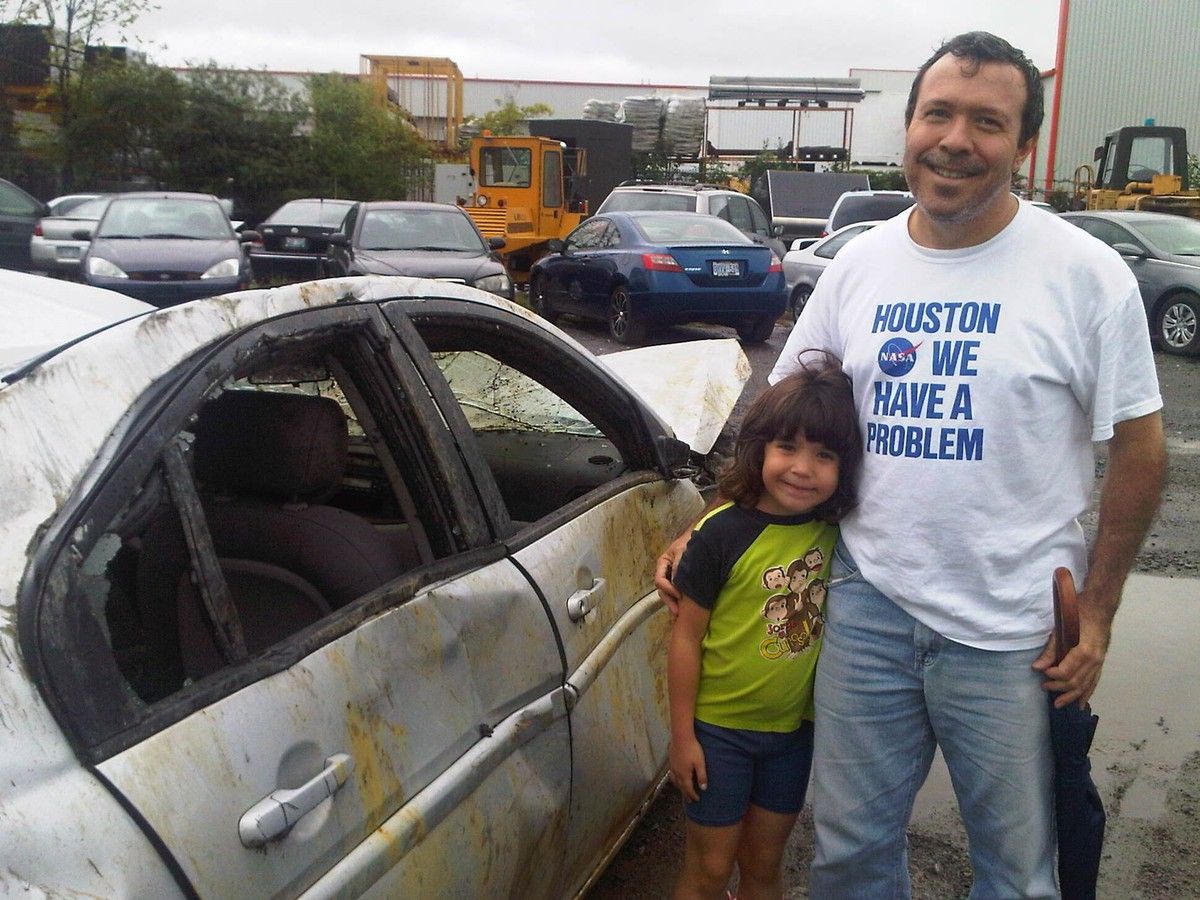
He later sued the City of Ottawa , with which he settled. It was enough money to replace the Hyundai and pay for physio, but Unger continues to do battle with the municipality over holes.
Telephoned recently for this story, Unger said he was in the middle of writing the city about a sinkhole on a pedestrian and bicycle path near his house heading into Big Bird Park.
“I have placed a couple of red cones to warn people about the gaping hole — currently sharp (and) wide and deep enough to cause serious damage to a leg, hip and torso,” he wrote in an email shared with the Ottawa Citizen .
The City of Ottawa says that in general it has Ottawa’s sinkhole situation in hand.
“Like other Canadian cities, Ottawa has infrastructure that, in some cases, is decades old and ongoing environmental stresses can accelerate deterioration over time,” wrote Susan Johns, director of asset-management services for the city, in response to questions from the Ottawa Citizen .
“The City takes a proactive, risk-based approach to effectively manage infrastructure and reduce the likelihood of these events.”
But engineers like Korany and Ottawa-based Mohammad Rayhani , a professor of civil and environmental engineering at Carleton University, agree that anticipating sinkholes isn’t easy.
Underground leaks are one risk factor, but tracking those is a problem.
“Of course, infrastructure maintenance is the main concern,” says Rayhani, “and it’s very expensive — you know, the upgrade and rehabilitation of old infrastructure.”
The city said it doesn’t keep any sort of log of sinkhole events — the term covers too many phenomena for that to make sense, from water main breaks to sewer collapses to culvert failures.
But Ottawans make a sort of spectator sport out of tracking the latest road holes, especially on Reddit , where last month the pun term “ sinkhole de mayo ” appeared in an embarrassing number of posts.
A sinkhole that appeared one morning on O’Connor Street between First and Glebe avenues briefly snarled traffic but was filled within hours.
Such diligence only makes sense. Lawsuits, after all, are frequent companions to sinkholes.
The 2016 Rideau-Sussex sinkhole generated a raft of them while also significantly delaying the LRT, creating a costly legal tangle.
One person who did not sue, however, was Michel Kiwan, Charette’s boss and the owner of the Dodge Caravan that remains buried below Rideau Street.
Kiwan appears to be over the sinkhole 10 years later.
“The van,” he told the Ottawa Citizen , “is still there. Right?”
But Charette is no longer with him. He left Kiwan’s employ a couple of years after the sinkhole.
All Charette’s old tools remain in that Dodge Caravan, accumulated over years of service, and those too are gone, lost underground.
That hole preserved Charette’s old life in a workshop on wheels that’s now encased in cement — and also changed that life’s course.
He is now a locksmith at the Senate of Canada.
People still associate him with sinkholes, though.
Just the other day, a sinkhole formed behind one of those historical buildings that line the Wellington-Rideau strip not far from the LRT’s Rideau Station.
A bunch of Charette’s friends called him.
“Hey,” they told him. “You’re not parked there, are you?”
Related
Our website is your destination for up-to-the-minute news, so make sure to bookmark our homepage and sign up for our newsletters so we can keep you informed.

