

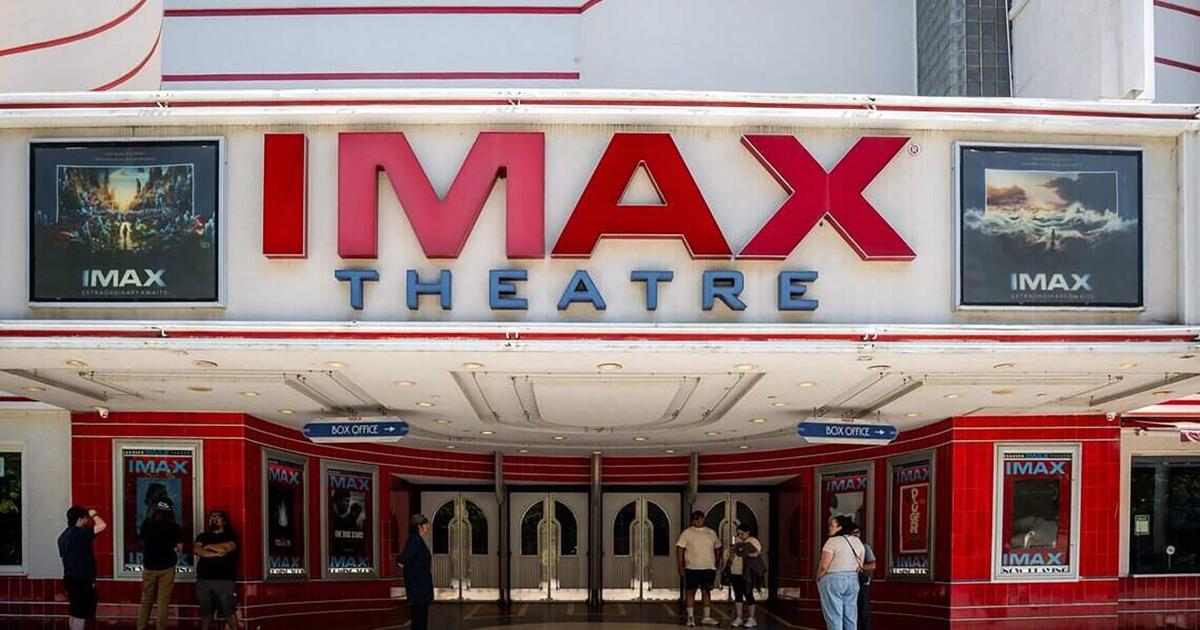
Variety, the Hollywood bible, says “the hottest brand in movies” is Imax Corp., a tech firm with Canadian roots that makes the motion picture technology that provides film patrons with the world’s most immersive movie-going experiences.
This year’s most talked-about movie, “The Odyssey,” is the first feature-length film shot entirely with Imax 70 mm-format cameras. Presented alongside Imax’s most sophisticated projectors and screens, the you-are-there experience provided is incomparable.
It is drawing thousands of fans hundreds of kilometres to the nearest of 41 Imax screens worldwide that are fully equipped with the company’s latest technology. Some movie patrons are lining up for 3 a.m. screenings of the film.
All told, there are 1,865 Imax locations in 91 countries, including 43 in Canada, but they use traditional digital projection. They are equipped with the Imax trademark floor-to-ceiling, wall-to-wall screens, however. And Disney, Paramount, Sony/Columbia and other major studios scramble to book Imax screens for their big-budget movies’ releases.
Imax doesn’t make movies or operate cinemas. It leases its cameras to filmmakers and studios and its screens, projectors and other complex equipment to cinema operators.
Imax, which splits its headquarters among Mississauga, New York and Los Angeles, generates revenue from licensing fees and a share of the box office. With the movie industry’s recovery from the pandemic and crippling strikes, Imax is posting impressive financial results. That has given rise to the speculation about Imax selling itself to the highest bidder. And the list of suitors is long.
Imax has an outsized impact on the industry. It accounts for only one per cent of movie screens worldwide, but in 2025 generated an estimated 3.8 per cent of global box office revenues.
It is often said that “The Odyssey” made Imax, which for most of its history was a low-profile firm with a pint-sized stock-market valuation. But Imax was thriving before the film adaptation of the classic Homer poem was released.
Imax revenues jumped by 16 per cent in 2025 to $410 million (U.S.) and profits surged by 33 per cent to $34.9 million Investors have seen their shares gain 55 per cent in value this year, to a current $53 per share.
Imax was launched in the late 1960s by Canadian inventors Graeme Ferguson, Robert Kerr, Roman Kroitor and William Shaw. Their novel projector, pioneered by an Australian whose invention they purchased and then refined, showed a single, large-screen image with more impact on audiences than conventional projection of multiple merged images. They came up with the name Imax as a play on maximum, or largest, images.
The first wide public exposure of the advanced technology was a documentary screening in 1971 at Cinesphere, the globe-shaped movie theatre at the then-new Ontario Place recreational attraction on Toronto’s waterfront.
That fit Imax’s early pattern of showing short documentaries at venues outside of the mainstream. After acquiring Imax in 1994 with a group of fellow U.S. investors, Richard Gelfond, still CEO of Imax, expanded Imax beyond specialized exhibition locations like the Smithsonian Institution, seeking mainstream exposure. Gelfond’s investor group paid $100 million for Imax, which today has a stock-market valuation of almost $2.8 billion.
Gelfond persuaded cinema chains like AMC Theatres and Toronto’s Cineplex Inc. to make room in their multiplexes for an Imax screen.
The 2009 release of James Cameron’s “Avatar,” the industry’s highest-grossing movie to that point, marked Imax’s transition to the Hollywood fixture Gelfond had been hoping for when he and his partners first bought the firm.
“Avatar,” partly filmed in Imax’s 70 mm format, opened in 261 Imax theatres in North America and abroad, helping boost Imax’s status as an international exhibitor.
The film’s astonishing box-office performance and Imax’s growing network of locations convinced more A-list directors to at least partly shoot their movies with costly and bulky Imax cameras.
The movies included Denis Villeneuve’s “Dune: Part Three,” Ryan Coogler’s best-picture Oscar nominee “Sinners,” and, of course, Christopher Nolan‘s “The Odyssey,” which opened on 443 screens.
Gelfond is convinced that with the right kind of financial backing, Imax could more than double its network to 4,400 locations. That could finance diversification into concerts and other non-traditional films.
Still, Imax has enjoyed operating independently in an industry controlled by conglomerates.
Gelfond has reason to hesitate in handing the keys to a new owner that might slash costs or flip the company, which has known only one change in ownership in the past 32 years. And though Gelfond wants Imax to grow, a reckless buyer could overexpand, saturating the market.
Yet Gelfond seems unsatisfied with the status quo, agreeable though it is. At a December industry event, Gelfond mused that Imax would be an “incredibly valuable player, either as a wholly differentiated publicly traded company or as part of a larger company with the keys to unlock even greater value and our strong business worldwide.”
To sell or not to sell. There are tougher decisions.

