

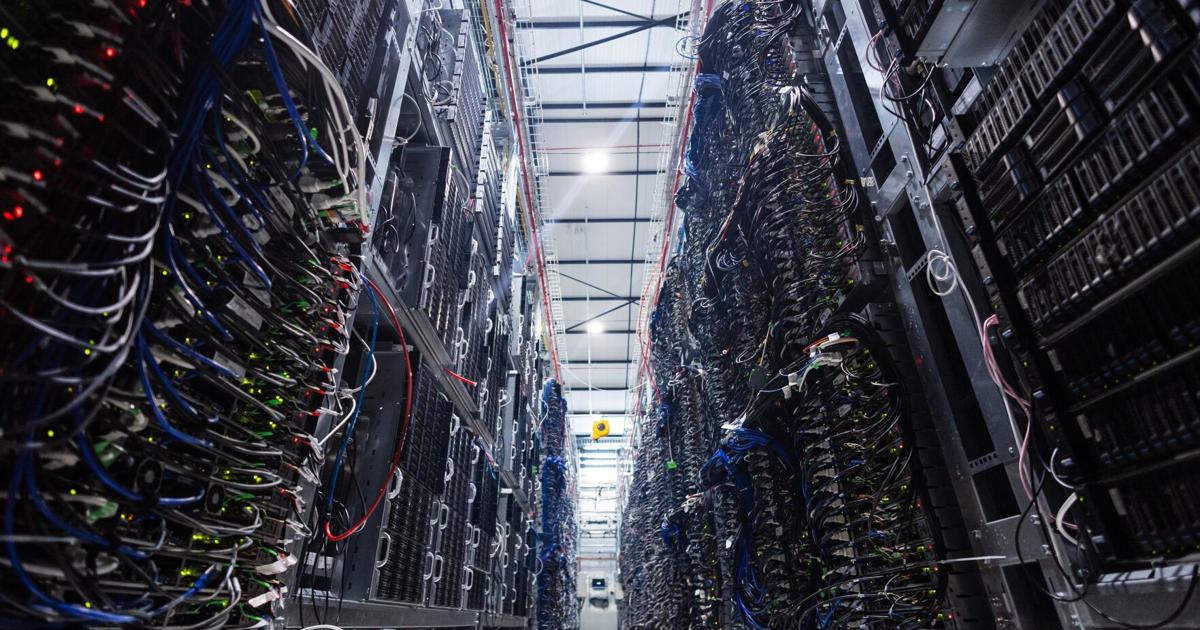
Among the more worrisome current social phenomena is the backlash against artificial intelligence in the form of opposition to the build-out of AI data centres.
Proposed AI data centres — enormous warehouses packed with high-powered computers that process vast amounts of data — have been blocked in Hamilton, Ont., and Manitoba, and opposition to them is rising across Canada and the U.S.
In the U.S., there are dozens of local moratoria banning data centres, and protests have blocked almost $100-billion (U.S.) worth of projects.
Opposition to AI and data centres has become a populist rallying cry.
“We cannot sit back and allow a handful of billionaire Big Tech oligarchs to make decisions that will reshape our economy, our democracy, and the future of humanity,” U.S. Sen. Bernie Sanders (D-Vt.) said in calling for a moratorium on AI data centres earlier this year.
There are only five large-scale data centres in Canada. But there are close to 100 more under construction or proposed.
Local authorities look favourably on data centres as sources of economic stimulus and industrial development. Alberta hopes to attract about $100 billion (Canadian) in data centre investment by 2030. Data centres are power-hungry, and Alberta hopes that natural gas-fuelled power stations that serve the data centres will soak up a glut of gas in the province.
So far, objections to data centres are often based on ecological concerns, which is not an effective way to confront the real issue of how AI and its Big Tech sponsors are disrupting our way of life.
Yes, data centres consume tremendous amounts of electricity, which has ratepayers worried about bigger power bills from utilities expanding their capacity. They also use a great deal of water, and are accused, without convincing evidence, of depleting or contaminating local water supplies.
But those potential harms are overstated.
Most of the newest data centres use recycled water to keep their computers cool, in “closed loop” systems. And many have their own dedicated power plants rather than putting a strain on local utilities.
Worse, the environmental objections enable the tech barons to sidestep the real issue with AI, which is its unregulated takeover of the economy and humanity itself without any real accountability.
The rapid build-out of AI — from data centres and the new power plants that run them to adaptation of AI tools in the workplace — coincides with a mood of popular discontent stemming from the pandemic and extending into the current cost-of-living crisis. People distrust institutions, and none more than a secretive techno-plutocracy imposing a new world order in which we lose our autonomy.
AI is an abstract agent of revolutionary change, even more so than the largely unseen proliferation of mainframe computers of the 1960s.
So, rage over AI is directed at data centres, the physical manifestation of AI. Politically, AI exists in a vacuum. “The public has not been offered any credible political vision of a future where AI could be deployed to support human flourishing,” Vox magazine said in a June report on the sociological impact of AI.
Every day brings new reports of AI breakthroughs in health care, education, safer transportation and more efficient uses of energy.
And data centres provide a significant boost to the property tax revenues of municipalities. They also typically raise local employment levels by at least five per cent, with their long-term need for electricians, engineers and plumbers.
There is an irony in the resistance to data centres, the Economist said in a June report on the backlash.
“Not long ago, the era-defining problem for the rich world was stagnant economic growth and the populism it unleashed,” said the Economist.
“Now it has a technology that could power a surge in productivity and incomes, help find cures for untreatable diseases and improve everything from education to green tech.
“All this could be lost if countries starve the technology of computing power or regulate it into uselessness.”
That is, of course, the argument of Silicon Valley’s AI promoters, who don’t lose sleep over collateral damage from technological advances. That doesn’t make it an entirely false narrative, however.
Opposition to data centres squelches the debate we should be having about the proper role of AI itself in society.
We need alliances among Big Tech, governments and organized labour to devise guardrails for the safe deployment of AI in workplaces and the community.
Solutions to the AI challenge in a recent Brookings Institution paper include “policies to normalize job sharing, shorter work weeks, a job guarantee, and/or universal guaranteed income.”
AI’s vaunted productivity gains should free up plenty of capital to finance a four-day workweek. And they could fund tuition-free AI job re-skilling programs and a guaranteed income policy that protects households from AI-related job loss.
There are valid concerns about AI, and creative means of cohabiting with it. Let’s hope the furor over data centres doesn’t distract us from them.

