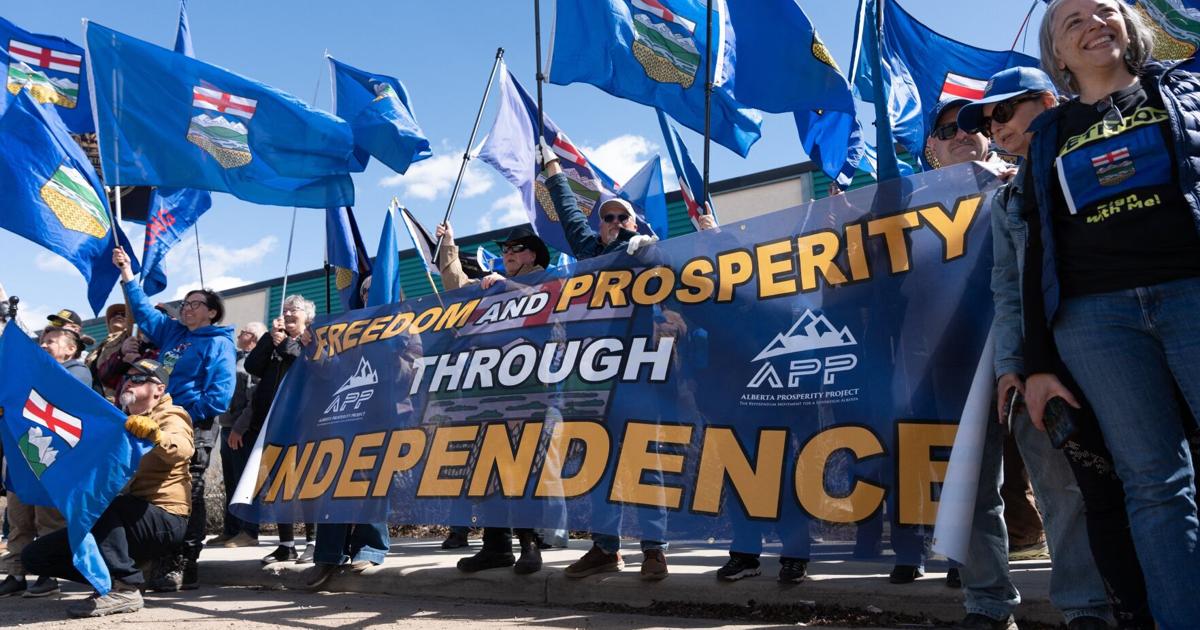
CALGARY—Olivia Brewster was driving down the highway near the Alberta Sports Hall of Fame in Red Deer last year when she first saw them for the first time — a honking and shouting crowd, urging her toward the highway pullout bedecked in blue Alberta flags.
These people — who wanted her to sign their petition in support of getting Alberta out of Confederation as soon as possible — would become a common sight, at rest stops and near the drive-through at her local McDonald’s. Brewster kept driving. “They can be pretty rowdy,” she says, “and I’m not looking to get into any fights.”
Brewster moved to Alberta from King, north of Toronto, in 2022, part of a massive influx of people that have made the Prairie province a top destination for people migrating within the country. That includes more than 100,000 Ontarians who have made the move in the last four years, according to Statistics Canada. Unlike the settlers of yore seeking farmland, this latest surge of migration has come for cheaper housing, family and no provincial sales tax.
Now these new Albertans find themselves in the middle of a debate with the tense energy of someone else’s family feud. For those in Alberta who have committed to separatism, the century-old grudge against Ottawa feels ancient and oozing — but sometimes opaque to an outsider. And while Albertans may be friendlier than their Eastern cousins, one recently arrived retiree told the Star, don’t tell them what to think.
This fall, Albertans will go to the polls in Canada’s first vote on separation outside Quebec, despite consistent polling showing the idea is unpopular with a majority of them. In an attempt to sidestep legal challenges, the question posed by the government is a referendum on a referendum: it asks whether or not residents want to go forward with a second, binding referendum on independence.
Canada Day in Alberta this year will play out against a heated debate about what it means to be Albertan, to be Canadian — and the ability to be both.
Despite Alberta’s long history as the conservative heartland, the landscape has become more mixed in recent years. Premier Danielle Smith’s United Conservative Party may have won the last election, drawing on a strong rural base, but 44 per cent of voters — mostly in the cities — still cast ballots for the opposition NDP.
While polling over the last year has shown that the ceiling for separatist support is around 25 per cent, that overlaps significantly with supporters of Smith’s party, which has had the effect of hardening already tense partisan battle lines.
As the separatists have gotten louder, federalists too have dug in their heels. Pollster Janet Brown has been asking Albertans about their attachment to province and country since 2020, and in the last year has seen the number of people who say they’re “more attached to Canada than Alberta” jump from 20 per cent to more than a third.
“It’s like with all this talk of separation, maybe they’re gravitating more towards Canada because they’re feeling a sense of alienation from Alberta,” Brown says.
When Brewster was doing the math on moving her family West, the prospect of her new home plotting to leave the country was not part of the calculus — “I wouldn’t say that separation was on many people’s radar when I moved, to be honest,” she says with a laugh — but it has begun to creep into her conversations with her new Alberta fiancé and in small rifts between friends.
With almost four months to go until the vote, Dawn Gibbons says the constant social media updates and headlines about separatism are “affecting her mood,” even in her adopted home of Calgary, where the ideology isn’t as widespread as in rural areas.
Regardless of their views, born-and-raised Albertans seem to better understand the groundswell of anger driving the movement, Gibbons says. Though she moved here 15 years ago, long before the latest wave of arrivals, she’s been feeling like she doesn’t know the province as well as she thought she did. “Coming from Ontario,” she says, “I just don’t understand it.”
In Innisfail, Brewster says she can feel the divide. “It can get pretty volatile, even in your workspaces or among your friends,” she adds. “In Ontario, the climate isn’t really like that. I can have friends who are Conservative, I could be a Liberal, someone else could support the NDP, and we can all still hang out,” she says.
“It doesn’t feel like that in Alberta anymore.”
There has been much speculation in Alberta about how the flood of new arrivals might shift the political culture — or the debate on separatism. But what that misses is that the Ontarians or other Canadians who move to Alberta have never been a random sample of the rest of the country.
‘ “The people who come to Alberta, they come to Alberta because Alberta makes sense to them,” says Brown. “They see something in Alberta that they’re not seeing in Ontario.”
Mohammed Barakat is a realtor in Calgary whose business is now roughly 60 per cent helping Ontarians making the move to Alberta. His Instagram account is full of videos where he skewers the myths about his new home for curious outsiders.
“When you speak to anybody from out East about Calgary, they usually tell you it’s the North Pole, it’s a small town, there’s not much to do, you know, the rhetoric that every Torontonian has about every other city in Canada,” he says with a laugh.
“Well, they never tell you about the chinooks, right?” he adds, referring to the warm winds that surge over the Rockies and periodically defrost the city each winter. “And your dollar just goes further out here than it does in Toronto.”
Some clients have asked him about separatism, he says, but it’s not their top issue, especially as the cost of groceries and fuel continues to rise. “I think when you compare separatism and food on the table, anybody that has that kind of comparison will always choose ‘How am I going to provide for my family?’ over what’s going to happen maybe in a year or two.”
The calls from Ontario area codes have slowed in recent months, but mostly because housing prices are dropping there, he says.
Barakat used to live in Toronto himself, and started seriously mulling a move West around the same time he got engaged. As a realtor there, he was very familiar with the cost of living struggles young people were facing, and suddenly had his own economic future to ponder.
He made the move to Calgary in 2021, lured by affordable housing and the absence of a provincial sales tax, and was pleasantly surprised by the community he found.
“I was thinking about building a life, and security in that sense, and Calgary has been phenomenal to provide me that.”
But for a few, the government’s rightward shift under Smith, and the spotlight on separatism — and the criticism of Ottawa, immigration and COVID policies that often go along with it — is a draw.
At the heart of the debate is what Alberta is, and who is an Albertan.
Kyle Pollock took advantage of a job transfer last summer to move from Burlington to Leduc, an energy hub just outside Edmonton. He was intrigued by the debate on independence that was then just getting underway.
“Love having a premier standing up for the people against Ottawa overreach,” he wrote in a message to the Star. This fall, he plans to vote for Alberta to move forward with a binding referendum on separating — so the conversation can be had, he says.
Pollock says he hasn’t made a final decision on where he stands, but in the 10 months he’s lived in Alberta, he’s started to tilt slightly more towards breaking up with Canada. He’s talked to more people, and the issue feels more personal now that he calls the Prairies home.
He’s been further nudged by the negative reaction online from people in the east, who, he says, refer to separatists as Maple MAGA or tell them to move the U.S. No one he’s spoken to in the separatist movement is keen on the idea of being the 51st state, he says, and besides which, “calling us traitors isn’t going to get us to think more favourably of them.”
But other new arrivals are worried the conversation leaves less room for them.
“Where I am, here in Calgary, I see a modern urban Alberta,” says Bob Pickard, principal of the public relations firm Leadership Communication Inc.
Pickard moved from Toronto to Calgary last year to be closer to family, but also because of what he saw as an opportunity in the market to do more international work — he notes, for example, the advantages of being slightly closer to time zones in the Asia Pacific.
But he worries about the economic impact of people — in the rest of Canada and beyond — getting the wrong idea about his adopted home.
“Alberta’s got the oil, Alberta has a lot of talent, a lot of ideas,” he says, “but if people get the impression that there’s an authoritarian government that can arbitrarily manipulate the law to bring about ideological objectives” — referring to the way that the government lowered the bar to help separatists gather signatures for a potential petition — “I think that’s bad for business in Alberta.”
It’s a fear echoed by the Calgary Chamber of Commerce, which recently released a study saying that nearly half its members would relocate if Alberta separates.
People like Gibbons, who arrived in Alberta more than a decade ago and has a job and a house and a community, are now wondering if perhaps they’re not as at home here as they’d thought.
“October is not that far away yet, but it feels far away,” she says. “It’s like, can we just get this over with now?”
Error! Sorry, there was an error processing your request.
There was a problem with the recaptcha. Please try again.
You may unsubscribe at any time. By signing up, you agree to our terms of use and privacy policy. This site is protected by reCAPTCHA and the Google privacy policy and terms of service apply.
Want more of the latest from us? Sign up for more at our newsletter page.