

The Irish Canadian author Anakana Schofield, who lives in Vancouver, has contributed to the Guardian, the New York Times and the Irish Times and writes an Opinion column for the Toronto Star.
Her books, which include “Bina” and “Malarky” — winner of Amazon’s First Novel Award — offer readers a rare and precious thing: stylistic continuity with the past and a deep engagement with the modernist movement.
With literary fiction often being crowded out from store shelves by books overinformed by realist tendencies or for general audiences who wish to engage with content analogous to what they might find on their streaming platforms, Schofield’s new novel, “Library of Brothel” (Knopf Canada), defiantly holds the line once made durable by G.V. Desani, Djuna Barnes and Flann O’Brien.
The book is set in a mazelike building that attracts lovelorn, depressed and lonely clients, whose attendants are named after the hyper-specific rooms they are responsible for: Giraffe Room, Scrabble Room, ASMR Room, Human Car Wash Room, History of Accidents in Civil Aviation Room, etc.
“At the Library of Brothel,” Schofield writes, “classification has been demanded. We’re told classification breeds calm and consistency, stability and stoicism. It can help you find your way around, or so the feedback form suggests.”
“However, we feel certainty encourages a dependence upon the probable,” she continues. “We don’t go in for that. We value the unexpected. We prefer a bewildering grain. We are ambitious for you.”
And while the workers feel the pangs of their labour sharply — monotony, dispensability, isolation — and detest their employer Noble Leader, they retain a sense of obligation toward their anxiety-ridden patrons.
What did you last read and what made you read it?
Virginia Woolf’s “The Voyage Out.” I heard the formidable writer Yiyun Li mention it in a lecture. But I had also just finished reading two novels by May Sinclair, who preceded Woolf as a modernist. Sinclair is rather a forgotten modernist. Woolf was much more ambitious in language and the shape of her sentences. I was attracted to Sinclair because I had never heard of her and I am conducting a new Binge Reading project, so I wished to find works that were immediately available in the public domain to help build a community of readers.
I am always reading six to 10 different books at the same time! I think this is quite normal for writers. We are a bit like cattle grazing. We chomp a lot of pages and still it’s never enough. We have 66 stomachs for books.
What book would your readers be shocked to find in your collection?
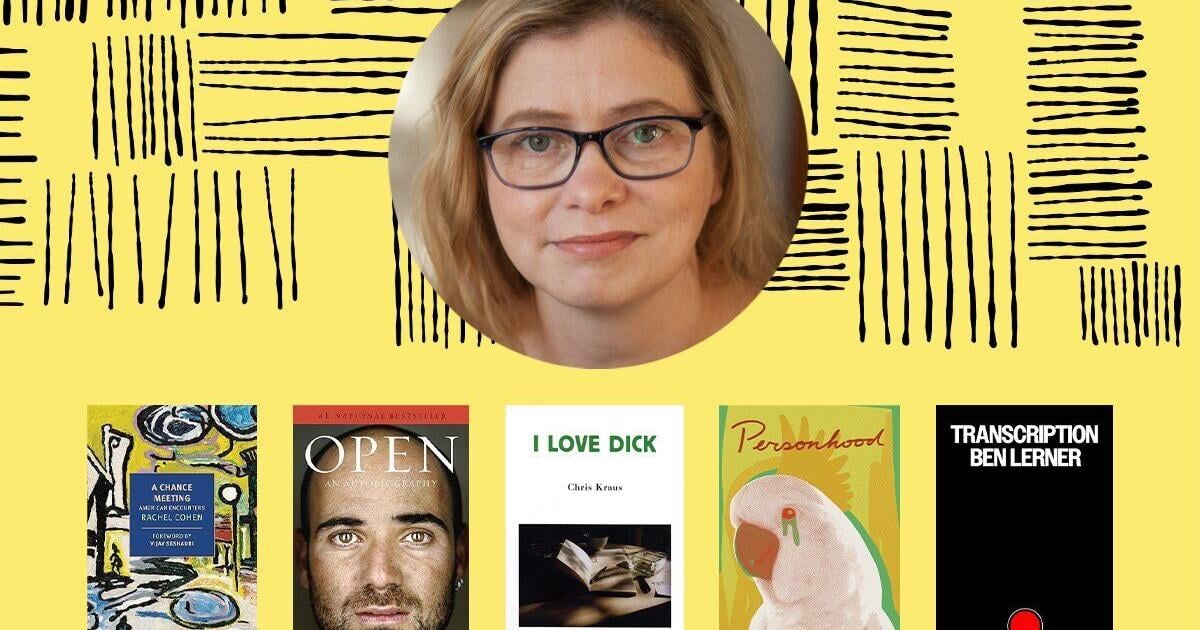
I don’t think readers would ever be shocked to find anything in my collection, given the kinds of novels I’ve written for them! I did hold on for many years to Andre Agassi’s memoir. I have no interest in him or tennis, but there’s an astonishing description of back pain that opens it. No one who reads “Library of Brothel” will be surprised to discover a copy of “Dictionary of Railway Terms” in Spanish. Or “The Thirty Years War.” Possibly, some might want to borrow “The Homoerotic 3-D Photographs of Denny Denfield.”
When was the last time you devoured a book in one, or very few, sittings?
My approach to reading is unconventional. I am curious about different ways of reading, of which there are many, just as there are different ways of looking at art. I can appreciate one paragraph in a book. I don’t need everything to add up. I am reading to become a better writer, therefore savouring language is vital, and if the prose is flat or the writer tin eared, I experience a kind of literary anaphylaxis.
I do remember tearing through Chris Kraus’s “I Love Dick” because conceptually it was fascinating and extremely funny. How to crash out on a crush! Rachel Cohen’s “A Chance Meeting: American Encounters” is the book I’ve been recommending endlessly since I had my own chance and transformative encounter with it last year.
Who’s the one author or what’s the one book you’ll never understand, despite the praise?
The list is long and I have sufficient enemies. I will say, I struggled to get through the first section of Ben Lerner’s thin novel “Transcription.” In the end, I read the parts in reverse to endeavour to understand the hype. Read backward or in reverse, it improved. I never would have gotten there without my topsy-turvy approach. In general, the only thing literature needs is what it has always had: curious and intelligent readers! Come back to us from the jaws of technology, please.
What’s the one book that has not garnered the success that it deserves?
I love the work of Thalia Field. She is a fearless literary genius who needs discovering. Her collection “Personhood,” on animal rights, is extraordinary. Each line of her prose is as strong as her love and advocacy for birds. Torontonian Tamara Faith Berger’s novel “Queen Solomon” is brilliant. Berger’s work is bold, funny and confrontational.
What book would you give anything to read again for the first time?
“The Bunney-Fluffs’ Moving Day,” which was a Ladybird book, written in rhyming couplets for toddlers. The image of the bunnies floating inside an upside-down open umbrella in the river captivated me. Perhaps I knew I would never become a competent swimmer and liked the backup plan of travelling by brolly.
When you were 10 years old, what was your favourite book?
A simple rectangular library book on gymnastics that documented basic moves. I wanted to be a Bulgarian gymnast. I don’t know how I thought I was going to manage the Bulgarian part, but the desire indicated an early aptitude for writing literary fiction. I spent a great deal of time upside down and turning cartwheels.
What fictional character would you like to be friends with?
Bagpuss, who is a big pink and white stripy cat, or Bartleby, or my Bina. I should like her to come visit me if I was in hospital and bring me a cup of steeped tea.
Do you have a comfort read that you revisit?
I like reading writers’ or artists’ journals and letters to discover what they read. Or also, in the case of George Eliot, how many dreadful headaches she had. I might read essays by Walter Benjamin, since comfort for me would be the reminder of what is possible in literature.
What is the one book you wish you had written?
Usually, the one I’m failing to write.
What three authors living or dead would you like to have a coffee with?
I don’t know if authors are ideal people to have coffee with, since I’d prefer if they were at home writing. I love all the writers I currently drink coffee with, but once in my early 20s I met an Irish poet I admired, and it was disappointing because she ignored me and gave attention to a young man wearing sunglasses instead. Now I understand that she was tired. I think I’d like to have coffee with someone who does kidney transplants or who researches Neanderthals or orders the compression bandages and equipment for the Raptors.
What does your definition of personal literary success look like?
I would like to be able to buy a small church with a pipe organ in it. I would install a basketball hoop at the other end and live there with my books and a ginger cat. Other writers or friends would come and stay with me. I’d also like to be invited to read in Baltimore or Prince Edward Island.
Error! Sorry, there was an error processing your request.
There was a problem with the recaptcha. Please try again.
You may unsubscribe at any time. By signing up, you agree to our terms of use and privacy policy. This site is protected by reCAPTCHA and the Google privacy policy and terms of service apply.
Want more of the latest from us? Sign up for more at our newsletter page.

