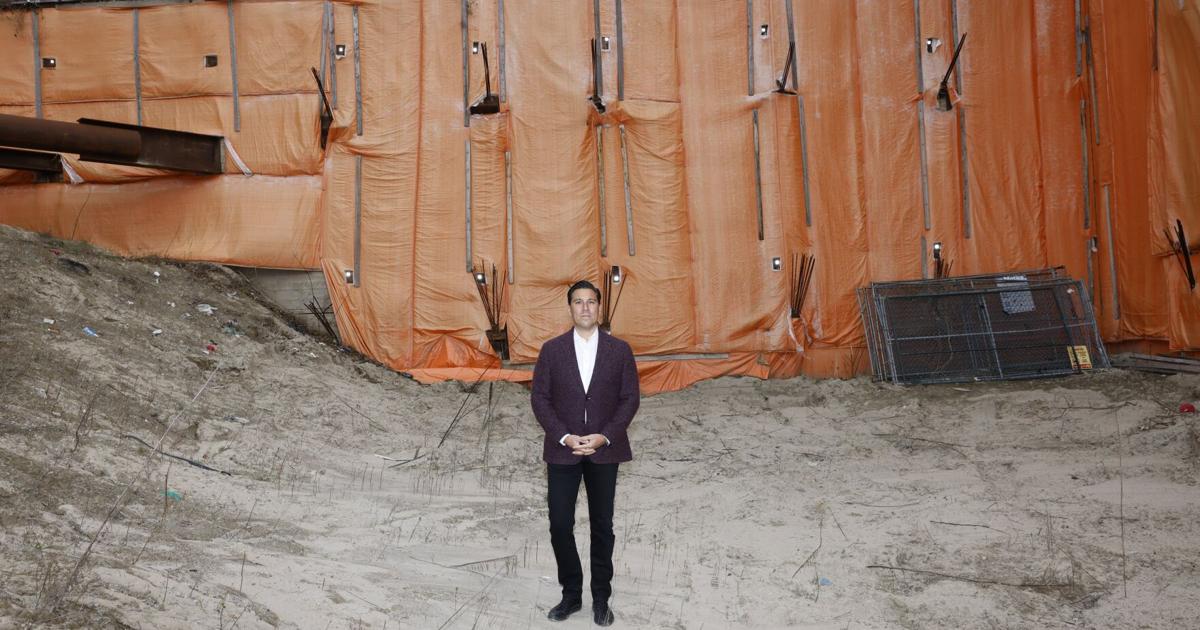
As Toronto’s condo market tanked, Marcus Tzaferis had money on the line.
Years ago, the founder of mortgage firm Cannect was among lenders for a new condo project planned about 20 minutes’ walk north of Toronto’s eastern lakeshore at Kew-Balmy Beach.
The proposal was for an eight-storey, 30-unit building divvied into two- and three-bedroom homes, which Mayor Olivia Chow would later described as “luxury” housing. But somewhere along the way, the project hit roadblocks, Tzaferis says.
“We just started to see that it was not viable, and we weren’t being repaid,” he said. The condo was cancelled, and the property eventually went into a power-of-sale process. But Tzaferis found himself hesitant to walk away.
He wasn’t a homebuilder. But staring at what he called a “three-storey hole” on Kingston Road, he saw the potential to build something different.
Now, he’s working to make that happen, partnering with a local builder and a housing non-profit to construct a new, mixed-income rental building, still eight storeys but now with 90 units — a third set aside at affordable prices.
“I was so scared of embarking on this path. It’s terrifying,” said Tzaferis, who admits he didn’t know much about the homebuilding process.
He’s under no illusions about the project yielding a financial windfall. But with some cushioning from government incentives and funding, he’s confident the new plan is feasible.
“The neighbourhood, they don’t want a hole in the ground.”
Across Toronto, the last few years have seen a dramatic rearrangement of the real-estate market, as developments that used to rise at breakneck speeds struggle to get shovels in the ground — up against a knot of financial challenges, including higher interest rates and tepid buyer activity.
Between the start of 2024 and last fall, market research firm Urbanation found 32 projects with nearly 7,000 homes in the Toronto and Hamilton area were cancelled, plus 20 projects placed on hold or put into receivership. This has left a smattering of idle properties, half-baked construction sites, and questions from neighbours about their future plans.
In Tzaferis’ case, he turned to his city councillor for advice.
The councillor, Brad Bradford, was familiar with the site — telling the Star his understanding was the original builder “fell on hard times.”
“Work stopped, and we were just left with a big hole in the ground,” he said. For Cannect to cut ties with the property would have meant a “pretty material loss,” Bradford said. So he offered to connect Tzaferis with others who could help.
That included housing staffers at city hall, as well as the non-profit Neighbours Community Homes, which already operates a housing site across the street.
Neighbours CEO Gautam Mukherjee says that, while details are still being ironed out, his organization is hoping to rent the 30 affordable units. Under Toronto rules in 2026, a one-bedroom counts as affordable housing if it costs $1,426 or less.
Mukherjee said their team would then add extra subsidies to the units and sublease them to their tenants at more deeply affordable rates.
The idea is to create a better housing pipeline, he explained. Right now, Neighbours has buildings filled with deeply affordable housing and 24-hour supports. But some tenants who move to those sites are able to address challenges such as mental illness and become “quite stable,” he said.
They might no longer need 24-hour support services, Mukherjee said, but still need deeply affordable rents, some level of support services, and want to stay in the neighbourhood.
“This sort of opens up that pathway,” he said. He hopes the mixed-income model also means the lower-cost units are maintained to a higher standard than might be found elsewhere in the city, he said.
The project also involves a team from Streetcar Developments, the development company behind east-end projects such as the Broadview Hotel and the tower with Crow’s Theatre at the base.
Jeff Schnitter, Streetcar’s vice-president of development and construction, knew the Kingston Road site from his commute home from work. What Tzaferis wanted to do was “right up our alley,” he said.
“It’s a good way in this current climate to make a project work, which offers what is really needed out there — both rental housing and affordable housing,” Schnitter said. He doesn’t believe a condo there would be viable in today’s market, with government money key to getting shovels in the ground.
City hall, in an April press release, confirmed it had approved $7.8 million in capital funding to go toward the Kingston Road development, along with other incentives such as a 40-year property tax exemption.
If all goes to plan, Tzaferis said the building could be ready for occupants by early 2028. He expects other homebuilders to explore similar affordable housing projects to access government supports.
“When property values are dropping, everybody is running for the hills,” he said. “This is a really good time to actually step in and solve a problem.”
Error! Sorry, there was an error processing your request.
There was a problem with the recaptcha. Please try again.
You may unsubscribe at any time. By signing up, you agree to our terms of use and privacy policy. This site is protected by reCAPTCHA and the Google privacy policy and terms of service apply.
Want more of the latest from us? Sign up for more at our newsletter page.