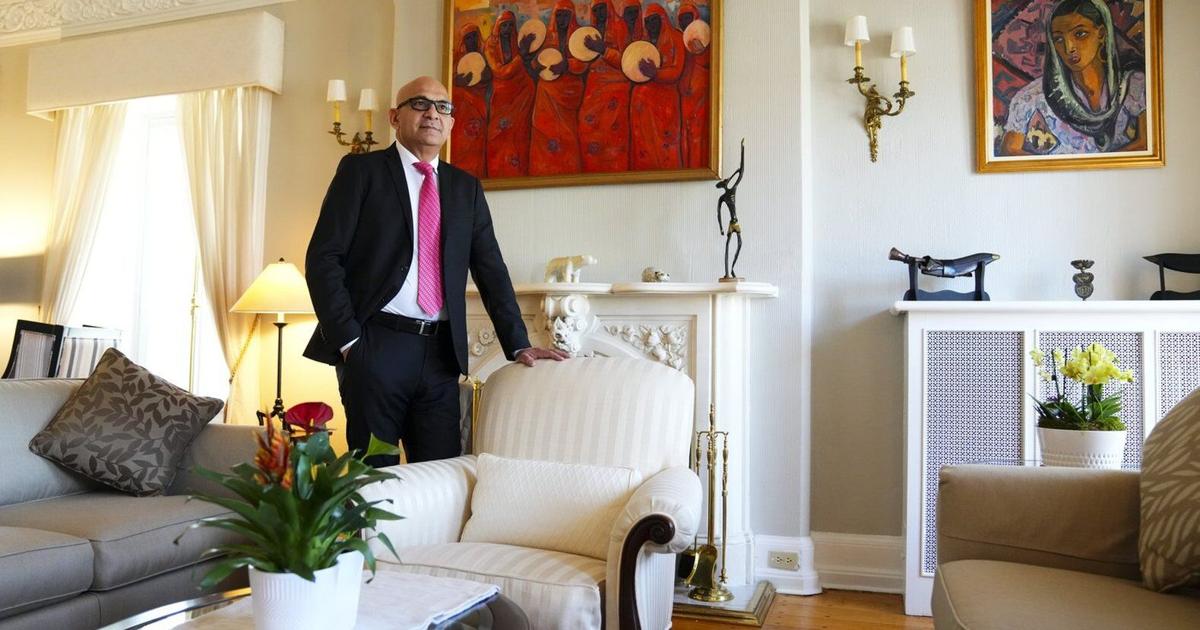
As Lillian Allen walked through Yorkville one recent afternoon, she kept returning to what used to be there — buildings since torn down, artists who once gathered in the neighbourhood and a community she remembers as central to its creative life before commercial development reshaped it.
Allen, Toronto’s Poet Laureate, dub poet and two-time JUNO Award winner, has turned that history into “The Village Corner – Yorkville,” a poem featured in “New Voices, New-New Voices, Something Wonderfully Lush,” a 20-foot interactive installation on Yorkville Avenue. The installation is part of Yorkville Murals, a two-day street art festival filling the neighbourhood with murals, installations, music, fashion and poetry, with more than 70,000 attendees expected. This weekend will mark Yorkville Murals’ final year after a seven-year run.
The poem looks back on Yorkville’s history as a place where music, literature and artistic expression thrived, while honouring figures such as Joni Mitchell, Gordon Lightfoot, Margaret Atwood, Michael Ondaatje, Leonard Cohen and bpNichol.
Ahead of the festival, the Star sat down with Allen to discuss what made Yorkville such an important creative neighbourhood, how it changed as commercial development and affluence took hold and what Toronto has lost along the way.
What do you think Toronto has forgotten about the Yorkville you knew and what made it such an important creative neighbourhood?
I think Toronto doesn’t know enough about Yorkville. We don’t know about the different spaces, different times and the different groups of people who have put in the work, the struggle, the art, the creativity, the love to bring us to this point in history.
These were young people who were rebels. The constraints of their heritage could no longer hold them. Their imagination was running wild and free. They wanted a new world, they wanted a new life, and they had a tool that was their creativity in writing, singing, art and building communities.
What came out of it? Some of our greatest artists, our greatest writers. You had Margaret Atwood, Michael Ondaatje, Dan Hill, Murray McLauchlan, Joni Mitchell, Rick James and Sylvia Tyson. Creativity doesn’t happen in a room by itself. To grow, contribute and to impact and expand our communities and ourselves, we have to engage and build communities.
With how much Yorkville has changed, is there still space for artists to be as creative and free-spirited as they once were?
Artists can’t be as free-spirited and as creative as they once were because the first thing they have to think about is where they’re going to live and pay rent.
The whole economy has changed, so that most of the artist’s time is taken up with keeping their personal dignity, having a place to live and taking care of themselves, and then what’s left over they have for creativity.
I know we have galleries, they’re commercial galleries, which is good. We need a mixture of that too. We need artist-run spaces and more programming for places like this. So you can come down any time of the day. You know, you can walk down and there’s something beautiful and good and exciting that will be happening. That’s the kind of city I would love.
What did Yorkville offer artists at that time that you think is harder to find in Toronto today?
This was probably one of the least expensive areas to live during that time. It was affordable to the artists. It was walkable to downtown, to theatres and the University was right there.
But it was the whole culture. It was a counterculture. People were wanting to be different. They wanted a different world. They wanted a more creative world. They wanted a fairer world. They wanted a world where they lived and communicated with different kinds of people. They wanted more art in their lives and they wanted to express themselves more.
It was almost like a mecca. They knew that creativity lived here. It was really a different kind of community, building a different kind of community and imagining a different kind of world.
Do you feel like people are losing the act of being present? Are we more disconnected?
We definitely are losing the act of being present. I don’t think we understand what it is to be present because we are present with the digital. We’ve been recolonized by the digital.
That’s why that (era) was so special. Can you imagine? People didn’t even have phones back then. It’s that kind of presence — it’s communal, grounding, it’s based in human needs, human imagination, human wants, human connection.
This will be the final Yorkville Murals after seven years. What do you think Toronto risks losing when events that celebrate the city’s arts and culture can no longer sustain themselves?
It’s worrying. I mean, this is the soul of the city. Art is the soul of this city, and culture.
It’s worrying that there isn’t enough support, not just from the government, or our municipalities, but from businesses, to sustain something like this festival that draws tens of thousands of people.
Why Yorkville? What is it about this neighbourhood that makes it worth writing about and remembering?
The history. The fact that this was one of those moments that transformed Toronto, that showed us that Toronto could leave its puritan past and embrace a wider vision of what our culture and society could be.
I like the scale of (Yorkville), apart from the towers that have gone up. Apart from this commercial zone, where the houses are, where people live, it actually feels pretty cosy.
And I love the galleries. I wish they would do more programming apart from the visual arts — more music and more kind of artsy, experimental stuff, more poetry, more book launches.