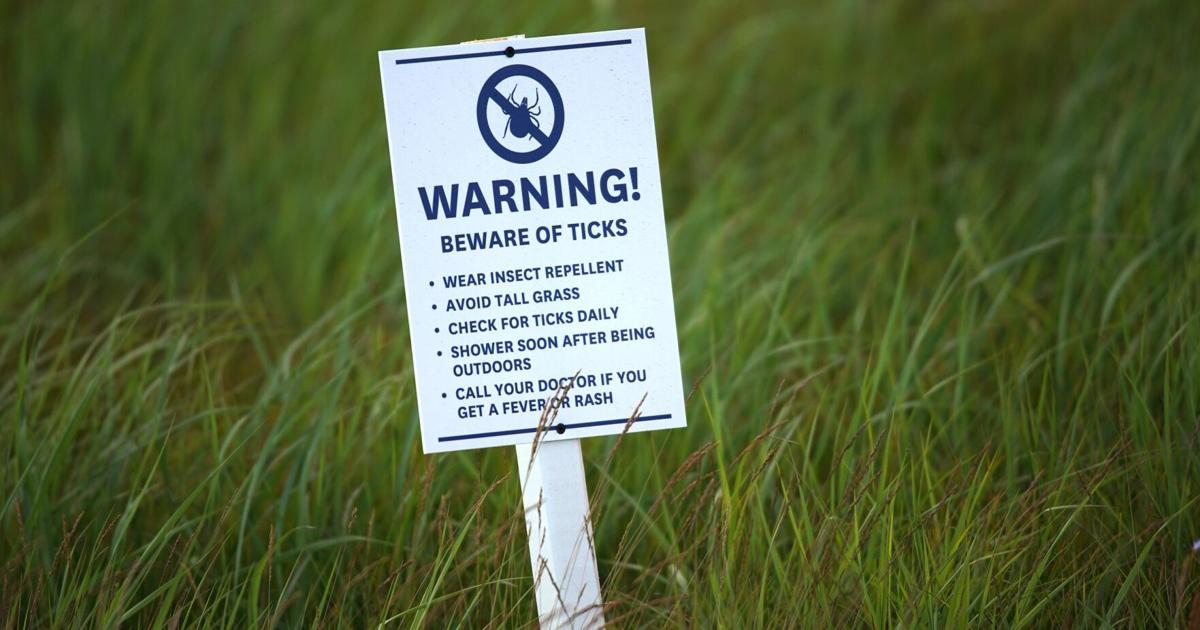
Ontario is seeing a surge in reports of blacklegged ticks this year, leading experts to warn of a tough summer ahead.
Tick populations in the province have trended upward year over year as climate change warms our winters and makes our northern geography more tolerable for the temperature-sensitive arachnids.
In 2026, reports of blacklegged ticks — the type that spread Lyme disease — are up more than 40 per cent in Ontario compared to this time last year, with the bulk of the reported activity clustered around the Greater Toronto Area. As tick numbers and habitable regions continue to grow, so does the burden on our health care system.
“This year especially, we are seeing a lot more cases and concerns from homeowners about ticks,” said Nick Dudlak, co-owner of Mississauga tick and mosquito control company Buzzskito. “Homeowners that live in heavily vegetated properties are definitely at greater risk.”
Here’s how this summer is looking, and which areas are in the “hot spot.”
Where the ticks are, and why
Ontario’s tick season is off to a “very strong start,” said entomologist Jade Savage, a professor at Bishop’s University in Quebec and the creator of eTick, a Canada-wide tick-tracking platform promoted by Public Health Ontario and Health Canada.
As of Wednesday, eTick had logged 2,759 tick reports across Ontario, including 1,672 blacklegged ticks — the main spreader of Lyme disease. That’s a roughly 45 per cent increase in blacklegged ticks over the same time last year.
Recent weather patterns have contributed to the surge: Last winter was relatively warm, and it’s been a cool spring so far. “Blacklegged ticks really like this sort of weather,” Savage said.
As with previous years, the vast majority of tick reports were in southern Ontario, centred around Toronto, Mississauga and Hamilton. “The Greater Toronto Area is always the hot spot, and it usually remains the hot spot throughout the year,” Savage said.
The region has a higher human population, which means more tick reports. But it also has a greater concentration of ticks due to its warmer climate, dense network of ravines and wooded areas, and populations of white-tailed deer — the ticks’ preferred host.
Blacklegged ticks are most active from spring to fall. In Toronto, reports start coming in around April and continue until October, said Dudlak. But even during the winter, adult blacklegged ticks can become active if the temperature rises above 4 C.
The threat of Lyme disease
While currently confined to southern parts of Ontario, Manitoba, Quebec, New Brunswick and Nova Scotia, blacklegged ticks are gradually spreading northward as climate change makes our winters more bearable for the arachnids, exposing new populations to tick-borne disease.
Ticks serve as a vector for many infectious diseases, including anaplasmosis, babesiosis and alpha-gal syndrome, which causes an often-severe allergy to red meat. The most common diagnosis is Lyme disease, a bacterial infection that, if left untreated, can spread to the nerves, joints and nervous system, potentially resulting in long-term symptoms.
A 2016 study found that 12 out of 29 blacklegged ticks in Ontario — about 41 per cent — carried the bacterium that causes Lyme disease.
The incidence of Lyme disease has swelled along with tick populations. In 2009, there were 144 recorded cases in Canada. In 2024, there were 5,239 cases.
This year, Ontario has logged 118 cases of Lyme disease as of the last week of April; there were 153 cases at the same time last year.
These numbers are likely a “huge underestimation” as Lyme disease has historically gone under-reported, said Janet Sperling, president of the Canadian Lyme Disease Foundation.
In the early stages, people often make a full recovery from Lyme disease after 10 to 14 days of appropriate antibiotics. But if left untreated, the disease can evade the immune system and spread through the bloodstream, making it difficult to treat and potentially leading to long-term symptoms.
Lyme disease is difficult to diagnose; symptoms vary from person to person, and the widely used antibody tests can return false negatives during the first four to six weeks of infection, the most critical period for treatment.
That’s what happened with 28-year-old Torontonian Sarah Hackett. She said she contracted the disease after a tick bite in Algonquin Park, as a 19-year-old university student in 2016. After an initial test came out negative, her doctors refused to believe she had the condition. “I could see things progressing and getting worse,” she said. “I was having neurological symptoms. I was having twitches and tremors by the time fourth year came around.”
She spent two years looking for answers, before a private California lab, iGenex Labs, diagnosed her with Lyme disease in 2018. By then, antibiotics weren’t able to fully quell her symptoms. Today, Hackett remains unable to work full time and lives with chronic pain and fatigue, although her condition has improved after taking long-term antibiotics and other therapeutics.
There is skepticism in the medical community over chronic Lyme disease. Hackett said her family doctor and immediate physicians have accepted her diagnosis, but “when I am meeting new doctors, I am quite apprehensive about bringing up chronic Lyme as I am never sure how they will react,” she said. “While some have been accepting or stated that they don’t know much but they believe me, others have been bad at hiding their cynicism or downright dismissive.”
How to prevent bites and remove a tick
When you’re entering an area where ticks may be found, Health Canada recommends wearing closed-toed shoes, and tucking your long-sleeved shirt into your pants and your pants into your socks (ideally both are light-coloured and treated with permethrin). Apply insect repellent containing DEET or Icaridin.
In light of the alarming numbers this year, experts are urging people to be extra vigilant in checking themselves — and their pets — for ticks after time outdoors, especially in grassy, brushy or wooded areas. Over 40 per cent of the ticks reported in Ontario this year were found on animals.
If you do spot a tick, remove it as soon as possible. Using fine-point tweezers, grab its head as close to the skin as possible and slowly pull straight out. Try not to twist or squeeze the tick. If its mouth parts are lodged in the skin, do your best to remove them with tweezers; otherwise, leave them alone. Once you’re done, cleanse the wound with soap and water or an alcohol-based sanitizer.
If you’re unable to remove the tick or experience symptoms like a rash or fever after a tick bite, Health Canada recommends seeing your health care provider.
Early detection is key. “If you remove your tick, especially a blacklegged tick, within 24 hours of attachment, the probability of developing Lyme disease is extremely low,” Savage said.
And if you do develop symptoms, don’t panic, said Sterling. “The most important thing is to remember that (Lyme disease) is easy to treat if you catch it early.”