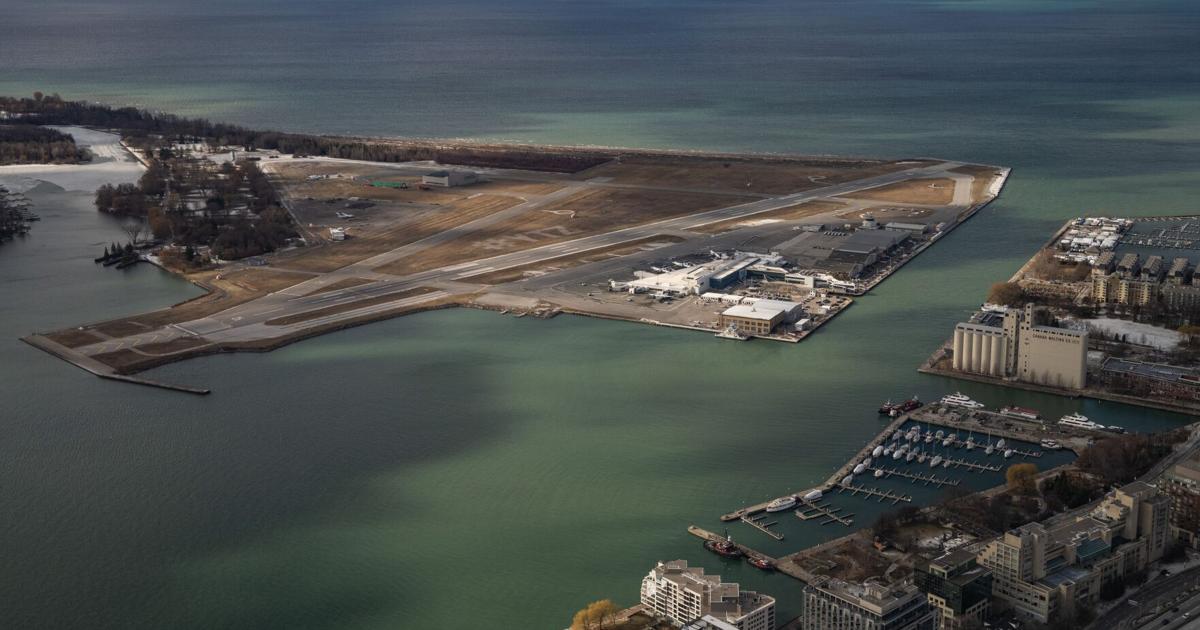
Toronto’s business community is “disappointed” the Billy Bishop airport expansion isn’t moving forward, with several saying it would have been a boon for the economy.
On Friday, the federal government grounded Premier Doug Ford’s proposed expansion of Billy Bishop airport after public consultation showed Torontonians are overwhelmingly against the idea.
But business groups are frustrated the airport expansion isn’t moving forward, calling the move a missed opportunity to aid the ailing airport and Canada’s flailing business confidence.
The expansion was seen as a necessary investment in Toronto’s infrastructure, to help businesses grow with easier and improved travel to the U.S., and inject billions of dollars into the economy. Without this investment, the airport is living on “borrowed time,” a business group said.
Giles Gherson, president and CEO of Toronto Region Board of Trade called the federal government’s response “disappointing” as the downtown airport has been “hugely valuable as a business asset and helping to grow the economy here.”
“When we make decisions about critical infrastructure in a hasty way, it sends a signal to the business community,” adding that the underinvestment of Toronto infrastructure is leading to companies moving to the U.S. as they don’t see a profitable future in the city.
“We need to keep investment here,” Gherson said.
A Transport Canada public survey received 87,000 responses, which revealed public opinion was solidly opposed to the expansion.
In a statement, Transport Minister Steven MacKinnon said Friday that the feedback had raised a wide range of concerns from economics to environmental impact to quality of life.
“Toronto voices will shape any future plans for Billy Bishop Airport,” MacKinnon said in his statement.
Until earlier this year, Billy Bishop had been governed by a tripartite agreement composed of the city, the Toronto Port Authority and the federal government.
Ontario Premier Doug Ford announced the planned expansion in March and passed legislation taking over the city’s role, but the agreement requires all parties to be on board with any proposed expansion.
Gherson said the 1983 operating agreement governing the airport locks it into “a single aging airplane” — turboprops — and needs updating, with appropriate guardrails for concerns ranging from flight paths to passenger growth, he said.
Business group says airport is on ‘borrowed time’
“It’s a fine plane, but it’s been around for 45 years and carriers are not using it nearly as much as they used to because they’re replacing those planes with more modern planes,” he said.
“When the airport says you can only fly one plane in and it hasn’t been manufactured in four or five years, what does that tell you about the future of that airport? It tells you it’s on borrowed time,” Gherson said, adding that no one will want to invest in an airport that has “declining” infrastructure and an operating agreement that expires in 19 years.
Pascal Chan, vice president of strategic policy and supply chains at the Canadian Chamber of Commerce, said that modern transportation infrastructure “matters” in Canada’s largest business network, and that Billy Bishop is a “critical” transportation link.
“It is essential to strengthening internal trade, diversifying our exports, improving labour mobility, expanding tourism, and building a more resilient economy,” Chan said. “Major infrastructure projects across the country are helping restore business and consumer confidence, and Canada will need more of them in the years ahead.”
Shopify’s CEO Tobi Lütke also shared his frustration on X after the news broke late last week.
Lütke responded to Ontario NDP opposition leader Marit Stiles’s post lauding the federal government’s announcement.
“Toronto said yes,” he wrote. “But we also knew that the NIMBYs would somehow figure out a way to stop it. Like everything else anyone actually wants to improve. Doug at least tried.” Not in my backyard, or NIMBY, refers to residents that are opposed to new development.
The Star reached out to Shopify for further comment from Lütke, but did not receive a response in time for publication.
Transportation groups remain quiet
Toronto Port Authority referred the Star to their official statement, published over the weekend, saying they’ll support the federal government’s efforts to improve safety projects at the airport, but would not provide comment on whether Billy Bishop is profitable in its current state and will continue to operate.
“We will be in touch when we have more to share,” Claire Pfeiffer, senior manager, communications, special projects at Toronto Port Authority wrote in an email.
Brad Cicero, director, communication and public affairs at Porter Airlines told the Star, “We don’t have a statement to provide on this subject.”
Air Canada, which operates out of Billy Bishop, said they are “engaged in the development and growth of the Toronto City Airport” demonstrated by their recent expansion to four major U.S. cities and increased flights to Montréal and Ottawa, Christophe Hennebelle, vice president, corporate communications at Air Canada, said in a statement to the Star.
“We will continue to collaborate with all stakeholders on the future of the Billy Bishop airport, including on the ongoing safety improvements.”
With files from Ryan Tumilty.