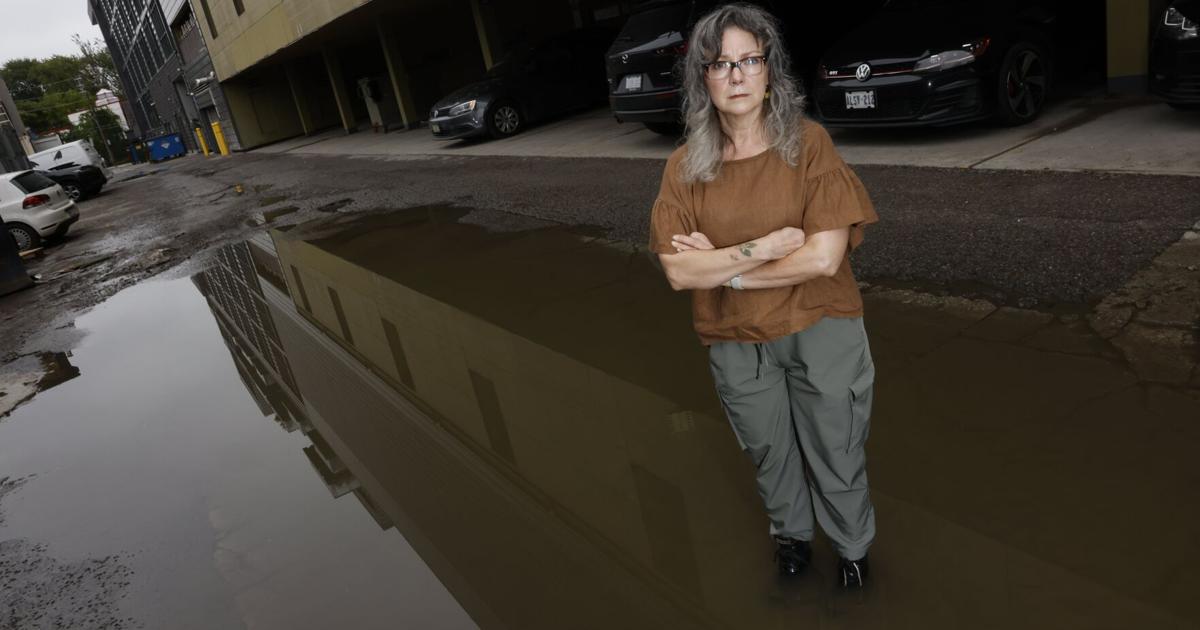
Lining the laneway that connects Ritchie and Howard Park Avenues behind Dundas Street West is a hodgepodge of businesses, condos and the Kingdom Hall of Jehovah’s Witnesses.
The road is a patchwork of failed attempts to fill potholes, now cratering under a pool of brownish-green water deep enough to submerge your feet.
For years, the residents of a Roncesvalles condo building have been asking the city to do something about the craggy laneway that, they’re fairly certain, belongs to a man who died more than 40 years ago.
“I went down to the provincial records trying to find his death certificate,” said nearby resident Adria Budd Johnson. “It’s like he doesn’t exist.”
Toronto’s laneways serve as collective driveways for tens of thousands of homes across the city and provide throughways and drop-off points for many homes and businesses. Yet many of these alleys remain unclaimed, held in title by defunct corporations or owners who died decades — sometimes more than a century — ago.
When one of these roadways falls into disrepair, trying to fix it can be onerous, sometimes demanding a years-long process to prove that former laneway owners are dead and gone.
“Layers of bureaucracy are creating problems,” said Budd Johnson.
Already, the Roncesvalles resident said that her condo board was repairing potholes in the shared laneway, costing anywhere from $5,000 to $40,000 per year.
“I have no mechanism to get my fellow neighbours in the alley, the businesses on Dundas who we share it with, to pay,” she said.
The lane serves as a delivery entrance for several businesses, including a brewery, a gas station and an auto mechanic, and is often used as a throughway between Howard Park and Ritchie Avenues.
Budd Johnson said the laneway’s surface is so egregious, it knocks passing trucks into the condo, damaging the building facade as well as the vehicle.
She said the city and province have no simple way to transfer the land, while her condo’s lawyers said they can’t legally fix the road and have advised them to stop doing so.
According to land registry documents, the last time the laneway changed hands was in 1945, at which time a man named Alexander G. Baird bought the land for $1.
Her journey to track down the enigmatic owner ended at Mount Pleasant Cemetery, where there is a gravestone for a man bearing the same exact name who died Feb. 25, 1983.
Due diligence for the dead
While tracing the genealogy of a laneway to a literal dead end might feel like an impasse, retired real estate lawyer Ron Kanter successfully won laneway ownership for his clients in 2021, prying the title from the hands of James J. McKittrick and Giles S. Ransom, who bought the lane in 1881.
“We went through quite a lot of effort,” said Kanter, who represented real estate development corporation “Laneway (Bathurst & Richmond) Inc.”
Kanter had a land use planner provide an affidavit saying that private ownership would take good care of the lane and hired a genealogist to prove that the owners were deceased with no heirs that might have a claim to it.
“The person applying for ownership of an orphan lane should publish a legal notice in a national paper seeking any descendants,” he said. “Typically, you won’t get a response, but if you do get a response, you have to deal with them.”
According to a case from 2022, a condo development corporation did, in fact, deal with the descendants of late laneway owner John Henry Boulton — more than 60 living heirs contested the corporation’s right to own a narrow strip of land “just wide enough for a car or a horse and buggy.”
The great-great-great-grandchildren of Boulton, who purchased the land in 1824 and died in 1870, ultimately lost the case and the developer, “185 King Developments Inc.,” gained ownership of the alley attached to the King Street East address in Toronto.
A glitch in the system
Local historian Adam Wynne has a theory about what’s causing some of the ghost-ownerships across the city.
“There’s orphaned laneways owned by defunct corporations, there’s orphaned laneways which are survey and map-related errors, and then there’s orphaned laneways which may not actually be orphaned laneways at all,” said Wynne, “but which may actually be a product of the province of Ontario’s land registry computer database having a glitch.”
Wynne believes that many of these unclaimed laneways are simply a computer error that occurred when the data was digitized in the early 2000s.
The province refutes this.
“Ownership is updated in the Land Registry on the registration of a document that would change ownership,” reads a statement from Ontario’s Ministry of Public and Business Service Delivery. “If a person has a legal claim to property registered in a deceased person’s name, they should consult with a lawyer for advice on possible legal options.”
Yet in his years of research, Wynne has found several peculiar cases.
He found that Leonard Place, an unnervingly narrow alleyway in Kensington Market, was owned by nineteenth-century Toronto developer Francis Phillips, who acquired the land in 1881.
The Dominion Radiator Company, which formerly had a factory on Dufferin Street south of Queen Street, retains ownership of Milky Way Lane in Parkdale despite the company’s departure from the industrial site in 1907.
Wynne said the company hasn’t existed since the 1920s.
“If you have a defunct corporation owning property in Ontario, it is supposed to revert to government ownership after two years,” said Wynne.
Who should adopt these lanes?
For many who neighbour the unclaimed laneways, public ownership is the ideal solution.
“The City cannot simply take ownership of private property without legal authority,” said Hilary Caton-King, a senior communications adviser with the city. “In some cases, however, abandoned laneways have been brought into City ownership through development applications.”
In December 2025, the principal of Kensington Community School, Gary Pieters, wrote a letter to city councillor Dianne Saxe asking that the city take ownership of two alleys adjacent to the elementary school and use community benefit charges from a new student residential building to turn it into a linear park.
Pieters wrote that “staff, students and families using the laneway as a main route into the school grounds have expressed concerns that it is not well-lit, not safe and not accessible.”
In a report from March of this year, the city determined that the funds would be insufficient to make improvements to the laneway, hinting at (but not committing to) a potential acquisition in the future.
Kanter said the city might be reluctant to take ownership of all orphaned laneways because they may be too narrow or too expensive to maintain.
“I would think that the city would make an argument that to be a public laneway, ideally we want to connect two roads,” said Kanter. “If all this does is lead to a garage, then does the city really want to take responsibility for it?”
For the city’s part, Budd Johnson said they’ve occasionally been caught on the condo’s security cameras stealthily filling potholes in the back lane.
As the president of her condo board, she’s nearing the end of her term and the limits of her frustration.
“A province needs to step up and basically institute a process for dealing with this,” she said, noting this is not just a Toronto problem.
“This is everywhere in Canada.”