

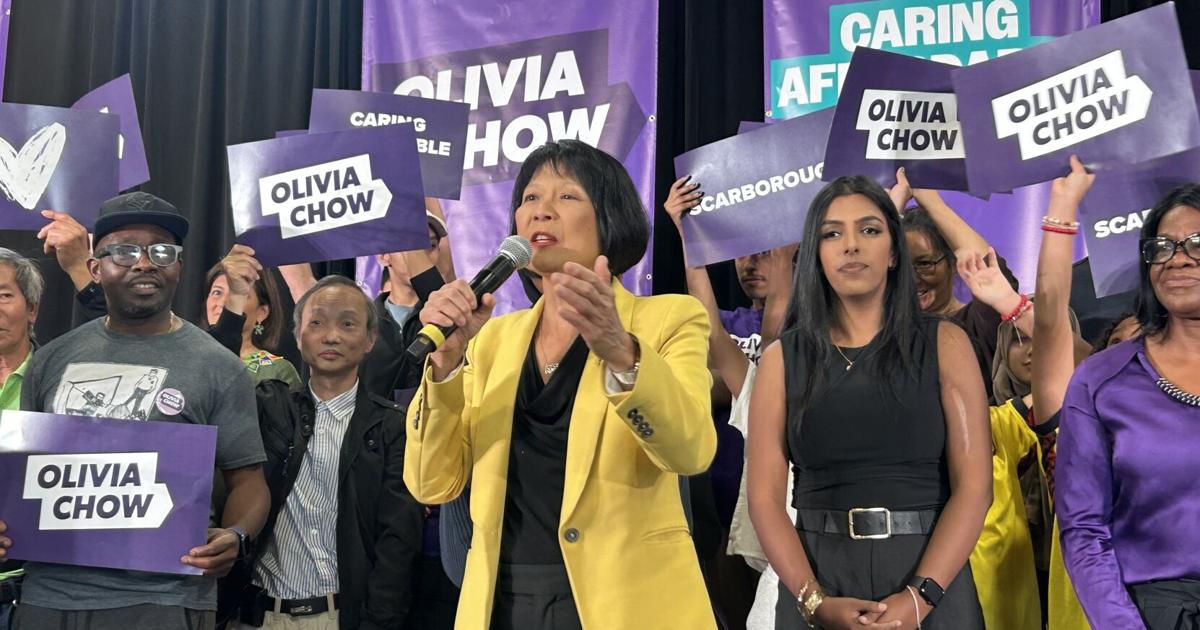
Olivia Chow is having a tougher time keeping her job than her predecessors.
With just three weeks left until election day on Oct. 26, the latest opinion snapshots show Chow’s chief rival, Brad Bradford, is closer than anyone has been this century to winning an election against a sitting Toronto mayor.
“We’re seeing very competitive movement in North York,” said David Valentin, principal at polling firm Liaison Strategies. “Support for him in Etobicoke is there but it needs to be higher. If he can continue to grow it, he’ll be in really good shape.”
A Liaison poll of voters this week has Chow in the lead with the support of 40 per cent of respondents and Bradford with 33 per cent. Former immigration minister Chris Alexander is in third place with eight per cent, down slightly from the numbers he debuted with this summer.
The ratios remain largely the same among decided and leaning voters. Chow is at 48 per cent, Bradford and 40 per cent and Alexander at nine per cent. Liaison surveyed 1,000 people over the phone. Its margin of error is 3.1 percentage points, 19 times out of 20.
A poll by Mainstreet Research the week before with the same methodology got even closer results. Chow received 38.1 per cent, Bradford 32.2 per cent and Alexander 7.2 per cent.
Among decided and leaning voters in the Mainstreet poll, 45.4 per cent supported Chow, 38.3 supported Bradford and 8.5 per cent supported Alexander.
In a news release, Mainstreet called the election “too close to call.” Quito Maggi, president and CEO of the polling firm, wrote that while the race “remains Olivia Chow’s to lose,” the winner is “far from certain at this point.”
Past re-election campaigns cruised to victory
There have been four re-election campaigns in the megacity. Historical election and polling data shows none of the incumbents ever faced as serious a threat as Chow is right now. Previously, the closest a Toronto mayor got to losing re-election was David Miller in 2006. Even then, he beat his biggest rival by 25 points.
Valentin said Chow’s incumbent advantage has been watered down by increasing partisanship in Toronto municipal politics. Whereas before, name recognition was thought to be the number one determinant of success, there are now what he calls “quasi-political parties” operating in Toronto that advocate loudly for their chosen candidates at the door and online.
“A lot has changed about our media consumption and how narratives are built,” said Valentin. “Non-traditional actors are getting involved and there is more partisanship now.”
Could appealing to renters yield dividends?
Bradford has spent much of the campaign making overtures to homeowners, Valentin said. He promised to hold the property tax increase next year to just 1.5 per cent and has spent many press conferences talking about how the mayor should do more for public safety.
“Safety takes on a different dimension to renters,” said Valentin. “People living in apartment buildings, with two sets of doors between them and the street and a parking garage, aren’t as scared of break-ins and car thefts.”
On Monday, Bradford seemed to turn his attention to renters, promising them that, if elected and allowed to turn Toronto Water into an incorporated, publicly owned municipal service, which he claims would cut water bills, he would advocate to higher levels of government for legislation to compel landlords to pass any savings on to renters. (Chow has criticized this plan, saying it opens the door to privatizing drinking water.)
“Bradford’s voter coalition has been people in houses,” said Valentin. “Now he is leaning into renters. That’s a critical group he needs to do a lot better with.”

