Are you a music fan suffering from digital fatigue? Bored of the internet, and fed up with the fleeting, ephemeral nature of streaming services. You’re not alone.
Since the long dark days of the pandemic, physical media has surged in popularity, especially among young people. In Canada, record sales have risen by 240 per cent since 2019. Last year, revenue from vinyl sales topped $1 billion in the U.S. for the first time since 1983.
“We’re definitely seeing a technological backlash taking place,” said Jeff Barber, who owns Sonic Boom, Toronto’s largest independent record shop. Turntable sales, which Barber says are a “great barometer on where things are,” are higher than ever.
“People want something tangible. They want the ritual of putting on a record or a CD. The ritual is what brings you back into the moment, kind of like pouring a glass of wine with your friends — you sit back and enjoy it, rather than just have it go in one ear and out the other without even knowing what you’re listening to.”
The market is also changing rapidly, according to Barber. Once the domain of middle-aged men, the vinyl collectors who visit Sonic Boom today are younger and far more diverse. To stay afloat, record shops have had to rapidly adjust to changing tastes and preferences.
“I call it the ‘second vinyl revival,’” said Andrew Koppel of Kops Records, a Toronto institution that has spent a half century evolving to keep up with fluctuating consumer preferences.
The record shop landscape in Toronto has also changed drastically. For years, fans flocked to major chains like Sam the Record Man, Tower Records and HMV. Today, the city’s top music retailers are independently owned and operated.
We asked Star readers to share their favourite spots to buy records. These four were the standouts.
Kops Records (209 Danforth Ave.)
A slice of Toronto history, where old meets new
Time collapses the moment you step foot into the Kops Records on the Danforth. The shop is home to tens of thousands of LPs and 45s, new and vintage, some dating back to the 1950s and earlier, a microcosmic sample of nearly a century of popular music. Each wall is lined with photos and other bric-a-brac that span the decades: a promo poster for the Grand Ole Opry (tickets just $1.75), a black-and-white photo of Elvis in cowboy hat, glossy posters of Taylor Swift and Harry Styles. Moving deeper into the space, you’ll discover retro record players, displayed on shelves like ancient artifacts in a museum.
“Blending history with modernity, that’s our big thing,” said Andrew Koppel, who runs Kops with his brother, Nick, and father, Martin. “It’s about preserving the classics, while also appreciating new artists like Bruno Mars or Olivia Dean.”
Toronto’s oldest independent record retailer, Kops was founded in 1976 by Martin, a Manchester, U.K., transplant, who got his start selling 45s that he’d amassed as a young man as a side hustle. Eventually, Kops became a key supplier for major record stores like Sam the Record Man and HMV. On the verge of turning 50, Kops now has three locations, including a shop on Queen West and one in Oshawa.
Today, Kops remains a great place for seasoned collectors, but in recent years, has shifted strategies to appeal to a new wave of music fans — namely, Zoomers. To that end, Kops has not only cultivated a buzzy social media presence but has also tapped into the popularity of listening parties, where fans gather for an exclusive preview of new releases.
Younger audiences, Andrew explained, aren’t just interested in physical media, they’re also interested in experiences.
“We’ve survived so long because we’re willing to change,” said Martin, who is now in his mid-70s. He mentioned one of Kops’ new regulars, a 14-year-old girl who collects 45s of old songs that have been sampled in new songs or that go viral on TikTok.
“She came in asking for Connie Francis and the Ink Spots,” he said with a laugh. “Because of her, I decided to create a new section of songs that have been famously sampled. It’s very popular.”
“I call him the master of reinvention,” Andrew quipped.
Summertime spins:
Martin: I’m on a Hank Williams kick after watching the biopic (2015’s “I Saw the Light”). I’m also listening to lots of stuff from the ’20s and ’30s, the pre-big band stuff, the guys who started all that.
Andrew: I am really into “Pacific,” this Japanese instrumental from the 1970s with Tatsuro Yamashita and some of the other big City Pop guys. The staff play it all the time.
Nick: Anything Bruno Mars. I wasn’t into him until I went to the show. I ended up going twice. The choreography, the set changes, everything about it was amazing. I’ve been listening to his entire discography on the way to work and coming home.
Play De Record (411 Spadina Ave.)
Vinyl mecca for crate-diggers and DJs
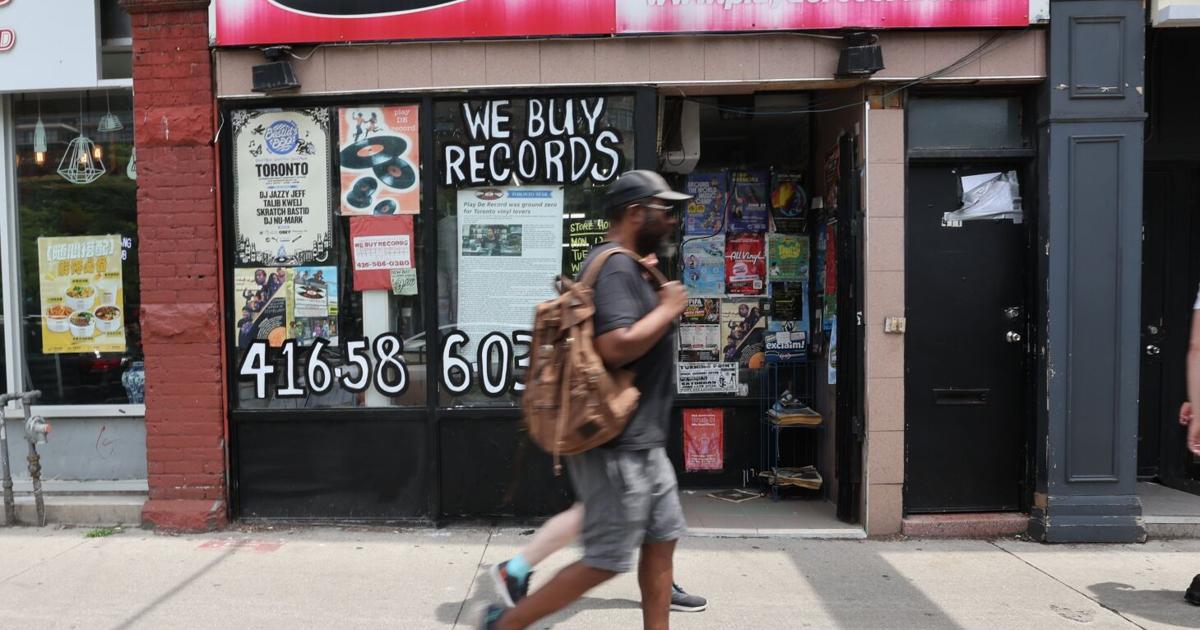
Like any great vinyl shop, Play De Record is a bit of a mess. Within the narrow confines of the unassuming shop in Chinatown, haphazardly labelled milk crates jammed with LPs and 12-inch singles are stacked into perilous columns, and the walls seem to strain under the weight of merch racks that stretch from the floor to the ceiling. Nearly every surface is covered by posters or plastered over with colourful stickers.
At the helm of this beautiful chaos is proprietor Eugene Tam, whose legendary music curation and dedicated service has made Play De Record a central node of Toronto’s hip-hop and electronic music scenes for more than three and a half decades. The shop is also the subject of the 2022 documentary “Drop the Needle.”
“DJs love to dig,” Tam said. “When you go to a record shop, you want to stumble across something no one else has. Too many people want things handed to them, but here you have to work.”
“Sometimes, I’ll try to clean up the place, make it neat,” he added, a subtle wryness in his voice. “But then I can’t find nothing.”
The cultural impact of Play De Record is well documented. Tam, who was born in Trinidad, opened the store on Yonge Street in 1990, and specialized in sourcing underground records — jungle, funk, drum and bass — that couldn’t be found anywhere else in the city. The shop became an essential meeting place for DJs and MCs looking to find the latest vibe and helped shape the sound of Toronto’s emerging electronic and hip-hop scenes.
Over the years, the landscape has changed drastically — the internet has replaced the record shop as a place for trendsetting and music discovery, Tam said — but Play De Record remains a destination for serious collectors and DJs.
“This place is for the real music lovers,” Stephanie Tsong, a DJ visiting from Pittsburgh, told me, as she shuffled through her stack of newly purchased records. “It’s got such a wide variety of stuff: reggae, funk, stuff from other countries.”
But for many Play De Record loyal customers, it’s not just the collection, but Tam himself who makes the experience special. Now a grandfather, he remains a fixture at the shop, chatting with his regulars and sharing his latest discoveries.
“He’s so nice and helpful,” said Luca Digiovine-Lapp, a 16-year-old collector from Mississauga. Earlier this year, Tam helped him secure a rare LP from experimental alt-rockers Ween, hiding the coveted record away from other customers until Digiovine-Lapp was able to make it into the shop. “I’ll never forget that,” he said.
“I don’t really say no to customers,” Tam admitted. “Maybe that’s not good, but oh well.”
Summertime spin
Tam: “Inna Soul Steady Situation” by Joey Quiñones. It’s new, but it sounds like ’60s-’70s reggae and soul. I put this on and people say, “Who the hell is this!”
Sonic Boom (215 Spadina Ave.)
Cultural hub and date-night destination
Housed inside a massive converted warehouse in the beating heart of Chinatown, Sonic Boom is Canada’s largest independent record retailer. With a sprawling, mazelike collection of vinyl and other merchandise that spans two floors and some 13,000 square feet, it’s a music lover’s paradise — the perfect spot for a date night perusal or a quiet afternoon of solo digging.
But slinging records is only part of the experience at Sonic Boom, which in recent years has evolved into one of Toronto’s key cultural hubs, an increasingly rare physical space where local and global artists connect with their fans.
Last spring, Sonic Boom hosted a jam-packed release party for the new Arkells record, which featured a surprise performance from the beloved Hamilton band. A few days later, hundreds of fans lined up along Spadina for a chance to say hello to country superstar Kacey Musgraves, who dropped by to sign copies of her latest record. And a little over a week after that, Sonic Boom celebrated its 25th anniversary with a blowout party at St. Anne’s Parish Hall, featuring performances from the Sadies, Kiwi Jr. and others.
“We had a blast, but it was overwhelming,” Sonic Boom founder Jeff Barber told me over a coffee a couple weeks after the party. “It taught me that I never want to be an event co-ordinator.”
Originally from Minnesota, Barber opened his first record shop in Milwaukee in 1996. “I learned a lot, made a lot of mistakes, but was kind of treading water,” he recalled.
By the turn of the decade, the rise of file-sharing had decimated the market for CDs and vinyl, forcing major retailers to shrink or go out of business. Unwilling to give up, Barber decided to take a risk and open shop in a bigger market, namely Toronto. “The pie was shrinking,” he said, “but this was a much bigger pie.”
The original Sonic Boom, located in the Annex, opened in 2001, and distinguished itself from major chains, which only sold new records, and smaller shops, which mostly sold used records, by offering both. Barber also introduced a selection of what he calls “lifestyle merchandise,” including turntables, socks, books, T-shirts and posters. “We’re like 80 per cent record shops, 20 per cent Urban Outfitters,” Barber said.
The risk paid off. As other retailers went out of business, Sonic Boom grew its market share, and by the early 2010s, it was perfectly placed to reap the benefits of the vinyl resurgence. Despite pressure to focus on e-commerce, Barber continued to invest in Sonic Boom’s brick-and-mortar shop, and in 2014, opened its flagship store on Spadina.
Its flashy and playful interior, combined with its busy roster of in-store events, has made Sonic Boom a destination for a new generation of music fans looking to unplug from technology. Barber said his clientele is far younger, and far more gender- and ethnically diverse than ever before.
“I’ve always tried to make the store as fun and beautiful and entertaining as possible,” he said. “I want it to be an experience when you come here.”
Summertime spin:
Barber: “Redstar Wu & the Worldwide Scourge” by Australian rapper Genesis Owusu. I find Genesis Owusu’s complex rhythms and electronic sound both unique and refreshing. His lyrical style is thoughtful, intense and thought-provoking.”
Rotate This (186 Ossington Ave.)
Long-time gathering place for hipsters, curated by Toronto’s most endearing music snobs
For the uninitiated, stepping foot into Rotate This can be a touch intimidating. Located on an ultrahip stretch of Ossington, the highly curated vinyl shop has, over the decades, earned a reputation as a haven for diehard collectors and Pitchfork-pilled music snobs. Walking through the spacious and meticulously organized shop, attempting to bob your head to the obscure but undeniably cool music blasting from the speakers, you can almost feel the gaze of the staff as they quietly size you up.
“There’s definitely a bit of surliness that people expect from the staff here, but there’s also a sweetness and depth of knowledge that comes from paying attention to what customers want,” said Char Healey, who has worked at Rotate This for more than two years. “It gives this place a character that I don’t think you can design.”
Founded in 1991, Rotate This prides itself on hand-picking the records that it decides to shelve on a weekly basis. It’s a painstaking process, but it’s kept the lights on for 35 years.
“This is going to sound a little snotty, but it’s important to weed out the crap in order to offer something that is a good value,” said owner Pierre Hallett. It’s a model that requires an expert staff — music fans who have their own tastes but also understand what’s popular.
“This place is an institution in the city,” said Erol Blakely, a loyal customer and collector who owns between 400 and 500 vinyl records. “They’re just good people here, and they’ve got one of the most diverse and specialized collections, whether you’re looking for electronic music, post-punk or jazz. It really feels like a community to me.”
“We’re grandaddies now” said Hallett, “but we’ll keep going.”
“Humans want to touch things, to own things, to possess them,” he said. “Whether it’s a book or a record or a CD or a cassette, these are things we want to love and cherish.”
Summertime spin
Hallett: “Tightfit” by Flake. Flake is a women-led rock band from Toronto. They’re super loud and the vocals are super intense. I love women screaming at me, though, so I love them.”
Seven more shops worth a visit
Invisible City (222 Spadina Ave.)
Located in Chinatown Centre, this eclectic shop was formed out of Invisible City Editions — a Toronto record label known for its reissues of rare electronica and dance-floor obscurities.
Neurotica (567 College St.)
Despite its meagre size, this basement gem in Little Italy is home to an impressive collection of new and vintage vinyl, including sections dedicated to goth/industrial music and exotica.
Dead Dog (1277 Bloor St. W.)
Known for its friendly and knowledgeable staff, Dead Dog offers a mix of curated vinyl and bargain bin picks, making it a solid destination for both new and seasoned collectors. There’s also a second location at 568 Church St.
Tonality Records (2173 Dundas St. W.)
A small record shop located on the main floor of a house near Roncesvalles, Tonality is one of the only spots in the city that offers full-service repairs for vintage audio systems.
Press Vinyl Cafe (2442 Danforth Ave.)
Grab a coffee and listen to some tunes at this intimate shop in East York, which boasts a collection of more than 46,000 new and used vinyl records (many that sell for less than $10).
Pop Music (345 Broadview Ave.)
This LGBTQ+-friendly shop specializes exclusively in new and trending pop music.
Futhark (127 Monarch Park Ave.)
A shop for headbangers, with hefty collections of death metal, doom metal, black metal and thrash.