U.S. President Donald Trump has long been involved in real estate, but he’s now playing a big role in a market he probably never even thinks about.
The reignited trade war with Canada has injected more uncertainty into the upcoming Toronto regional fall real estate season, historically the second busiest time of the year after spring.
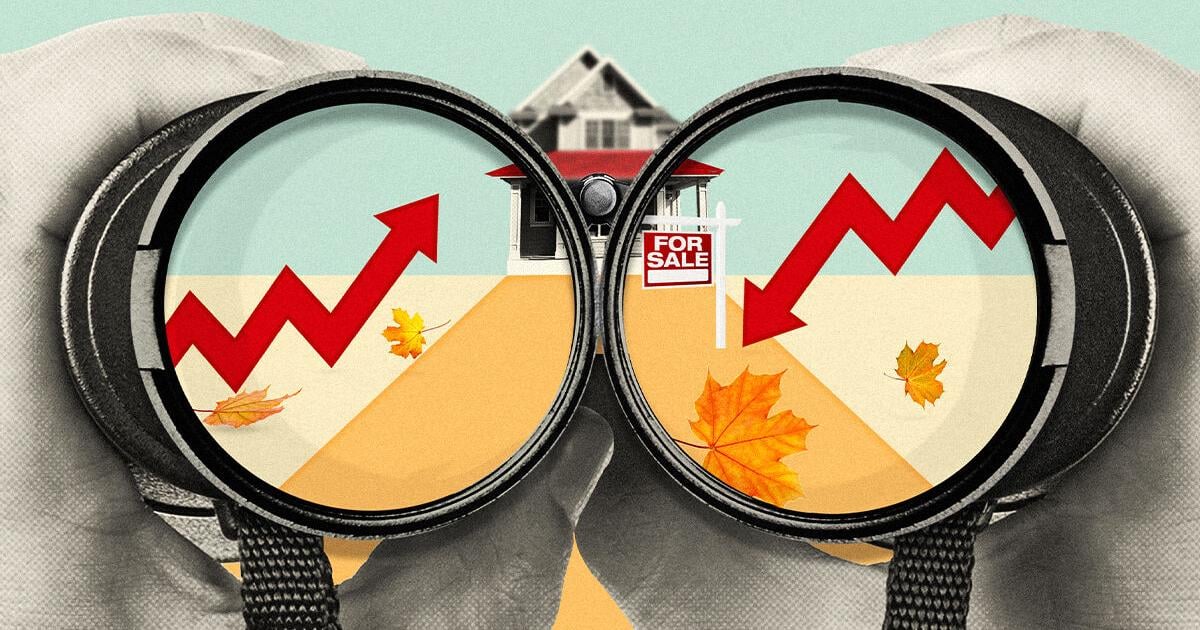
Some experts are optimistic, predicting an increase in sales, continued tightening in the market, and only modest price drops. Others are more cautious.
One thing they all agree on is that the rising tension between Canada and the U.S. is a wild card hanging over the sector.
The industry is watching sellers to see if they get jittery, and the continuing wave of mortgage renewals at higher rates that could push more listings into the space.
Meanwhile, buyers still have plenty of choice and the average sales price has dropped below $1 million, according to August data from the Toronto Regional Real Estate Board (TRREB).
But they may stay on the sidelines anyway, either hoping for prices to fall further or, especially in the case of first-time homebuyers, because they have been spooked by the uncertainty.
“Who could have predicted Lake America? Or 50 per cent tariffs?” said Phil Soper, president and CEO of Royal LePage. “Trump 2.0 has been the major drag on residential real estate activity since he took office again.”
Otherwise, he said market fundamentals like interest rates and employment have pointed to a “steady, healthy recovery after the pandemic correction.”
Small price drops predicted
The market is coming off a slow summer, returning to a more balanced market in August, with new listings down from the same time last year, according to data from TRREB. Prices were also down over the same period, along with sales.
Royal LePage’s fall forecast predicts a two per cent drop in home prices in the Greater Toronto Area by the end of the year, compared to the same period in 2025. Soper said while condos continue to drag the market down, that’s an improvement from more extreme price drops over the last couple of years.
He also predicts sales will increase.
Re/Max’s 2026 Housing Market Outlook predicts a 3.5 per cent drop year-over-year for Toronto, and a five per cent increase in sales, pointing to a buyers’ or balanced market.
“We’re starting to see evidence the market is finally turning around,” said Robert Hogue, assistant chief economist for Royal Bank of Canada (RBC), in an email.
July marked the second straight monthly rise in the benchmark price, the longest stretch of appreciation since the start of 2024, in the Toronto region, he added. (RBC’s housing reports use the MLS Home Price Index, an estimate of price that is supposed to be less volatile than the average or median.)
“Still, the market isn’t out of the woods yet,” Hogue cautioned.
“Abundant inventory is poised to keep condo prices on a downward trajectory for a while longer,” he added.
The Trump effect on the market
In August, trade talks between Prime Minister Mark Carney and Trump collapsed. The U.S. is imposing 50 per cent tariffs on a range of exports and Canada has hit back with planned counter-tariffs.
Hogue said much will depend on the length of time tariffs are in place, Canada’s response, and the broader impact on the labour market and consumer confidence.
“But the trade war escalation does heighten downside risk to our economy and housing market.”
Otherwise, he said RBC expects a “gradual but uneven recovery,” provided there aren’t further major shocks to the economy.
Buyers are now overwhelmingly purchasing homes to live in, not as investment properties, said Tom Storey, a sales representative at Royal LePage.
“Upsizers, downsizers, even just people who have been renting for a long time that have noticed prices have dropped and are now qualifying for what they might want, that’s the market right now.”
But Soper said first-time buyers have had a “real crisis of confidence.” A home is probably the biggest purchase of their lives and it’s scary to take the plunge when they’re worried about their job or the economy in general.
Some of it is related to the AI boom and fears about how that will impact young people’s careers.
However, he says he believes the big drag on buyer enthusiasm “had nothing to do with actual economics and everything to do with the bombastic president in the White House.”
Up until a few weeks ago, he said people were hearing “so much erratic behaviour from Donald Trump that you start to tune it out.” But now, for buyers and sellers, “it’s back to being a significant determinant of whether people will get off the fence or not.”
To list or wait?
Brittany Kostov, the senior director of sales and industry relations officer for real estate company Zoocasa, said there are a few things worth watching this fall. One question she says will be a big determinant of how the market goes: “Are listings going to return after Labour Day?”
Another thing to look for is “sales momentum,” Kostov said. There was growth in sales in the region in spring and early summer, and slow sales in August are to be expected for the season, she said.
Both she and Storey say they feel the trade war will have an impact on the fall market.
Even before the most recent news cycle, Storey was seeing some owners decide they just couldn’t stomach a sale.
Since the market peak in February 2022, prices have dropped across the Greater Toronto Area by about 25 per cent, according to numbers from the Toronto Regional Real Estate Board. Those that bought around the peak, especially condo owners, are facing losses.
“We’ve had quite a few people that have become accidental landlords,” Storey said. These are individuals who would have sold a condo and moved on to a bigger property, but are instead leasing it, while buying their next place.
“Not everyone’s in that position,” Storey said. It’s a lot to carry a mortgage on two properties, and qualify for them. But those who can afford it are planning to wait three to five years to see if the condo market rebounds.
“When you look at the inventory numbers and new listings, you clearly see seller fatigue,” Soper said.
Some just decide to get by with the home they have. Others are waiting until the value rises to sell, but he cautions for move-up buyers that this may not be a great strategy because the next, bigger home they purchase will also be more expensive.
‘No guarantee’ of a rebound
Thirty-five-year-old Diana Pegoraro found herself outgrowing the one-bedroom condo she bought on Toronto’s waterfront in 2020, and had to decide whether to sell at a loss to buy a bigger home or wait out a down market.
“It was a lot of back and forth consideration,” said Pegoraro, who ultimately listed her roughly 670-square-foot condo in mid-July.
She said she didn’t want the risk and responsibility of taking on a tenant. Ultimately, she felt her desire to continue growing and move to a different neighbourhood outweighed selling at a loss, which she could weather financially.
But Pegoraro faced an uphill battle, with a smaller buyer pool willing to pay less. She hoped her condo’s stunning view of Lake Ontario would help set it apart. Over about a month, her corner unit, which had large windows and overlooked a park, got plenty of showings. It even netted a few offers.
But most of them were “lowball,” she said.
Eventually, she got an offer with a loss she felt she could absorb — selling in mid-August for about $50,000 less than what she bought it for.
She’s purchased a larger one in a High Park building, for less than what she would have at the market peak, and feels she made the right decision — although she also found everyone had an opinion about what she should do.
“People said, you know, ‘the market may rebound in a few years,’’’ she said. “But there’s also no guarantee of that.”
Mortgage renewals keep coming
One other factor that’s still at play is that the last of the pandemic-era ultralow five-year fixed-rate mortgages will come up for renewal over the next year. This means some people will be in for much higher monthly costs at today’s rates.
A recent Royal LePage survey found that 39 per cent of respondents renewing a mortgage in Toronto felt more anxious than they did at their last renewal.
Jonathan Alphonso, principal broker at Mortgage Broker Store, meets people who face some of the worst situations in the housing market when they are trying to renew and may not be able to make the higher payments work.
He said April saw a record-breaking number of powers of sale, where a lender takes over and sells a property because the owner has defaulted on their loan. Since then, powers of sale have been steady (he keeps statistics on them by compiling data from listings).
Some homeowners are selling to get ahead of a forced sale, because they know they can’t keep up with payments at a higher interest rate.
But many are holding on, “scraping and saving,” however they can.
“They’re certainly not talking about upgrading their house or doing anything like that. If anything, they might be downgrading from a larger house to a condo,” he said.
Alphonso thinks that prices will continue to “grind down” slowly.
“I don’t think there’s going to be any large spikes in terms of power of sale or upward or downward prices,” he said.
Error! Sorry, there was an error processing your request.
There was a problem with the recaptcha. Please try again.
You may unsubscribe at any time. By signing up, you agree to our terms of use and privacy policy. This site is protected by reCAPTCHA and the Google privacy policy and terms of service apply.
Want more of the latest from us? Sign up for more at our newsletter page.