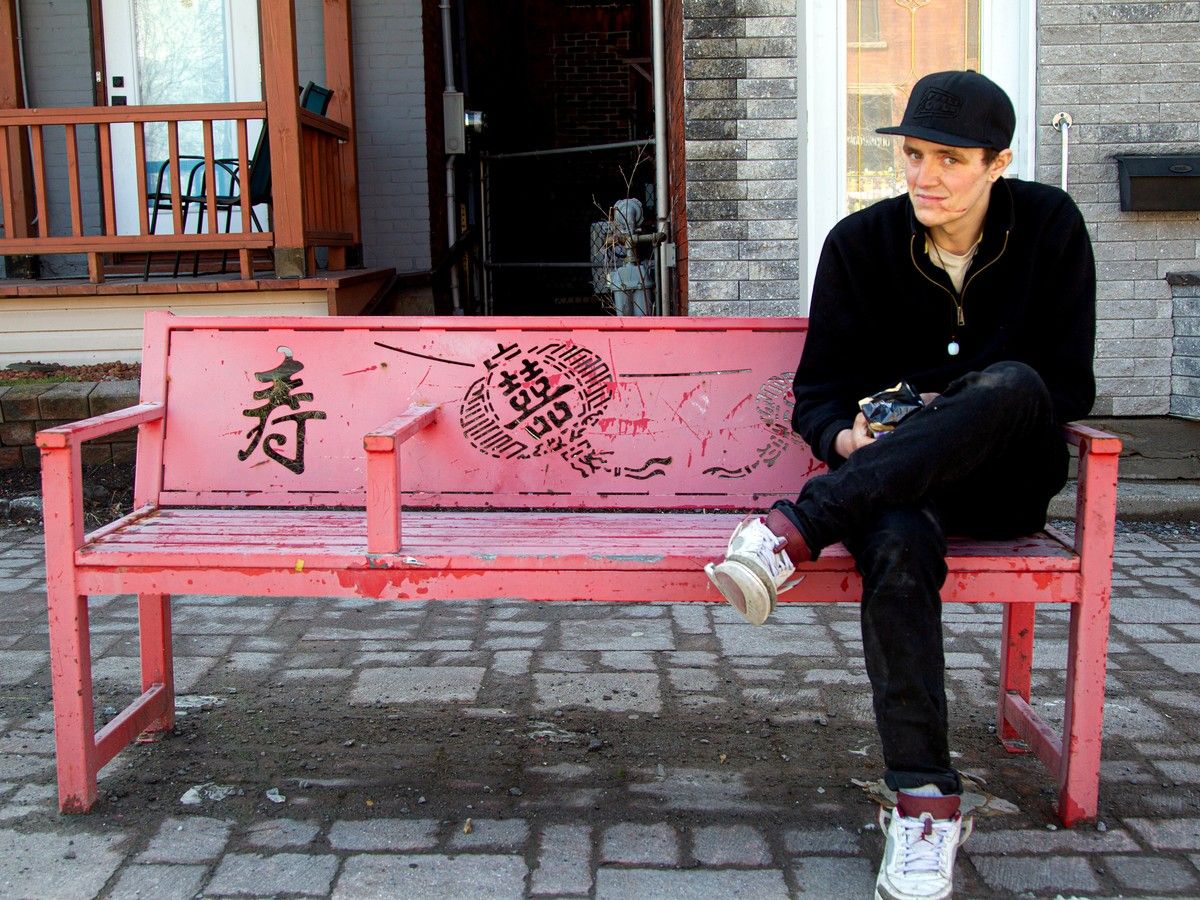
Ottawa residents who feel they see too much of the problem in their neighbourhood now are due for a surprise next month.
Fifteen minutes into our conversation, Joey MacRae-Chiaralli’s hands begin to shake.
He’s in withdrawal — “dope sick,” he says — and due for a dose of the Dilaudid he picked up moments earlier at a Chinatown dispensary. But he badly wants to finish our conversation sober.
Joey is 31, quick-witted and eager to talk. He says he only recently started reading newspapers again and seems genuinely pleased that someone wants to hear his story.

He grew up in Beaverbrook, in Kanata, attending Georges Vanier Elementary and All Saints High School. He says he was finally expelled on the first day of Grade 12 after having racked up, by his count, 367 absences.

The Evening Citizen
By then he was well-acquainted with opioids — he started taking them when he was 12 — and lists them, along with alcohol, cocaine and Xanax, as some of the substances he’s been addicted to at one time or another.
He’s been homeless for a little more than a decade now, notwithstanding the handful of times he called the Ottawa-Carleton Detention Centre home following incidents of theft, assault, obstruction and what he refers to as “breach” — typically a failure to adhere to a court order. His face bears a scar from a knife fight. He says he’s overdosed more times than he can count: Just three or four days before we met, he says, residents found him unconscious and purple beside a nearby apartment building.
“They told me I was dead,” he recalls.
“Waking up and hearing that — talk about shell shock.”
Listening to Joey, it’s easy to imagine everyone who has given up on him.
Encouragingly, he isn’t among them. He’s still planning a future.
A year or two after his expulsion from high school, he went to St. Nicholas Adult High School, where he says he graduated with honours. He talks about wanting to study English one day — maybe even travel and teach it.
More immediately, he says he’s found supportive housing through Salus, an organization that provides stable housing for adults with mental and substance-use health challenges. Joey expects to move in within a couple of weeks.
“That’s going to be a huge stepping stone for me,” he says.
“Hopefully from there, I’m going to maybe cross the pond and get over to see Europe.”
And the opioids? He’s hoping that, with prescribed methadone, Dilaudid and Kadian, he can kick the street drugs.
“As I get older, I’m putting two and two together and being like, maybe I should really smarten up,” he says. “I kicked alcoholism on my own, cold turkey. That was hell on Earth. I cannot imagine what it’s going to be like to put this shit behind me.”
Beyond that, perhaps some fences can even be mended. He describes his relationship with his mother these days as at “arm’s-length,” yet a good deal closer than his rapport with his father.
“I haven’t spoken to my father in years,” he says. “I know he more than likely still has a lot of love for me, but I would like to know what he’s up to.
“Other than that, there’s not much else right now,” he says. “I’m just kind of making my way through all this and trying to see what my next step is.”
Joey is one reason supervised consumption sites exist.
He is also one reason they’ve become so fiercely debated.
For years, Somerset West Community Health Centre on Eccles Street operated one of Ottawa’s Consumption and Treatment Services (or CTS) sites, where people could use pre-obtained drugs under medical supervision, reducing the risk of fatal overdose and often creating pathways to treatment, housing and care.
In March 2025, the province forced Somerset West to close its CTS program under legislation banning such sites near schools and child-care centres. More recently, Ontario announced that its remaining sites would also shut, including Ottawa’s largest, known as The Trailer, at the Shepherds of Good Hope on Murray Street.
To supporters, these sites save lives. To critics, they encourage disorder in neighbourhoods already under strain.
Around Eccles Street, nearly everyone agrees on one thing: There is a crisis.
What they disagree on is where exactly it comes from — and what should be done about it.
When the province announced in August 2024 that Somerset West’s CTS site would close, I walked around the neighbourhood to ask residents how they felt about the decision. They were pretty divided. Some felt that the CTS site’s closure would only lead to more visible and open use. Others hoped that by ending the program at Somerset West, the people it served would leave.
If the past year is any gauge, Ottawa residents who feel they see too much of the problem in their neighbourhood now are due for a surprise next month when the remaining CTS sites shutter.
It’s uncharacteristically warm for a mid-April morning, as the streets and sidewalks around Somerset West Community Health Centre have come to life. Some residents are out on their porches or stoops, taking in the sunshine, chatting with neighbours. Others stand on the sidewalk as they await Uber rides. Clients and staff at the health centre come and go. Parents walk their youngsters to school. Passers-by pass by.
About a dozen people are already gathered under a tree beside a short cinder block wall by the entrance to Somerset West’s rear parking lot, off Booth Street. The tree is bare now, but will, in time, provide some welcome shade for many people with nowhere better to go. On this morning, one of them is injecting a needle into his arm. Another is smoking a crack pipe. Others smoke cigarettes. Some are talking loudly. Another is standing, bent over, seemingly unable to move. I catch Joey’s eye in the crowd. It’s been about 30 minutes since we spoke on Somerset Street; he looks calmer, I think, as we exchange waves.
Far less calm is a man on the health centre’s front lawn a couple dozen metres away. He is hunched over and talking loudly to himself as he circles a stop sign, occasionally pounding it with his fist. I initially think him quite burly, but as he removes layer after layer of winter attire, I realize he is actually quite slim.
Across Booth Street, Shelby — she would only tell me her first name — watches from in front of the Cornerstone housing building where she lives. She’s not seeing anything she hasn’t before. She’s 58 now and had a front-row seat since moving here three years ago. She’s heard the ambulances, listened to the arguments arise and subside, and seen men and women slumped on the sidewalk or against a wall. On numerous occasions, she’s alerted Cornerstone staff — who carry naloxone to reverse opioid overdoses. At other times she’s called 911 herself.
“You learn the difference between someone sleeping and someone in trouble,” she says.
You learn, too, that neighbourhood decline rarely arrives from a single cause.
In the past year, Shelby says, things have felt rougher. But the reasons behind that are difficult to pin down. Shelby lays at least some of the blame on the fact that Somerset West’s CTS site was closed.
“It’s discouraging that they stopped this program because people are just left on their own,” she says. “They took it away, and they left everybody else in the community with a problem that there’s not really a solution to.
“The number of people in the street hasn’t changed,” she adds. “It’s just happening a lot more, and more spread out.”
This shouldn’t be surprising; it’s the most predictable outcome of closing CTS sites. If people who consume drugs safely indoors have that option removed, they’re not going to stop. They’ll simply take it outside. That’s what Chinatown residents like Shelby are seeing.
But the closure of Somerset West’s supervised consumption program — it subsequently applied for and received provincial funding to operate as a HART Hub, a model focused on treatment, primary care and social supports rather than supervised consumption — is only one factor.
Many residents blame other services, most notably New Dawn Medical, a nearby safer-supply provider that prescribes pharmaceutical opioids to eligible clients — including Joey — as an alternative to street fentanyl. It’s a model praised by harm-reduction advocates but criticized by some neighbours who say the medications are being diverted — with recipients selling them to get money for other, stronger drugs — or contribute to street disorder.
Meanwhile, more people are struggling for other reasons, including a far more toxic drug supply, homelessness, and simply generally worsening economic conditions.
“Something changed,” says Shelby. “You can feel it.”
Catherine Boucher, president of the Dalhousie Community Association, agrees.
Boucher recognizes that many area residents opposed the CTS site when it opened in 2018, but says the disorder on the streets has worsened in the past year.
“I find it hard to believe that someone would say, ‘I feel much safer now that the safe consumption site is gone,’” she says.
She recognizes, too, the multifold causes behind the street disorder, noting that it cannot be understood without recognizing how dramatically the illicit drug supply has changed. Today’s substances, she says, are so potent and destabilizing that many users who might appear indifferent to their surroundings while intoxicated are actually incapable of engaging with them. There are more overdoses, yes, but also more people in heavily tranquilized states.
I see that, too, outside Somerset West. One young woman appears almost as motionless as a “human statue” street performer, but seemingly unable or unwilling to escape her trance. She is completely checked out, I think.
“It’s not that they don’t care,” Boucher says. “It’s that they can’t care.”
For residents, though, the precise mix that goes into the disorder matters less than the overall result. “You don’t have to know exactly which system failed,” says Boucher. “You know when several of them are failing at once.
“It’s become way worse,” she adds. “It’s pushed things further into the neighbourhood because there’s no supervised consumption site. Now it’s just everywhere.”
Police figures suggest that at least part of what residents are feeling is real: reported crime in the immediate area rose about 23 per cent in the year after the CTS site closed. But that figure comes with caveats. Reported incidents had already been climbing before the closure, and increases in theft and disorder have been seen more broadly across Ottawa in recent years.
Another figure illustrates some of the social disorder that isn’t captured by police data. Needle Hunters, the volunteer organization that collects discarded needles and other drug paraphernalia from city streets and parks, reported finding 783 needles and pipes just at the intersection of Booth and Eccles in 2024. Last year, that figure jumped to 1,148, an increase of almost 50 per cent.
But even that tells only part of the story. Go back further in the Needle Hunters data and the trend resists a simple explanation — up one year, down the next, more a roller coaster than a steady climb. It doesn’t point to a single cause.
What it does show is the scale of the problem: more than 5,400 needles and pipes collected at just one intersection over the past five years.
That is a number residents are living with, and being worn down by.
Sheri Arnott has lived on Eccles Street for 30 years — long enough to know its virtues and problems. She’s not pining for some imagined golden age; the neighbourhood has always had its rough edges, she says.
She has supported supervised consumption from the beginning.
“People are dying from toxic drugs,” she says. “This is an intervention that saves lives.”
What has altered her view was not the goal, but rather its execution.
“The health intervention was well managed,” she says. “The community aspect of it was poorly managed.”
She recalls the first used needle she found in her yard after the CTS site opened. She describes the garbage that accumulates that no one does anything about, the open drug use, the chaos. On a recent Monday, while crossing Booth Street on her way to the Plant Recreation Centre, she had to jump out of the way of a street fight. On Wednesday and Thursday of the same week, she called 911 three times to respond to separate overdoses.
She is sympathetic with the people at the centre of the crisis and careful not to reduce them to stereotypes. Many of the longtime rooming-house tenants living across the street from her, she says, are decent neighbours who have endured addiction, poverty, trauma and instability themselves. But the disorder over the past year has been destabilizing even for them.
“It’s a great neighbourhood that’s always had these issues,” she says. “But I’ve never seen the kind of stuff that we’re having now.”
She says she’s recently had to wrestle with what she jokingly calls her “lefty side” — her instinct to support compassionate policies — while simultaneously trying to reconcile how she and her neighbours feel forced to deal with the fallout of its failures on their own.
She still believes in compassion, public health and helping vulnerable people. What she has less time for are the different layers of officialdom avoiding responsibility for what’s happening on the street. “Everybody,” she says, “passes the ball.”
She also rejects the idea that residents must choose between compassion and order. “This should be done in a way that’s not punching down.”
People at the centre of the crisis should not be ignored, she insists, but neither should the community members shouldering the worst of its effects.
Right now, she says, it feels like both are being abandoned.
When Ontario announced the closure of CTS sites, it did so over the objections of many public-health experts, clinicians and harm-reduction advocates who argued that such sites remain an evidence-based tool for preventing overdose deaths while connecting people to such supports as treatment, housing and primary care.
Canada’s approach to problematic substance use has for years been built on four pillars: prevention, treatment, enforcement and harm reduction. Supervised consumption falls under the last category. It’s not a cure, but rather a way to prevent fatalities before someone is ready or able to seek help.
Treatment is essential. The province appears to be focusing on Homeless and Addiction Recovery Treatment, or HART, hubs: one opened at Somerset West following the closure of its CTS site. But the two aren’t interchangeable or competing models. They’re for people at different stages of the crisis. Ontario’s policy shift elevated one pillar — treatment — at the cost of another.
“We have completely eroded the pillar of harm reduction,” says Michelle Hurtubise, executive director of the Centretown Community Health Centre. “We haven’t invested in the pillar of treatment, because we don’t have good programs that respond to the kinds of addictions and drugs that we are seeing now.”
Part of the solution in treatment is safer supply, she notes, which has eroded alongside the province’s de-emphasis on harm reduction. She adds that prevention is also being curtailed.
But she points to the one pillar she says is getting a huge investment: enforcement.
Suzanne Obiorah, executive director of Somerset West, describes the shift more succinctly: “We’ve moved from supervised consumption services to unsupervised consumption services in our community.”
That single sentence explains much of what residents are describing. Drug use that once happened indoors under supervision now occurs outside. It has become more visible, more spread out and more dangerous for the people consuming drugs.
“Safety includes stability, safety includes predictability,” she says. “Safety includes having the resources needed to respond to any threat in our community.”
Some of the visible disorder people are now seeing, she argues, intensified because people lost a safer indoor option.
Before it closed, staff at Somerset West reversed 492 overdoses in the program’s final year and made more than 7,000 referrals for housing, counselling, addictions treatment and other supports.
Hurtubise says activity around Centretown Community Health Centre, about a dozen blocks from Somerset West, increased significantly after the latter’s CTS site was closed. Centretown is not a CTS site, but offers harm-reduction services such as a needle exchange and other supplies, drawing people who use substances. The overhang outside the centre’s Cooper Street building, along with a nearby parking garage, has become a sheltered gathering place.
As a result, Hurtubise says, the centre hired four additional community support workers.
“That’s not anything I have funding for,” she says.
She adds that the ANCHOR program — a community-wide crisis response team created to respond to mental-health and substance-use emergencies with health workers rather than police when appropriate — has also seen a significant increase in calls related to substance use since Somerset West’s CTS site closed.
One reason Somerset West was chosen as a CTS site in the first place was the level of need that already existed in the surrounding neighbourhood.
In other words, the site did not create the problem; the crisis created the site.
“There has been a historical presence of substance-use challenges, mental-health challenges and housing-precarity challenges in this community,” says Obiorah.
“There are varying opinions around consumption and treatment services,” she adds. “I think what is common amongst everyone that we speak to is wanting to feel safe in their community.
“It’s really important that the definition of safety holds everyone and all the challenges that we’re experiencing.”
Both she and Hurtubise caution against treating crime as a single-issue story. Assaults, thefts and disorder are shaped by poverty, housing instability, untreated illness, a poisoned drug supply, policing patterns and broader economic factors. Blaming it on one address, as the province did when it announced the closure of Somerset West’s CTS site, might make a tidy soundbite for the six o’clock news, but it’s a poor explanation for a crisis built on many causes and years of neglect.
Outside Somerset West, the man who had been circling the stop sign and peeling off layers of clothing is now getting a talking-to from Johnny Noir — who, in this street drama, has something of the role of a Greek chorus: part participant, part observer.
He’s 58, uses substances, speaks rapidly and has opinions on nearly everything. I mention that he seemed to be talking the agitated man off the ledge.
“Yeah,” he says. “Or pushing him off it.”
He explains that, like jail, life on the street has its own codes of behaviour. Ignore them, he says, and someone will eventually enforce them. What he was trying to tell the man was simple: You can’t act this way.
“Nobody wants that attention,” he says.
Whether or not the warning in this case had much effect, the exchange suggests something often missed in debates about disorder: many of the people living within the chaos dislike it, too.
The impression is echoed by Joey MacRae-Chiaralli.
“This is chaos, right?” he says. “I can only imagine what it’s like for some of the residents here — just absolutely blowing their minds. It’s just ridiculous.”
Neither MacRae-Chiaralli nor Johnny Noir have the answer, although both told me independently that they wish there was somewhere in Ottawa, away from children and schools, where they could safely consume substances.
Johnny is torn between opposite sides of the same coin: “There’s a fine line between enabling and support and encouragement,” he says. “But now that it didn’t work on the first run, they’re going to get rid of the whole thing and do nothing. You just f—-ing give people a bunch of ammunition, enable them by not being resourceful. and then pull the rug?”
He also doesn’t see the situation improving anytime soon. He looks at the warm spring weather as a harbinger of more people outside, more visible use and more tension.
“Today marks the first day of a crescendoing hell with the weather, I’m telling you. And I’ve been telling them, this will not last til June. I don’t have the answer, but I do know you don’t shut these places down and leave them walking around the street in the summertime.”
Johnny Noir doesn’t believe the province was caught off-guard by the added turmoil on the street. Rather, he believes it’s a form of organized abandonment, and suggests that if things are simply left to get bad enough, any action the government takes will be welcomed by an exhausted public.
He motions to the growing congregation of users outside Somerset West, in public view. It’s the predictable result, he says, of closing the CTS site without solving the problem.
“This,” he says, “was meant to happen.”
On June 14, 2026, there will still be plenty of people in Ottawa dependent on drugs, overdosing and desperately seeking help. Of that I am certain.
They just won’t be doing it at The Trailer — the city’s largest supervised consumption site.
Rob Boyd, the executive director of Ottawa Inner City Health — which operates The Trailer at the Shepherds of Good Hope — estimates it helps 850 unique clients a year, and last year treated nearly 900 overdoses, all within about 200 metres of the site. Depending on the season, The Trailer serves between 600 and 1,000 clients each week. That is, until June 13 when it’s mandated to close by the province.
And that’s when Ottawa will see what CTS site closures across the city looks like on a larger scale.
Where will everyone go? Some will use in parks and washrooms. Some will use alone. I recently walked past a disused OC Transpo bus shelter on Somerset Street West beside the Plant Recreation Centre with a professional-looking sign affixed to the glass that read: “Douglas R. Ford commemorative unsupervised consumption site.”
It’s clearly meant as a jab at the Premier and his government’s drug policies, but it’s also an argument: Closing indoor supervised consumption sites won’t solve anything.
The problem, Boyd argues, is larger and older than any one program: chronic homelessness, untreated mental illness, trauma, poverty and the toxic drug supply.
When supervised sites opened, he says, the main concern was preventing overdose deaths. But the drug supply changed and users required more frequent hits and became more cognitively impaired. The crisis, he says, worsened faster than the response could keep up, with CTS sites bound by funding models and provincial mandates that left them little room to adapt.
“We were set up to fail,” he insists.
After The Trailer closes in June, some users will overdose with no one in sight to help them. Some of those will die. Others will survive only after oxygen deprivation leaves them with serious brain injury.
Emergency rooms, paramedics, shelters and police will be forced to deal with what the site previously contained.
According to a report released by the Substance Use Health Network in March, the number of EMS calls for opioid overdoses in Ontario, which had declined in the nine months leading up to last year’s CTS closures, increased by nearly 70 per cent in the six-month period after their closure.
Emergency department visits in Ontario for overdoses saw a similar trend, decreasing by 47 per cent in the nine months prior to the first CTS shutdown, followed by a 67 per cent increase after.
Meanwhile, the number of confirmed or probable opioid deaths in the province, which had seen a nearly 40 per cent drop in the year prior to the March 2025 closures, rose by nearly 20 per cent over the subsequent six months.
Boyd is skeptical that more treatment beds alone can change this trend.
Many of the people most visibly caught in addiction, he says, lack what clinicians call recovery capital — the ordinary supports that make recovery possible, that others take for granted: stable housing, relationships, routine, meaningful activity and hope.
Without those, treatment can become another revolving door. A person may detox and complete a program, and then return to the same street corner, the same desperation and loneliness, the same poisoned supply.
“Fundamentally,” says Boyd, “the problem is housing.”
But housing alone isn’t enough. “People are more likely to stop using drugs when good things happen to them rather than bad things,” says Boyd.
Which brings us back to Joey MacRae-Chiaralli.
I have no idea what leads a 12-year-old boy to try opioids. Trauma? Pain? Peer pressure? Simple curiosity? I’ve spoken to enough people, though, who for various reasons found themselves caught in similar whirlpools. All were well aware that their circumstances did not reflect the path they’d expected their lives to take, and each still had hope they’d find their way out.
I don’t want us to give up on Joey.
He talks of studying English, maybe teaching it, maybe travelling. Finally getting his own place. Maybe reconnecting with family.
These may sound like modest ambitions, but they’re the kind of good things that Boyd is talking about — the very things that recovery is built on. And they’re also the kinds of changes exhausted neighbours need.
The Citizen newsroom is proud to report important stories like this one. If you would like to support our work and help our team continue to tell longform, deeply-reported journalism, please consider purchasing a digital subscription. ottawacitizen.com/subscribe