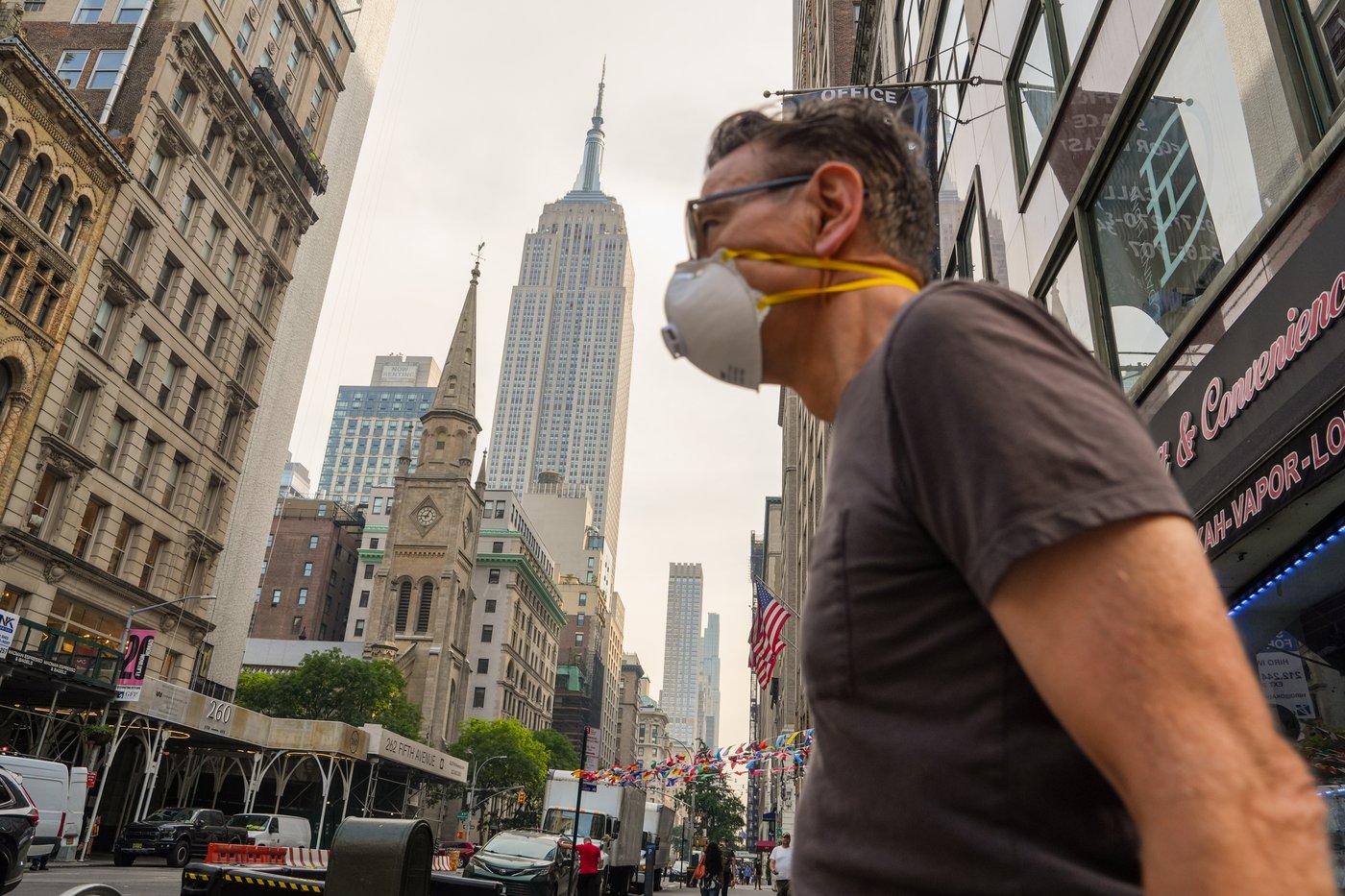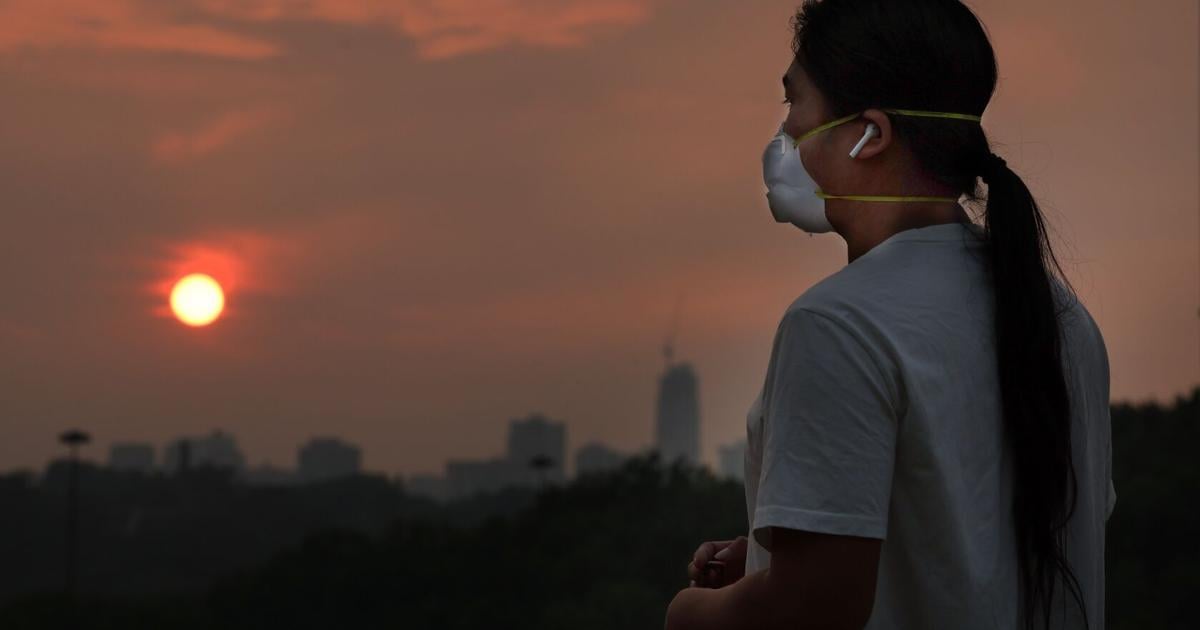
While the skies over Toronto are looking clearer as of Friday morning, Environment Canada still has an orange air quality warning in place, saying “there may be temporary improvement this afternoon however very poor air quality will return to all regions this evening,” and “everyone’s health is at risk.”
As of 9 a.m. Friday, exposure to the air for a 24-hour period carries roughly the same mortality risk as smoking 4.1 cigarettes, according to website How Many Smokes? The calculation is based on research by Berkeley Earth, which suggests breathing in 22 micrograms per cubic metre of fine particulate matter for 24 hours carries approximately the same mortality risk as smoking one cigarette.
In the short term, exposure to the smoke may cause eye and throat irritation, headaches, difficulty breathing, coughing and chest pain. Over time and after repeated exposures, the smoke could increase our risk of heart and cardiovascular disease, certain cancers, overall reduced lung function and potentially even developmental issues for children.
As smoke from wildfires in northwestern Ontario continue to drift across the province, experts urged people to stay indoors and avoid physical exertion outside if possible.
“At these very high levels, even well-ventilated, well-filtered buildings can have poor air quality,” said Greg Evans, director of the Southern Ontario Centre for Atmospheric Aerosol Research and a professor at the University of Toronto, on Thursday.
Many Torontonians are wondering how to stay safe amid the smoke, so we asked the experts. Here’s what they said.
Limit your time spent outdoors
As forests burn, they release great plumes of gases, water vapour and fine particulates into the air, which can travel thousands of kilometres from the site of the flames.
This smoke can contain dangerous chemicals including carbon monoxide, ammonia and ozone. But the vast majority of wildfire smoke, about 90 per cent of it, is composed of fine particulate matter smaller than the width of a human hair.
These particulates, known as PM2.5 (as they are less than 2.5 micrometres in diameter), are the main health risk of wildfire smoke. They’re so small that they can penetrate deep into lungs and even enter our bloodstream; from there, they can harm our heart, lungs and other organs, increasing our risk of heart attack, stroke and other illnesses.
The best way to protect yourself is to limit exposure time to the smoke, said Madeleine Orr, an assistant professor of kinesiology and sport ecology at U of T.
“The big thing is to limit how much air pollutant content you’re actually taking into your lungs,” she said. Orr recommended spending no more than two hours total outdoors per day, acknowledging this may not be possible for people who work outside.
She also advises avoiding heavy physical exercise outside. “Anything that would have you huffing and puffing would be something to avoid.
Some masks can help protect you from wildfire smoke, but not all
A well-fitted, high-quality mask, such as an N95 mask or respirator, can help in filtering out harmful PM2.5, said Jeffrey Siegel, a U of T professor who researches indoor air quality. However, not all masks are made the same.
“The fit is really important. Unfortunately, the blue surgical masks don’t really offer much of a benefit because the particles at issue are small enough to go through them, and especially around the gaps where they fit the face,” Siegel said.
Whether you need a mask or not depends on how much exposure you’ll have to smoke, Orr said. If you’re generally healthy and are going out for a 20-minute walk with your dog, “I’m not too concerned,” she said. But if you work outdoors all day, if you’re vulnerable to smoke or if you’re exerting yourself outside, “you probably should wear a mask.”
People especially vulnerable to smoke, like the elderly or those living with respiratory conditions like asthma or COPD, can consider masking up even when indoors, Evans said.
Close windows and doors — unless it’s extremely hot inside
There’s a bit of nuance to this recommendation. Usually, it’s a good idea to close your doors and windows to limit the amount of smoke getting inside. But this week’s smoke coincides with a heat wave in Toronto, and extreme heat indoors can be worse for you than smoke exposure, Siegel said.
If you don’t have air conditioning and feel you’ll overheat without cracking open a window, it might be worth the tradeoff in air quality. “It’s a real judgment call,” Siegel said. “Extreme heat is worse, but particles are really bad too. You’ve got to strike a balance.”
Keep your fan running
Even well-ventilated buildings are not immune to smoke; in fact, most buildings are only able to keep about half — 40 to 60 per cent — of outdoor air pollutants from coming inside.
If you are fortunate enough to have a central air cooling and heating system in your home, Evans recommends having the fans run continuously. “You’ll be making the best use of the filter that’s already in your own system, and those fans push through a lot of air.”
If possible, consider fitting your ventilation system with a MERV 11-rated air filter or better. MERV, or “minimum efficiency reporting values,” measures how efficiently a filter can capture particles; a MERV 13 to 15 rated filter is preferred, Siegel said.
Consult with a professional before doing so; if your ventilation system is old or too weak, a filter that’s too dense could overwhelm the system and lead to drops in pressure.
Invest in a portable air filter
If your home doesn’t have a quality air-filtration system, consider running a portable air filter, especially in crowded spaces or in areas where susceptible people are. The Star has outlined how to make an affordable DIY filter using a fan, air filters, duct tape and cardboard.
“The portable filters are fantastic,” Evans said. “They’re in fact, in some ways, better than central filters because you can locally clean a space quite well. You can pick your bedroom or your living room or whatever is your sanctuary and run portable filters there.”
If you’re looking to buy a filter, look for a device certified by the Association of Home Appliance Manufacturers (AHAM), according to Health Canada.
Set your car’s ventilation to “recirculate”
If you’re driving while the air quality is bad, Evans advises setting the ventilation system to recirculate air “so you’re not bringing in outside air.”
To shower after going outside or not?
A dermatologist previously told the Star that the harmful particles and chemicals within smoke can irritate and damage the skin, especially those with sensitive skin, allergies or conditions such as eczema or rosacea.
Some social media posts recommend showering after being outside in the smoky air, to remove particles from the skin. Evans said the main concern with smoke is inhalation, not its impact on our skin, so showering isn’t necessary. But Orr said if you’re spending a good deal of time outside, “that’s not a bad idea.
“It takes quite a lot of exposure time to accumulate anything that would really be deleterious, unless you’re in a situation where you’re experiencing a prolonged period of smoke and it’s on your skin all the time,” Orr said. “If it’s one day of bad weather, it’s probably not enough to hurt you.”