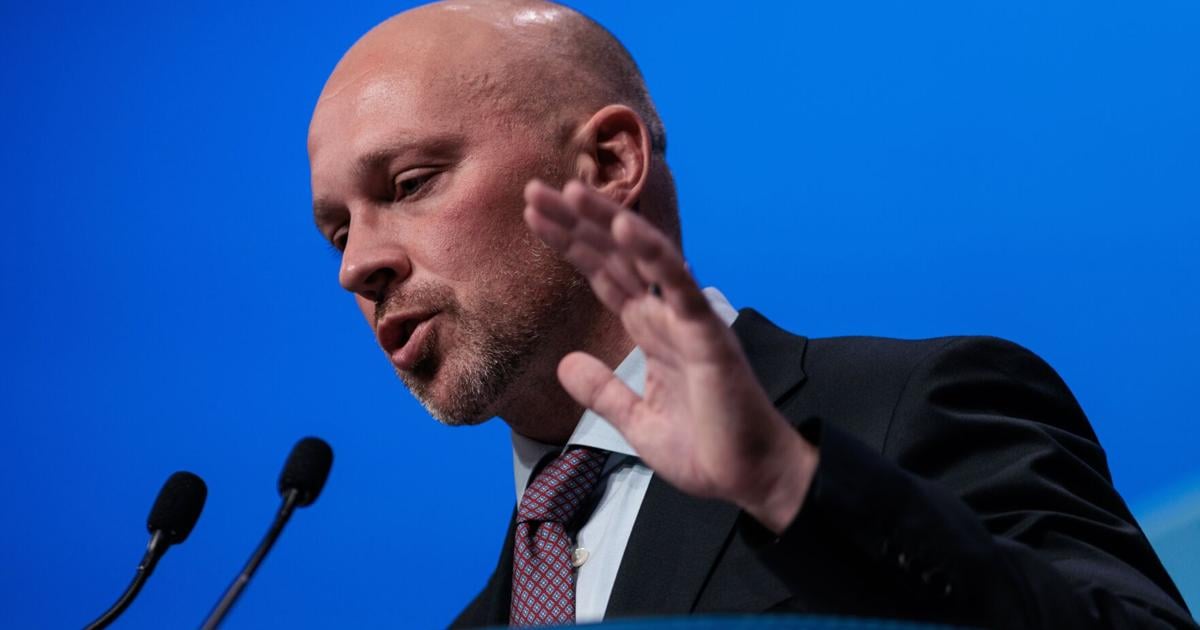
Brad Bradford believes there’s untapped wealth hiding in city coffers. He’s relying on it, in fact, as he advances a campaign that’s promising a line-by-line budget review and a number of pricey promises.
The councillor for Beaches—East York argues that a detailed, external examination of the city’s finances is long overdue, and predicts it will uncover major savings that will help pay for his campaign promises — including costly proposals for the police and TTC — while he limits new revenue through a property tax freeze in his first year.
Bradford’s promised review is raising the spectre of the last time Toronto conducted a similar exercise. That review, under then-mayor Rob Ford, led to uproar at city hall over proposed service cuts, and didn’t deliver the promised savings. And the official who was in charge of the effort 15 years ago cautions that given Toronto’s financial needs, any mayor who repeats the review next term shouldn’t use the money it might turn up to pay for tax holidays or new proposals.
At a press conference this week in the driveway of the rental home of a North York couple, Bradford accused Chow of being unwilling to do the “hard work” of finding savings during her three years in office.
“For NDP Mayor Chow, it is just so much easier to raise everybody’s taxes,” he said.
The mayor, a former New Democrat MP, has raised rates by more than 18 percentage points over her term, including a record 9.5 per cent in 2024, adding $683 to the average bill since 2023. Bradford said renters and owners alike feel the pinch because landlords pass on higher costs to their tenants, and his plan for a one-year tax freeze, which he announced at Tuesday’s mayoral debate, would “provide immediate affordability relief.” If elected Oct. 26, he promised to keep increases during the remainder of his four-year term below the rate of inflation.
Mayoral candidate Chris Alexander, who is polling in third, has also promised to freeze property taxes in his first year and keep them below inflation afterward. “Property taxes have been skyrocketing, while new housing goes unbuilt and services continue to disappoint,” he said in a statement.
The mayor has argued she had to raise taxes early in her term to fix the financial “mess” she inherited, but that she’s implemented policies to prevent vulnerable renters from being affected. She has promised that if re-elected she would keep increases “at or around” inflation.
Asked about Bradford’s financial proposals this week, Chow charged they would return Toronto to “the bad old days of cut-slash-burn public service.”
Councillor has made expensive promises
Bradford has made several proposals that would swell Toronto’s budget.
They include hiring 1,000 new front-line police officers at an estimated cost of at least $140 million a year, and installing platform-edge doors at “priority” subway stations, at up to $55 million per station. He has also proposed refunds for late TTC service, which city staff pegged at upwards of $50 million in operating costs and as much as $30 million in capital spending.
Asked Wednesday how he would pay for those ideas without raising taxes, he said the money would come from sources such as higher tax revenues through assessment roll growth caused by new developments, other levels of government, and more accurate predictions about yearly spending.
Some of the funding would also come from his proposed spending review, which would “go through every division, every agency, every program line by line.”
Under Chow’s administration, “nobody can tell you where the money went. Nobody’s looked,” he said.
City routinely conducts spending reviews
While Bradford claimed during Tuesday’s debate that the city hadn’t performed a line-by-line budget review since 2011, according to municipal finance documents, such reviews are conducted regularly, and yielded between $78 million and $180 million in spending reductions each year since Chow took office. The mayor says that this year alone the internal review and other measures found more than $700 million in savings and cost avoidance.
The councillor has dismissed savings from the city review as “fictitious.” He said they were the result of bureaucrats asking for less money than they initially planned, and didn’t represent actual spending reductions.
The new audit Bradford is proposing would be modelled on the core services review Toronto last performed a decade-and-a-half ago under Ford. Led by consultant firm KPMG, it was intended to determine which programs the municipality should be providing, and at what service levels.
Although Ford predicted it would find vast amounts of wasteful spending, the study determined that 90 per cent of services the city provided were considered “core.” It identified “opportunities” to eliminate, off-load or reduce services, including cuts to public libraries, overnight TTC bus service, child care, housing, snow removal standards — and even closing or selling Toronto’s zoos, Riverdale Farm and some museums.
Budget review in 2011 caused wild scenes at city hall
The KPMG recommendations were deeply unpopular with many residents, and in July 2011 dozens showed up at city hall to make speeches against them in what turned into a caffeine-fueled 22-hour meeting of Ford’s executive filled with pleas, tears, yelling and cheering (some residents wore pyjamas). Ford and council ultimately didn’t adopt most of the proposed cuts, and the city auditor general later determined the review resulted in about $16 million in savings, a fraction of the city’s multibillion-dollar budget.
Sean Meagher, who gave a deputation at the 2011 meeting and is now executive director at advocacy non-profit The Change Lab, recalled that the residents speeches “were incredibly stirring,” particularly a 14-year-old from Scarborough who “broke down and wept” over the idea of her local library closing.
“I just don’t understand why anybody would go back to this worn-out idea when it is so clear that we cannot cut ourselves to effectiveness,” Meagher said of Bradford’s plan.
Bradford says he wouldn’t support service cuts
In a press release, Chow’s campaign said Bradford was proposing a “Rob Ford-style” review that would take the city “backwards to the years of deep cuts.”
She rejected Bradford’s call for an external review, telling reporters it would mean the city paying an expensive consultant “to tell us things that we already know,” such as that it would be cheaper for the city to operate fewer long-term-care homes, which was a finding of the KPMG report.
“That’s not where I want to go. I certainly hope that is not what Coun. Bradford is suggesting,” she said, raising the prospect of shuttered seniors homes.
Bradford stressed that he wouldn’t support the unpopular cuts proposed by the 2011 service review.
“No, of course not,” he told reporters this week. But he insisted his review, which would be conducted by outside experts and former city leaders, could find more palatable sources of savings because city spending has changed over the past 15 years.
“We’re gonna protect the front-line services that people count on. We’re going to find the waste that exists,” he said.
A warning from a former city manager
Joe Pennachetti, who was Toronto city manager from 2008 to 2015 and led the 2011 core service review, said the original exercise was worthwhile and an updated version could be helpful.
“It’s definitely time for an independent review of city services and costs,” he said in an interview.
But according to Pennachetti, if a review conducted in the next mayoral term did turn up savings, the money should be put toward vital existing programs that aren’t getting enough funding. He said that includes policing, but also transit and housing.
“It is critical for any mayor to prioritize core underfunded services … and any savings should be reallocated towards those, rather than to fund tax freezes or new services,” he said.
Pennachetti warned that pausing increases to property taxes, the main source of city revenue, would have a negative effect on programs residents rely on.
“You can’t run any city by freezing taxes, because you fall behind in providing key city services,” he said.