When she was asked for advice by younger actors about performing at the Festival Theatre in Stratford, Ont., with its famous thrust stage that cradles its audience, Martha Henry, the late Canadian First Lady of Shakespeare, would proffer this: “If you fully understand why you’re there, what you’re doing in a scene and what you’re saying, the stage will gather you up, give you a giant hug and protect you,” she said. “But if you don’t, it can throw you — literally — off it.”
That’s what Donna Feore recalls hearing when she was a member of the Stratford Festival ensemble. And now, as a director and choreographer of some of the company’s biggest musical productions, it’s the same advice she passes on to performers stepping onto the Festival Theatre stage for the first time.
For actors and directors alike, that space has been an enigma for decades — not because of some inherent flaws, but because of its unique qualities and capabilities, and the power it wields when artists work with its strengths. “It’s my best friend and nemesis,” Feore describes it.”
“I’ve long been fascinated by Stratford’s Festival Theatre. If there’s one stage, in fact, that can be considered my “home” venue, then the Festival would be it. It’s where I received — and continue to receive — my theatre education, where I saw my first Shakespeare production, where I’m continually reminded of what theatre, when done right, can be.
In my eyes, not only is the Festival Theatre the most important and influential stage in English-language theatre, but it’s also one of the best and most underappreciated.
A revolutionary design
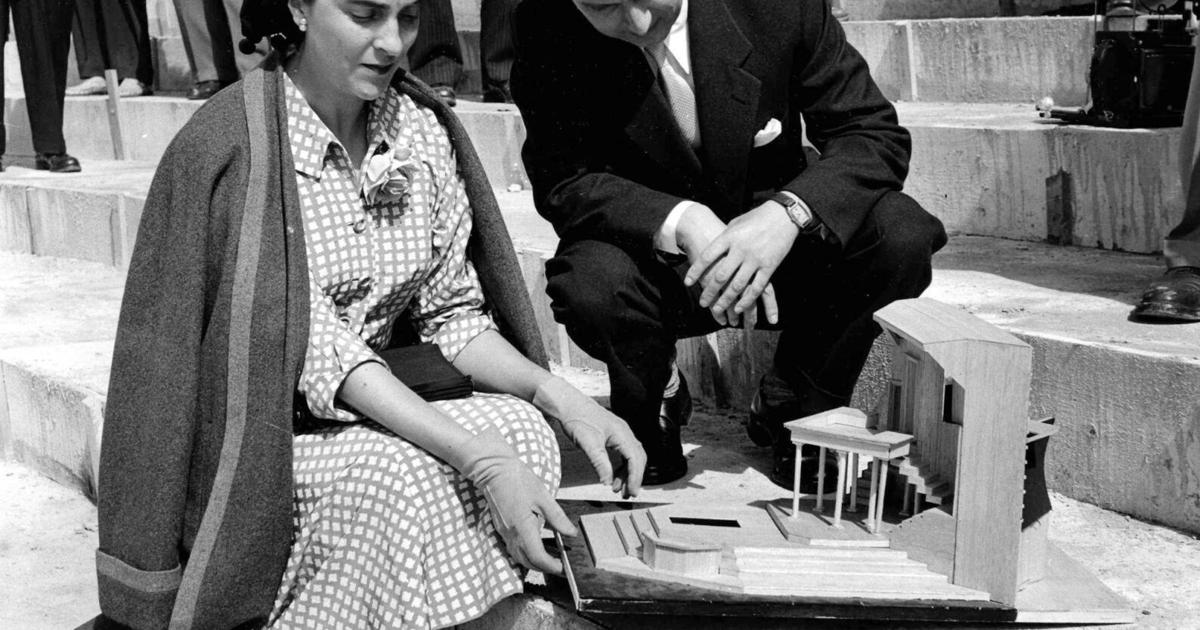
Dreamt up by designer Tanya Moiseiwitsch and Tyrone Guthrie, Stratford’s first artistic director, the original Festival Theatre opened in 1953 for the company’s inaugural season, a two-show program featuring Alec Guinness in “Richard III” and Irene Worth in “All’s Well That Ends Well.”
At the time, the stage was housed underneath a giant canvas tent. Then, gradually, the theatre evolved to what it is today through a series of renovations. In 1957, Stratford replaced the temporary tent structure with a permanent theatre building. The company also added a balcony and expanded the upstage area of the wood stage.
Moiseiwitsch’s revolutionary design, however, has largely remained the same. Inspired by the architecture of ancient Roman theatres and the Elizabethan stages that Shakespeare would’ve worked with, the venue’s auditorium wraps 180 degrees around the stage.
The stage itself — often referred to as the Tanya stage, in recognition of its original designer — has two downstage vomitoria (exits that run underneath the raked seating area). And directly opposite and aligned with these vomitoria are a pair of upstage entrances.
The brilliance of the Festival stage lies in this layout — with the downstage right vomitorium and upstage left exit, along with the downstage left vomitorium and upstage right exit, forming perfect diagonals.
It’s along these diagonals where many directors stage their scenes, particularly those with two characters. Here, one actor typically faces downstage with their back to the upstage exit, while another faces upstage, their back angled into the vomitorium, thereby minimizing the number of audience members looking at them from behind.
This configuration creates a dynamism that isn’t present in a more traditional stage. “Prosceniums are really about a two-dimensional picture,” explains Antoni Cimolino, the Stratford Festival’s outgoing artistic director. “The thrust stage, however, is about asymmetry, circles and geometry. So, the complexity of that blocking makes it feel more like real life. You’re standing in real spatial relationships to others.”
A stage that embraces its audiences and actors
The Tanya stage also serves as a real test for actors and directors. Over the years, I’ve seen many artists, perfectly capable on proscenium stages, struggle on the Festival’s thrust, overwhelmed by the theatre’s immersive design and discovering, often the hard way, that there’s really nowhere to hide on that stage.
Geraint Wyn Davies, who worked his way up through Stratford’s ranks over the past four decades and is now one of the company’s leading actors, perhaps best describes the difference between a proscenium stage and the Festival’s thrust: “You’re not talking at an audience. You’re talking within an audience,” he told me. “And that allows your performance to be far more intimate.”
But actors who can perfectly calibrate their performance for the Festival Theatre are always richly rewarded. And while the Tanya stage is more than capable of hosting large ensembles, there’s something particularly magical about witnessing a monologue or a Shakespearean soliloquy delivered in that space, feeling as if all the energy in the room has seemingly collapsed into that one spot on stage where an actor is speaking.
The Festival, designed in a way that none of the theatre’s 1,800 seats are any further than 20 metres from the stage, is seemingly able to amplify an actor’s performance without stripping it of its nuance.
I won’t easily forget Ian Lake’s testosterone-filled Macbeth, how he prowled across the Festival’s wooden stage with such Machiavellian fury. Or Andrew Iles’ mesmerizing Queen Mab speech in “Romeo and Juliet,” delivered in spasmodic bursts that reverberated around the walls of the auditorium. Or Henry’s magnetizing Prospero, whose staff could seemingly draw lightning out of the roof of the Festival Theatre.
But there’s also more to the Tanya stage than merely its unique shape. For one, its lack of an orchestra pit means that the first rows of audience members are often not much further than an arm’s length away from the stage. (For musicals, the orchestra is located in a loft above the stage.)
As well, because the theatre was built before illuminated exit signs were required in public buildings, and has been grandfathered into the newer laws, the Festival is one of only a few major theatres in the world that can plunge into a complete and total blackout.
Directors, like Feore, have used this to their advantage. In 2017, her production of “Guys and Dolls” featured an ingenious opening sequence that switched, almost instantaneously, from black and white into dazzling technicolour, achieved through a series of rapid-fire costume changes happening onstage in complete darkness. Nearly a decade later, it remains one of the greatest coups de théâtre I’ve seen on that stage, or on any stage for that matter.
A blueprint for other iconic stages around the world
It’s no surprise that many theatres around the globe have attempted to imitate the design of the Tanya stage, including the Vivian Beaumont Theatre at Lincoln Center in New York City and the Olivier Theatre at Britain’s National Theatre.
But no other theatre could ever truly replicate the success of the Festival. And each time I see a show at one of those other venues, I return with a greater appreciation for Moiseiwitsch and Guthrie’s original design.
The Olivier’s thrust stage, for one, is so wide and cavernous that rather than supporting the actors onstage, it tends to overwhelm them, stripping small, quiet moments of their intimacy. The Vivian Beaumont, meanwhile, can only be described as a fat lump (that can barely be considered a thrust), protruding out of a traditional proscenium. Unlike the Festival, there are no clean, clear diagonals, and the upstage entrances are misaligned with the downstage vomitoria. It’s as if the designers of the Vivian Beaumont wouldn’t fully commit to either a complete proscenium or a thrust.
The Broadway venue is also notorious for its acoustic problems. It was perhaps no more apparent than when the Stratford Festival transferred its production of “King Lear” there in 2004. “It had a cast made up of just incredible people, across the board,” recounts Cimolino. “They had played to the 1,800-seat Festival Theatre without any support in terms of sound, and it went perfectly. But when we arrived at the Beaumont, which has sound reinforcements and is half the size of the Festival, suddenly we were having audibility issues with Brent Carver and Christopher Plummer. And you’re going, this is insane.”
But beyond its technical and architectural superiority, what makes the Tanya stage most special is its enduring legacy. In its well-trod wooden boards, you can not only feel but quite literally see the history that it carries. And you’re reminded of the performers whose voices once filled that space: greats like Brian Bedford, Maggie Smith, William Shatner and Zoe Caldwell. What a gift for Canadian theatre — and also the world.
Error! Sorry, there was an error processing your request.
There was a problem with the recaptcha. Please try again.
You may unsubscribe at any time. By signing up, you agree to our terms of use and privacy policy. This site is protected by reCAPTCHA and the Google privacy policy and terms of service apply.
Want more of the latest from us? Sign up for more at our newsletter page.