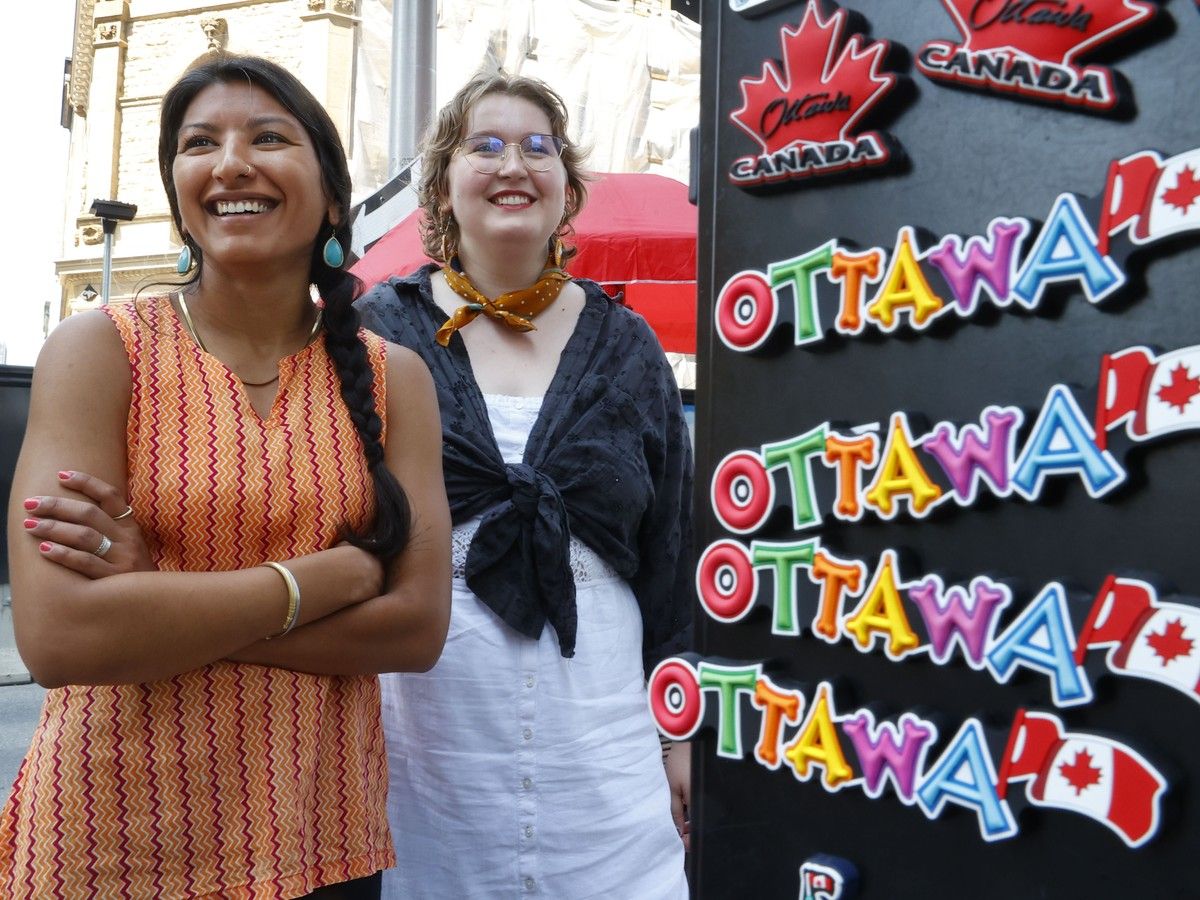
While browsing the shelves of the Glebe’s Octopus Books, you might stumble across a small, folded booklet titled “Mid City.”
Flipping through black-and-white pages of doodles and bubble letters, you might end up learning about an anti-renoviction bylaw and what Somerset Coun. Ariel Troster has to say about it.
Or maybe, you’re interested in a story about a local musician working on an OC Transpo-themed rock opera.
Laura Blanchette, the maker of Mid City, said this accidental democratic engagement is exactly the point.
Blanchette launched the zine in the hopes of getting more young people engaged in local politics. She’s also expanding the zines for this fall’s municipal election, with plans to launch special issues for each ward.
“It’s about bringing people in and letting them decide how they want to engage. There are so many other ways to shape a civic society and to engage in democracy other than just voting. It’s nice to give people an entry point that’s accessible and also kind of fun,” Blanchette said.
Mid City is a zine, a style of self-published magazine that’s focused on a specific subject, and often political with a bit of a countercultural bent.
View this post on Instagram
In Ottawa, Blanchette said the booklets are gaining popularity through community workshops and local markets, both of which she has led and attended. Some have been around for years, like the Ottawa Small Press Book Fair, she said.
She started the zine with funds from Carleton University’s first Peter Mansbridge Emerging Reporter Fund in 2024. Now, she publishes Mid City every two months.
“It’s a knowledge mobilization and information-sharing tool. People are picking it up. I think it goes along with people feeling dissatisfied with the internet landscape right now, and feeling like we’re looking for alternatives to connection and community building,” said Blanchette.
But her upcoming project, “Your guide to the city elections,” is her biggest yet.
It’s a partnership with local civic engagement organization Synapcity, which will produce and distribute hundreds of zines across Ottawa during election season — a different one for each of the city’s 24 wards.
An alternative to the city elections
The 24 booklets will focus on city council elections instead of the mayoral race because it’s less reported on, Blanchette said.
“In Ottawa, we have such ready access to federal politics. It’s so messy and big and important, but in our wards, in our neighbourhoods, I’ve seen my city councillor on the street. I’ve bumped into the mayor, and I can go to city hall and listen to their meetings, and it’s just so much more approachable and rooted in community.”
The project will consist of hand-folded paper zines, with volunteer-drawn covers specific to each ward, said Blanchette, who added that she works on them in the evenings and on weekends, after clocking out from her public service job.
And she has volun-told her friends to help her out with the monster project, too.
“We’ve drafted a brief questionnaire with limited word counts that we’re going to start sending to the councillor candidates so that they can tell us in a few words about what their policy points are and a bit of their campaign.”
Blanchette, who grew up in Edmonton, got the idea from The Sprawl, a publication in Calgary, then pitched it to Synapcity.
It was an immediate go when Riyaz Basi, Synapcity’s board chair, first heard Blanchette’s idea.
“It’s such a vital project, and our goal was to try to work with the most communities that don’t have the best engagement with voting or have the best understanding of it, because we want to make sure that everybody can participate and everyone feels like they can have a voice,” Basi said, adding that Synapcity has focused on youth and newcomers as groups to help engage.
Who votes anyway?
Christopher Waddell, a professor emeritus at Carleton University and the former head of its journalism program, agrees that this local project can make a big difference in civic engagement.
“What happens at the municipal level in many ways has a much more direct effect on people’s lives than anything that happens at Queen’s Park,” he said. “Municipalities have a big role to play in public health and social services, like how (they) are trying to deal with some of the decisions made at the provincial level about ending safe injection sites.”
The former professor suspects younger people in Ottawa often aren’t as engaged in local politics because some of them might not be planning on sticking around very long.
“Is the money going to be spent to upgrade a recreation facility or a swimming pool or a library? Do they care about that? Not so much, because they figure they’re probably not going to be here after they finish their four years.”
Waddell said even though municipal elections have low voter turnout, if young people get together and decide to push for certain policies or focus on certain issues that they care about, like transit, they can have a real impact.
Meeting people where they’re at — like a local bookstore — is a facet of civic engagement that Blanchette’s project picks up on.
Robin Jones, the director of the Association of Municipalities of Ontario, agrees, noting that not only young people might need support.
“Municipal democracy is strongest when everyone feels informed, welcomed and able to participate. Engaging young people and newcomers requires listening first: understanding the barriers they face, the issues they care about, and meeting them where they are — whether that’s in schools, community centres, newcomer services, or online,” Jones said in an email statement.
Ottawa’s municipal voter turnout is low, beyond just young people and new Canadians.
According to Kendra Titley, who works for the city’s media relations office, in the most recent 2022 municipal election, voter turnout was 43.79 per cent, she said in an email.
In 2018, she said, 42.55 per cent of eligible Ottawa residents voted, and in 2014, 39.92 per cent.
She also noted that the city does not track or maintain demographic data about Ottawa voters.
Where and when can I get one?
Blanchette said the project is still in its early stages, so exact pickup dates and locations of the zines aren’t set in stone quite yet.
She’s hoping councillors — or soon-to-be-councillors — will pick up boxes of her folded paper books and make it easy for people in their wards to stumble across.
Her Instagram page, @goodgollyzines, is the place to find out more as election season ramps up.
Related
Our website is your destination for up-to-the-minute news, so make sure to bookmark our homepage and sign up for our newsletters so we can keep you informed.