

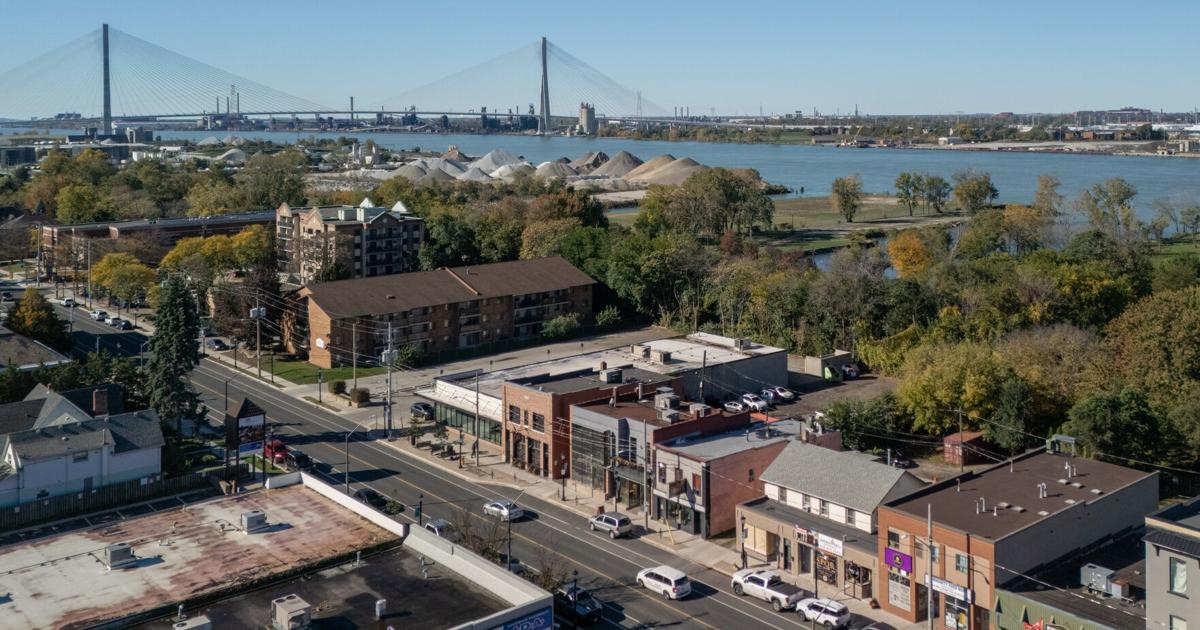
Jim McKellar, clad in a jersey emblazoned with a red maple leaf, was waiting under the blazing August sun, eager to be among the first to cycle across the newly opened Gordie Howe International Bridge.
As the 74-year-old retired Ontario Hydro operator pedaled across the bridge, its white pylons and sweeping cables rising above the Detroit River, a stream of cyclists came coasting towards him from the U.S. side, grinning and posing for photos.
“The Americans were all saying, ‘Thank you, Canada,’ and everybody was high-fiving. It was just a big party,” McKellar said animatedly, recalling the day two months later as he sat with a circle of friends around a breakfast table at Olde Towne Bake Shoppe.
McKellar and his friends gather every Saturday at the Bake Shoppe, tucked inside a 218-year-old Georgian-style house in Sandwich Town, the Windsor neighbourhood at the Canadian entrance to the new bridge.
As a terminus on the Underground Railroad, Sandwich, first established as a village by the British in 1797, offered enslaved people their first landfall on free soil. Now the area is a welcoming threshold for American cyclists riding into Windsor at a time when cross-border relations have declined to a historic low.
When the bridge’s multi-use path opened on Aug. 5 — a week after the vehicle lanes — hundreds of pedestrians and cyclists descended onto the neighborhood’s main street. Restaurant and bar patios were filled to the brim, and bikes packed every rack, spilling onto street lamps and fence posts.
Nor was it a one-day spectacle. From August through mid-October, about 35,000 people used the Gordie Howe Bridge’s toll-free multi-use path, while roughly 600,000 vehicles crossed the bridge, according to the Windsor-Detroit Bridge Authority.
Americans have kept pouring into Sandwich Town in Windsor’s west end that has suffered through decades of neglect and local avoidance. The influx breathed new life into a streetscape long-marked by rows of boarded-up homes which were part of a possible expansion of another international crossing a few kilometres upriver, the Ambassador Bridge.
On a recent Saturday in October, Vince LaCroix drove his vintage navy-blue MG convertible into Sandwich Town, its chrome bumper gleaming in the afternoon sun and Canadian and American flags fluttering above the windshield.
LaCroix, who hails from Michigan, said this was his first time driving across the Gordie Howe Bridge. He drove across to meet a member of the Windsor-Detroit MG Club at a Sandwich pub to celebrate the bridge and two nations’ friendship.
“It’s the first new crossing (in this region) in nearly a hundred years,” the retired school teacher said. “If people think our relationship was a thing of the past, this is a huge sign of optimism for the future.”
Sandwiched between two bridges
Heading west along the waterfront from downtown Windsor, the road to Sandwich Town runs straight toward a towering span of blue steel: the Ambassador Bridge, which has cast its shadow over the neighbourhood since 1929.
Passing beneath the bridge and turning left onto Indian Road, Stephen Hargreaves’ car bounces over potholes. The head of the local business improvement area points to the vacant lots lining both sides of the street, punctuated by driveways that no longer led to front doors.
Up until 12 or 18 months ago, he said, rows of dilapidated houses had stood there. Their doors and windows were nailed shut with wooden boards, their back walls gnawed at by rats. Raccoons and squatters had moved in, and every so often, one of the places would catch fire.
“You start walking this way, and it’s just rows and rows and rows of boarded-up houses,” said Hargreaves. “This looks like I’m going into the ghetto.”
Those were among more than 100 homes bought up by companies controlled by the family of the late billionaire Matty Moroun, owner of the Ambassador Bridge, since the 1990s. For decades, he fought to block a competing crossing while buying up neighbourhood homes to make way for a second bridge of his own.
As the project stalled amid opposition from Canadian authorities, the houses were left to rot in plain sight. The neglect hollowed out the neighbourhood — frequented in the mid-last century by professors and students from the nearby University of Windsor — as residents left, taking with them Sandwich’s only grocery store, bank branch, and, amid dwindling enrolment, its high school.
“We’re sort of ignored by the city, a lot less now,” said Hargreaves, his tone brightening. “This glow-up we’ve had with the Gordie Howe Bridge has really changed the way people feel about this part of town.”
Beginning in 2023, the Gordie Howe International Bridge project funded the reconstruction of three kilometres of Sandwich Street, including road repaving, new bike lanes, traffic lights, lampposts, garbage bins and bus shelters, along with $1 million in streetscape enhancements.
Walking through the neighbourhood, Hargreaves gestures toward several storefronts undergoing renovations or preparing to open, including a shop selling soaps and bath bombs.
On his laptop, he keeps a spreadsheet listing 35 businesses interested in setting up shop in Sandwich. But there are no vacant storefronts left.
“When you can walk around noon around Sandwich Town on a Saturday or Sunday, and the amount of bicycles makes you feel like you’re in central Amsterdam,” said Hargreaves. “It’s night and day compared to what it was like five years ago, even six months ago.”
‘We just want to apologize’
On a brisk mid-October Saturday, a 10-degree chill had Sandwich Town looking quieter than usual. But around 1 p.m., cyclists began trickling in, one after another, filling the racks outside restaurants occupying prime spots along the route from the bridge.
Among them were Julie Brennan, a retired special education teacher, and her sister Sarah, both from cities north of Detroit.
It was Sarah’s fourth time cycling across the Gordie Howe Bridge and Julie’s fifth. Sarah has made a habit of exploring Sandwich Town and beyond. On a previous visit, she stopped by Jake’s Olde Towne Tavern during a charity raffle with cuts of meat as prizes. She has also grabbed a drink at the historic Dominion House Tavern, a regional fixture since 1878, and cycled across the city to a distillery in Walkerville on the east edge of Windsor.
Julie, meanwhile, has developed a soft spot for Sandwich Brewing Co., which is where they are today. The sisters ordered two ciders and settled at a table overlooking four towering stainless-steel brewing tanks.
“I love this town. It’s very quiet, clean and nice,” said Julie, who had not visited Canada in 30 years until she crossed the new bridge by bike. She called the experience “the funniest thing ever.”
“We just want to come here and apologize for everything,” she said. “I always just love Canada … it’s unfortunate that guy,” she said, referring to U.S. President Donald Trump, who she said “is just not a good leader and creates tension with everybody.”
Nicole Sekela, who opened Sandwich Brewing Co. in 2017 and has run its next-door bar and grill, Rock Bottom, for three decades, said she has seen many American customers apologizing profusely over the past three months.
“I said to them, ‘You don’t need to apologize. The fact that you’re here and supporting us in our country, that’s apology enough,’” Sekela said.
As summer gives way to winter, cycling traffic is expected to dwindle, and the question remains whether the summer’s momentum will return next year and usher in a lasting revival in Sandwich.
Ward 2 Councillor Frazier Fathers said that despite the newfound optimism, the neighbourhood still faces hurdles, including lingering boarded-up homes, absentee landlords who leave properties vacant, and the challenge of drawing residents back.
But for now, on warm, sunny weekends, tables at Rock Bottom are packed from lunch straight through to dinner. The cycling tourists roll in, ordering poutine before their seats are even warm, eager to sample local beers. Sekela has had to hire six extra staff members just to keep up with the rush, and her sales on some days in August nearly tripled.
“It’s such a transformation. When they say ‘if you build it they will come,’ they certainly did,” said Sekela. Behind her, a chalk drawing of the Gordie Howe Bridge stretched across a blackboard on the wall, with a single word scrawled underneath in bold white letters: “WELCOME.”
Conflicts and friendship
Sandwich was once a more prominent economic hub than neighbouring Windsor, until the Great Western Railway arrived there in 1854, drawing people and commerce eastward.
When the British relinquished Detroit to the Americans in 1796, they moved across the river and established Sandwich as the administrative and judicial centre of Upper Canada’s Western District.
In the decades that followed, Sandwich became a battleground for conflicts between the British and Americans. During the War of 1812, it was among the first Canadian settlements occupied by American troops. Two decades later, the Patriot War brought renewed bloodshed to the area as armed rebels crossed from Michigan to challenge British rule, said Mary-Lou Gelissen, a librarian at the Windsor Public Library.
Yet despite the conflicts, Gelissen said, people on both sides of the Detroit River maintained close ties.
During the Underground Railroad era, abolitionists in Detroit helped people fleeing slavery reach Sandwich, where some of the formerly enslaved made bricks from the river’s mud to build Sandwich First Baptist Church.
Peter Berry, who has served as Harbour Master at the Windsor Port Authority for 17 years, said a story from the War of 1812 best illustrates the deep-seated connection between the two border regions.
When American troops withdrew from Sandwich, General William Henry Harrison, the ninth U.S. president, ordered the town to be burned down, including the local St. John’s Church. Three years later, the U.S. offered assistance, sending bricks from Buffalo to help rebuild the church.
While Berry acknowledges that the rift in the current cross-border relations may take a generation to repair, he is convinced the bond will endure in the end.
“We may have our conflicts, but in the end we’re still family. We’re still friends.”
