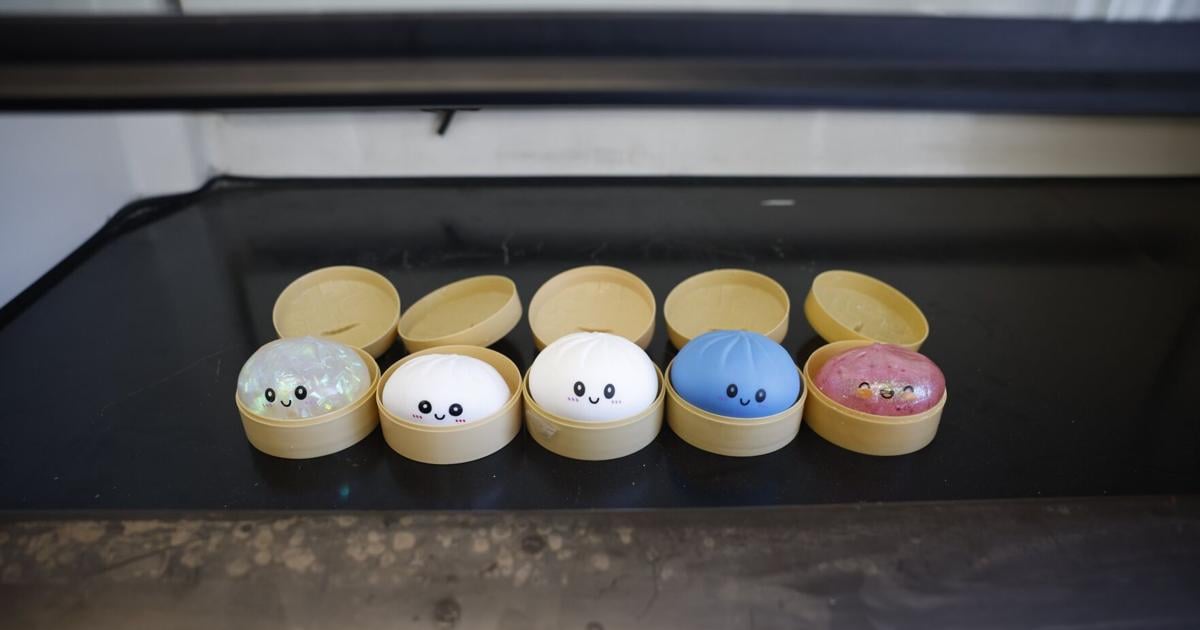
Jordan Collinet was suspicious of the adorable squishy dumpling right away.
He was no stranger to the bao-shaped toys, which have recently proliferated in the halls of the Nova Scotia school where he teaches. So he wasn’t surprised when his five-year-old daughter came home with one, a gift from staff at her after-school program.
But there was a problem.
“We immediately noticed that it smelled really bad — like paint or paint thinner,” Collinet, 35, told the Star.
Mystery squishy dumplings, which come in “blind boxes” you have to open to see which ones you got, are hugely popular. Unboxing videos of rare varieties attract millions of views on TikTok. A year since the toys emerged in 2025, restocks of the colourful collectibles still sell out in days, and countless off-brand copies are now sold by online vendors and major retailers such as Canadian Tire. But concerns have been raised about the toys’ potential emissions of volatile organic compounds (VOCs) — a class of carbon-based chemicals commonly released by some plastic goods and cleaning products — and the possible health effects for the children who play with them.
Some VOCs can cause nausea, headaches and breathing difficulties. Others have been linked to organ damage and cancer after long-term exposure. But experts note that not all VOCs are harmful. So we decided to take a closer look.
A dad’s DIY testing
From his past experience working with paints and fibreglass, Collinet suspected the freshly opened toy’s smell was the result of VOCs. He decided to run a test with a hand-held air quality detector, and was shocked when it detected so many VOCs, it maxed out his instrument.
He posted about this on TikTok in three videos, which garnered more than seven million views. One commenter said they’d contacted Canadian Tire about the “horrific” chemical smell of their own dumpling squishy, adding, “I couldn’t even have it out the packaging for a minute without getting a headache.”
Collinet’s detector can measure up to about 10 milligrams per cubic metre. A total VOC count of 1 to 3 milligrams per cubic metre is considered by some experts to be of “high” concern, but that depends on which specific chemicals are present, and Collinet’s instrument can’t ascertain that.
Collinet’s results appear concerning, especially since the toys are rated for ages 3 and up, and kids are at greater risk of VOC exposure because they breathe more air relative to their body size. But without knowing which chemicals he detected, experts say it’s hard to draw conclusions.
So we decided to have the dumplings tested in a lab ourselves. Here’s what we found.
To the lab
I bought two of the original squishy dumplings, made by the company Really Magical Stuff (RMS), from a Showcase store in Toronto, in rainbow and glitter variations.
Next, I headed to Canadian Tire and bought two BK-brand dumplings. I also ordered two off-brand variants from Amazon.ca. All of them were labelled as made in China.
While at Showcase, I asked a staff member how popular the squishy baos are. “You have no idea,” she said. “I saw grown adults cry when I told them we were out of stock.”
Toys in hand, I enlisted the help of Paul Bozek, a professor of occupational and environmental health at the University of Toronto’s Dalla Lana School of Public Health.
Bozek invited me to his lab, where he recommended we let each toy sit in a sealed plastic bag for 10 minutes before testing them, in order to get an idea of all the VOCs present. This would simulate a “worst case” scenario, he said, somewhat representative of what someone might encounter after close, prolonged exposure to a toy fresh out of the package.
Upon opening the packaging, we could smell a pungent odour similar to paint thinner or glue, from every toy. After letting them off-gas in a bag, we measured VOC levels above 20 parts per million (ppm) in every sample. One of the brand name toys emitted more than 60 ppm. (The empty plastic bag off-gassed 0.17 ppm VOCs by itself.)
For reference, 20 ppm is roughly equivalent to about 65 milligrams per cubic metre, well above the levels Collinet detected, although this conversion varies depending on the exact chemicals present.
In real-life, exposure to these chemicals would likely not be as concentrated. Usually, kids would be playing in an open, ventilated room, so they would be exposed to lower levels.
As well, a total VOC count reveals little about potential hazards, as not all of these compounds are harmful — that’s why Health Canada doesn’t specify a single limit for total VOCs for toys. We needed to identify the specific chemicals present.
Are squishy dumpling toys toxic?
We borrowed a specialized instrument that can identify specific chemicals in gas — called a Fourier-transform infrared spectrometer — from Mississauga environmental consulting firm OHE Consultants.
This machine isn’t perfect — it’s only able to detect 20 different chemicals at a time, whereas a plastic toy could be emitting hundreds of them.
Even with its limited scope, the machine detected VOCs considered harmful from every toy.
In all of the off-brand dumplings, it found low levels of the same four chemicals: toluene, dimethylformamide, 1,3-butanediol and glutaraldehyde. One of the BK-brand toys from Canadian Tire emitted low levels of hydrogen chloride, and the machine detected a hint of formaldehyde from one of the toys from Amazon.
All these VOCs were measured at levels “below what would typically be considered concerns for exposure,” Bozek said, and were likely an overestimation given the sealed bag.
Still, he said, it’s a level where “you wouldn’t want to be playing with that for too many hours a day.”
Among the RMS toys, we measured low levels of hydrogen chloride and acetic acid in the glitter dumpling, and vinyl chloride, acetophenone and acetic acid in the rainbow dumpling.
Vinyl chloride is a known human carcinogen for which there is no safe exposure level, according to Health Canada. The U.S. Occupational Safety and Health Administration (OSHA) regulations limit exposure to vinyl chloride to concentrations no greater than 1 ppm over an eight-hour period. In one sample, we detected concentrations around 1.10 ppm.
The manufacturer did not respond to the Star’s requests for comment by deadline.
Dimethylformamide, detected in the off-brand toys, is also of concern: It’s a common industrial solvent that’s classified as a probable human carcinogen, said Miriam Diamond, an environmental chemist and professor at the University of Toronto.
“But would I be freaking out about these results?” Given the low levels detected, “the answer is no,” she said.
What levels of VOCs are allowed?
Toys sold in Canada must meet strict requirements regarding toxic, corrosive, irritating or sensitizing substances in order to comply with toy regulations under the Canada Consumer Product Safety Act, a spokesperson for Health Canada told the Star.
The results of our test aren’t conclusive enough to show if these toys comply, the spokesperson said, but dumpling squishies are already on Health Canada’s radar. It has received three consumer reports about a “strong chemical smell” coming from the toys.
“If these products are found to be non-compliant, program officials will determine whether any corrective action is required based on the risk posed by the product,” the spokesperson said. That could include a recall.
Section 22 of the regulations prohibits specific substances under certain conditions, but none of the chemicals we detected are listed.
Typically, regulators don’t account for the health effects that could occur from exposure to a mixture of different compounds. “We know that plastics consist of thousands and thousands of chemicals,” said Jane Muncke, a plastics safety expert and the managing director and chief scientific officer of the Food Packaging Forum Foundation in Switzerland.
“It doesn’t make sense just to look at one chemical at a time if you’re using a non-inert material like plastic, that leaches hundreds to thousands of chemicals at the same time,” Muncke said. “What you really want to do — but is not a legal requirement — is to look at the mixture effect of all of the chemicals.”
How can we minimize VOC exposure?
It’s not just squishy dumplings that emit VOCs. “Off-gassing of chemicals from plastics in general is a very common phenomenon,” Muncke said. “They will, in a way, breathe chemicals in and out.”
You can often tell when a plastic is off-gassing significant amounts of VOCs by the odour, although chemicals may be present even if you can’t smell them. That’s why Muncke tries to avoid toys with a strong smell.
“Obviously, it’s hard culturally to isolate your kids from plastic toys. But I tried my best to steer them away from toys that, at least to me, already had a bad smell, like those plastic squishies,” Muncke said. “But that’s not a scientific approach. That’s just trying to survive in this world as a parent.”
If you buy squishy dumplings, Bozek recommends letting them sit out of their package for at least a week to let most of the VOCs disperse. “If you can’t smell the odour anymore after a week, you can be pretty assured that they’re mostly gone, at least down to levels that’d be ridiculously low,” he said.
As for Collinet, he’s glad his message reached so many people.
“I only posted it because I saw all these kids have (the toys),” Collinet said. “I’m just doing it to try to make people think about safety and to maybe think twice before giving into viral trends.”