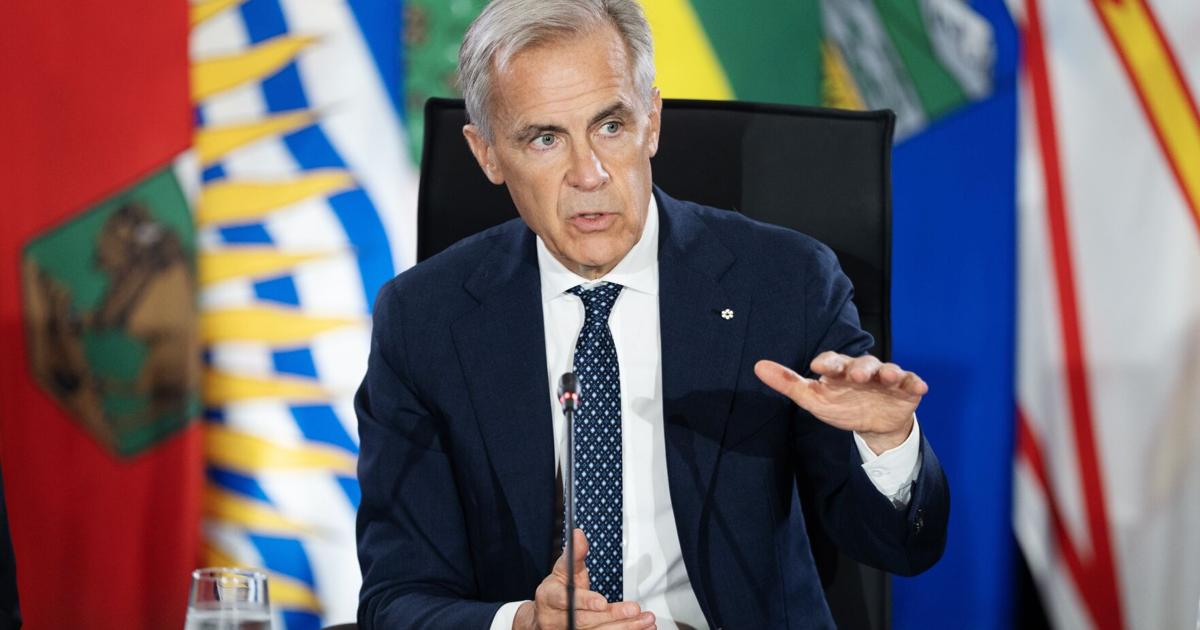
CHARLOTTETOWN — Did Prime Minister Mark Carney hold back from pursuing trade agreements with U.S. President Donald Trump because of concerns over whether the White House would honour its commitments?
In comments to reporters Thursday at the annual meeting of Canada’s premiers, he wasn’t exactly clear.
“There are other things we could have done in the intervening time that we didn’t do, agreements perhaps, because of the nature of your question,” said Carney, who had been asked how he would convince Canadians that any trade deal backed by the mercurial president could be trusted.
Carney was joined by premiers as the Council of Federation gathering concluded in Prince Edward Island after three days of meetings.
The prime minister later added that he had yet to ink any deals because Ottawa has been trying to secure a more comprehensive pact.
While he said Thursday that Trump’s latest tariff threat — an order to levy 50 per cent American tariffs on $28 billion of Canadian exports on Aug. 19 — was both an opportunity to reach a deal and a pressure tactic from across the border, Carney did not reveal what countermeasures he was prepared to take in response.
“If these tariffs or other measures come into force … there’s a full range of things that we can do in that regard. We don’t need to respond in advance. In fact, I think it would be counterproductive at this stage to respond in advance,” he said.
“But it’s important to know what your options are, to have worked it through, to have shared as it affects certain provinces … and be united in that response. And I would say, and premiers obviously speak for themselves, we are united in direction and objective and purpose and seriousness about the response.”
The prime minister spent the day huddled with the provincial and territorial premiers behind closed doors to discuss next steps in a widening trade war with Washington.
“Our destiny is in our hands,” Carney said earlier Thursday.
“Our unity is our greatest strength,” he added, following a conference this week that highlighted differences of opinion in how best to address the new threat and renegotiate the Canada-United States-Mexico trade agreement known as CUSMA.
Premier Doug Ford and British Columbia’s David Eby are among leaders taking a harder stance because their provinces are heavily impacted by the tariffs targeting natural resources and industry.
“Ontario has the most to lose right now,” Ford said before the meeting. “We need to fight tooth and nail. We can’t fight on our back foot all the time. We have to take the offence.”
Ford, who previously slapped a surtax on electricity exports to several American states only to pull it back amid protests from Washington, said he expects to see a plan within two weeks.
Eby told a news conference Wednesday his province stands ready to make sacrifices to give Canada a stronger position in trade talks given it has products like lumber and mineral resources the Americans need.
“If the prime minister calls British Columbia and says he needs support with some big sticks to have conversations at the table, then we’ll be there,” he said.
“The United States needs to decide what they want. They want a strong partner in Canada, where we work together, or are they keen to go it alone? But there’s not a middle road.”
Appearing with International Trade Minister Dominic LeBlanc, who has been a frequent visitor to Trump officials in Washington, Carney said the plan will include continued expansion of trade with other countries to reduce reliance on the United States.
“Canada has what the world wants, including being a reliable partner in a world that’s anything but,” he said.
In a nod to people across the country who have stopped visiting the United States and are boycotting American products including booze and fresh produce, Carney added “we’re in a stronger position because of the determination of Canadians themselves, and I will say this, because of the focus of premiers around this table.”
The formal discussions followed a Wednesday night social event where Carney, the premiers and their entourages listened to Maritime music and dined on lobster, prime rib, oysters and fish tacos.
Prince Edward Island Premier Rob Lantz, who hosted the premiers’ conference, acknowledged the array of opinions on the best tack to take against Trump’s threats.
“While provinces and territories may approach issues … in the same way, we sometimes have different priorities or even competing interests, we share a commitment to finding solutions and delivering results,” he said.
Error! Sorry, there was an error processing your request.
There was a problem with the recaptcha. Please try again.
You may unsubscribe at any time. By signing up, you agree to our terms of use and privacy policy. This site is protected by reCAPTCHA and the Google privacy policy and terms of service apply.
Want more of the latest from us? Sign up for more at our newsletter page.