Thomas Gellert couldn’t waste more time, because if he did, there’d be problems for Canadian goat farms.
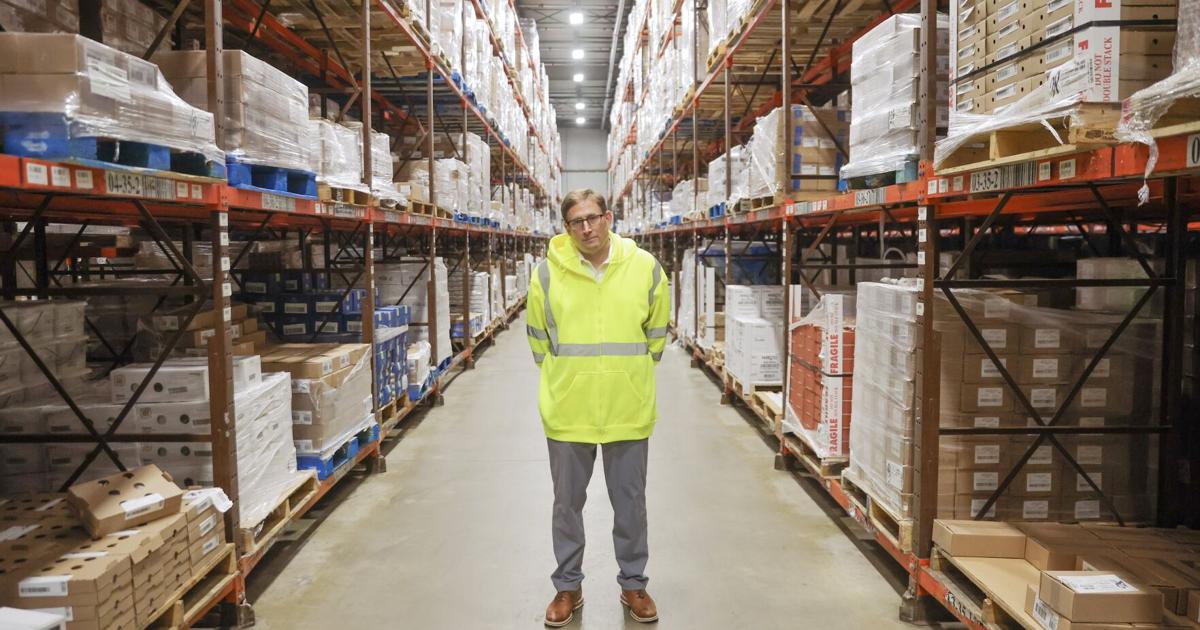
Gellert and his brother run a major importing business in New Jersey. They bring in pallets of food from 60 countries around the world — anchovies, olives, canned meat, mustard, cheese — to be stacked up to the ceiling at their 270,000-square-foot complex that stretches across the industrial shoreline near the Newark airport.
Being in the import business, they’ve had to figure out how to manage the chaos of American tariffs. But the latest round was different. The 50 per cent tariffs announced by U.S. President Donald Trump this summer would cost Gellert about $40 million (U.S.) more a year on his imports of Canadian cheese.
The cheese tariffs put him in an impossible situation. His family has been importing goat cheese from the same family-run dairy in Ontario’s Kawartha Lakes region for 30 years. Together, the two family businesses say they transformed chevre from a niche cheese found at farmers’ markets into a supermarket staple. But shoppers weren’t going to pay more to cover the tariffs, especially not right now.
“You can’t raise prices,” he said this week at his warehouse. “There’s no way.”
So his choices were: absorb the tariffs or stop buying the cheese. If he stopped buying the cheese, shoppers would move onto something else, the market they’d worked 30 years to build would disappear, and the Canadian goat farmers who had ramped up production to meet U.S. demand would suffer.
He took a big breath, standing next to pallets of Ontario goat cheese in his warehouse. “That’s what eats at me,” he said.
So last week, Gellert sued the White House.
The decision made him something of an outlier in New Jersey. He’s one of the few American CEOs to publicly take on Donald Trump, and one of the few people in the state who think deeply about Canadian cheese, or Canada, at all.
Unlike in the border states, U.S.-Canada relations are not top of mind in New Jersey, according to political strategists. But with the country hurtling toward midterm elections on Tuesday, New Jersey might be one of Canada’s best hopes for reining in Trump’s power.
In two congressional races, at the north and south ends of the state, Democrats are threatening to flip once-safe Republican seats in the U.S. House of Representatives. Democrats believe voters are fed up with Trump, the rising cost of living and the war in Iran, and that they’re about to ride that wave of resentment to regain control of Congress, where they could curb the president’s power during his final two years in office.
“The balance of power is at stake, and there’s only a handful of truly competitive seats in the nation,” said Republican strategist Jeanette Hoffman. “New Jersey is at the epicentre of who can control the House in 2027.”
Phillipsburg, in northwestern New Jersey, holds a street festival every year called Pork Roll Palooza. The last one happened this month and there appears to have been a statue of a pig made from pink balloons.
The Pork roll is a specialty of the region — a type of processed meat, pressed into a tubular form, cut into rounds and fried, like a slice of ham but more tangy. It usually comes on a bun, with egg and cheese.
“It’s got that little, vinegary taste to it,” said William Mandry, a lawyer in Phillipsburg, who seems to represent all the best places to eat in the area.
Joe’s Steak Shop, known for its cheesesteaks, is a client and he’s worked with Nicolosi’s Pizzeria. He also represents the local Democratic party and was at another pizza restaurant in Phillipsburg on Monday night for a meet and greet with Rebecca Bennett.
Bennett, a former helicopter pilot in the U.S. navy, is widely believed to be the Democrats’ best chance of flipping a seat in New Jersey. She is running in the state’s seventh Congressional District against Republican incumbent Thomas Kean Jr., who became the subject of media attention earlier this year for his months-long absence. Kean, the son of a New Jersey governor, later announced he was in treatment for depression.
“She flew a helicopter! He flew the coop!” Charles Boddy, the local Democratic committee chair, shouted to the crowd on Monday night, before Bennett came up. Some in the audience chanted along.
Most observers believe the Democrats have a good chance of gaining seats in the midterm elections Tuesday, but it’s not clear how many.
The most competitive races for Senate seats are so close, it’s tough to predict whether the Democrats will get the four seats they need to take control. They appear to have a better chance of taking the House. To do it, they would need to flip three seats — and one of them could be in New Jersey’s seventh district.
With Bennett looking like she has a chance to win, the district has become one of the most competitive House races in the country and both sides have been funnelling millions into the district in an attempt to take the seat, according to Benjamin Dworkin, a political science professor at Rowan University in Glassboro, N.J.
“It’s close,” he said.
On Monday night, dozens of people packed into the pizzeria in Phillipsburg to hear Bennett speak.
“I don’t need to tell you all, everything is more expensive,” she told the crowd. “The entire country is counting on us to flip this seat.”
Bennett left the restaurant and headed for a staff member’s car, to take her to the next event. In her speech, she talked about corruption in Washington and health care premiums and the flurry of Republican attack ads about her role in the health care industry, but she didn’t mention Canada, tariffs or the trade war.
“I wouldn’t say that it necessarily comes up specifically,” she said, “unless it’s with small business owners.”
To milk a goat, you’re best off bribing it first. Fermented hay and corn usually do the trick, some roasted beans.
A goat will march into the milking parlour and stick its head through a hole to get at the stuff, and it’ll stand there chewing while a mechanical milker attaches to its teats, according to Bruce VandenBerg, who worked with goats for more than 30 years. He talks about them in a wistful way. Never once, in all his milking, did one of these kind creatures kick him. They chewed his hair and licked his face, but never did something to hurt him.
“They know you,” he said.
In the late 1980s, VandenBerg and his wife, Sharon, started Mariposa Dairy on a 100-acre farm in Linsday, Ont., about an hour-and-a-half northeast of Toronto. In the beginning, it was a small cheese-making operation. They sold cheese locally, in health food stores, and by the 1990s, they were looking to expand, but couldn’t afford to hire more help.
“We had four children. We were milking goats. We were making the cheese. We were delivering the cheese. We were doing everything,” VandenBerg said.
Around that time, somebody at Gellert’s Canadian office came across Mariposa cheese and, eventually, Thomas Gellert and his father flew out from New Jersey to visit the farm.
“It was new,” Gellert recalled. “It wasn’t so mainstream.”
After the first meeting in 1996, the Gellerts and their three-generation family import business, Gellert Global Group, started marketing and distributing Mariposa cheese around North America. The company says Mariposa is responsible for a serious innovation in the goat cheese industry that has become a mainstay on cheese trays: the chevre log rolled in cranberries.
“They had people doing it on cafeteria trays, rolling it by hand,” Gellert said. “Now they’ve developed automation.”
At this point, Mariposa is a Canadian goat cheese giant with two production plants.
“The Gellerts introduced us to the chain stores, like the Costcos of the world,” said VandenBerg, now the chairman of the company. “We just kept growing and growing every year.”
Mariposa’s CEO, Mark Anderson, said the dairy buys about half of all goat milk produced in Canada, mostly in Ontario. And 80 per cent of Mariposa’s cheese goes to the U.S., via Gellert. More than once a day, a refrigerated truck leaves Mariposa’s plant in Lindsay and drives nearly 1,000 kilometres south to Gellert’s complex in Elizabeth, N.J. The cheese is sold under Gellert’s Celebrity brand, with a goat in sunglasses on the label. Or it’s sold to major supermarket chains around the continent, to be packaged and sold under the store’s private label brand.
To meet growing demand in the U.S., Anderson said Ontario farmers have taken out loans to build barns and state-of-the-art carousel milking systems. If it’s no longer viable to ship cheese to the U.S., the farms couldn’t survive, Anderson said. “A lot of them just wouldn’t make it and their herds would be destroyed.”
Gellert said he met with Pete Hoekstra, the U.S. ambassador to Canada, to ask for a carve-out for goat cheese, arguing that the U.S. didn’t have enough domestic producers to meet demand. Plus, goat milk isn’t part of the Canadian protectionist supply management system that has frustrated the Americans for years.
“There’s a lack of goat cheese production in the United States,” Gellert said. “The few U.S. producers import curd from Europe. So there’s a lack of milk.”
The meetings didn’t work. But he decided he needed to do something to force the administration’s hand, and teamed up to sue Trump with the libertarian organization Liberty Justice Center, which has a history of challenging the White House’s use of tariffs.
“This could be quite devastating,” Gellert said. “We don’t have time. We’ve spent a long time working with our suppliers and our customers to get these sales, to get the distribution on these products … We don’t want it to disappear overnight.”
It’s hard to notice Canadian goat cheese in New Jersey, but it’s here, almost secretly. Mariposa has all the different packaging at its plant in Lindsay. The company puts the American supermarket brand on the cheese before it sends it out to Gellert. A New Jersey shopper probably wouldn’t know, just from looking at the store-brand chevre in their basket, that it is part of an unprecedented international dispute that has badly bruised relations with Canada.
“I mean, in Michigan or Maine or Minnesota, it’s probably different. In New Jersey? The relationship or what it means to Canada? We don’t care,” said Kevin Drennan, a Democratic strategist based in New Jersey.
The tariffs, as far as Democrats are concerned, drove up prices and exacerbated a national cost of living crisis, he said. “That’s what the New Jersey voters see. No offence to our cousins to the North, if you will, but how it affects Canada is not on our minds.”
Democrats are banking on that anger with Trump, and the cost of living, driving more voters into their tent. Midterms classically hurt whichever party the sitting president belongs to, and Trump’s approval ratings have plummeted. So some House seats that the Democrats once believed were unwinnable now might actually be in play. One of those is New Jersey’s second district, in the south.
“Listen, if you had asked me maybe two months ago, I would have said there’s no way we could win the second district,” Drennan said.
The Democrats are running Zack Mullock, the mayor of Cape May, against Republican incumbent Jeff Van Drew, a former Democrat who changed party allegiance in the first Trump term. Van Drew won the last race handily and most observers suggest he’ll do it again, though not by as wide a margin.
“No one is sure how big the Democratic wave is going to be,” said Dworkin, who leads Rowan University’s Institute for Public Policy & Citizenship. “Will there be enough disaffected Republicans, motivated Democrats, cynical independents to push Mullock over the top? Or will it just be a closer-than-usual race?”
In the district on Thursday, a retiree leaving a McDonald’s in a shopping plaza said he was voting Republican because he supported Trump’s moves, including the war in Iran. Curtis, who declined to give his last name over fears of retribution for being a Trump supporter, said the war was necessary to stop Iran from getting a nuclear weapon.
“It’s worth the extra gas (money) right now, although it does hurt,” he said. “If (Trump) would just stop talking so much, it would probably be better.”
A day earlier, on Wednesday, Mullock, the Democratic challenger, held a campaign event at a coffee shop in Atlantic City. Mullock wore jeans, Vans sneakers and a campaign T-shirt under a tweed blazer. Cape May, where Mullock is mayor, is a seaside town that used to see a lot of Canadian tourists, though they’ve more or less disappeared.
“I cannot stand how we’re treating Canada,” he said in an interview. “I would say to the Canadian people, hold please. Give us to Nov. 3.”
It’s not clear exactly what a massive victory for the Democrats on Tuesday would do for the trade war, or Canada, or people like Thomas Gellert. His lawsuit argues, in part, that Trump is already going around Congress to impose tariffs. But if the Democrats take the House and the Senate, “there are many more options that can happen,” Dworkin said.
“There won’t be the willing acceptance that there has been under a Republican congress.”
This week, at Gellert’s complex in New Jersey, you could tell he felt uneasy with the sudden international attention. There were careful product displays set up in his conference room for cameras and he was doing media interviews all over the place, especially in Canada.
“I just want to buy cheese and sell cheese,” Gellert said.