

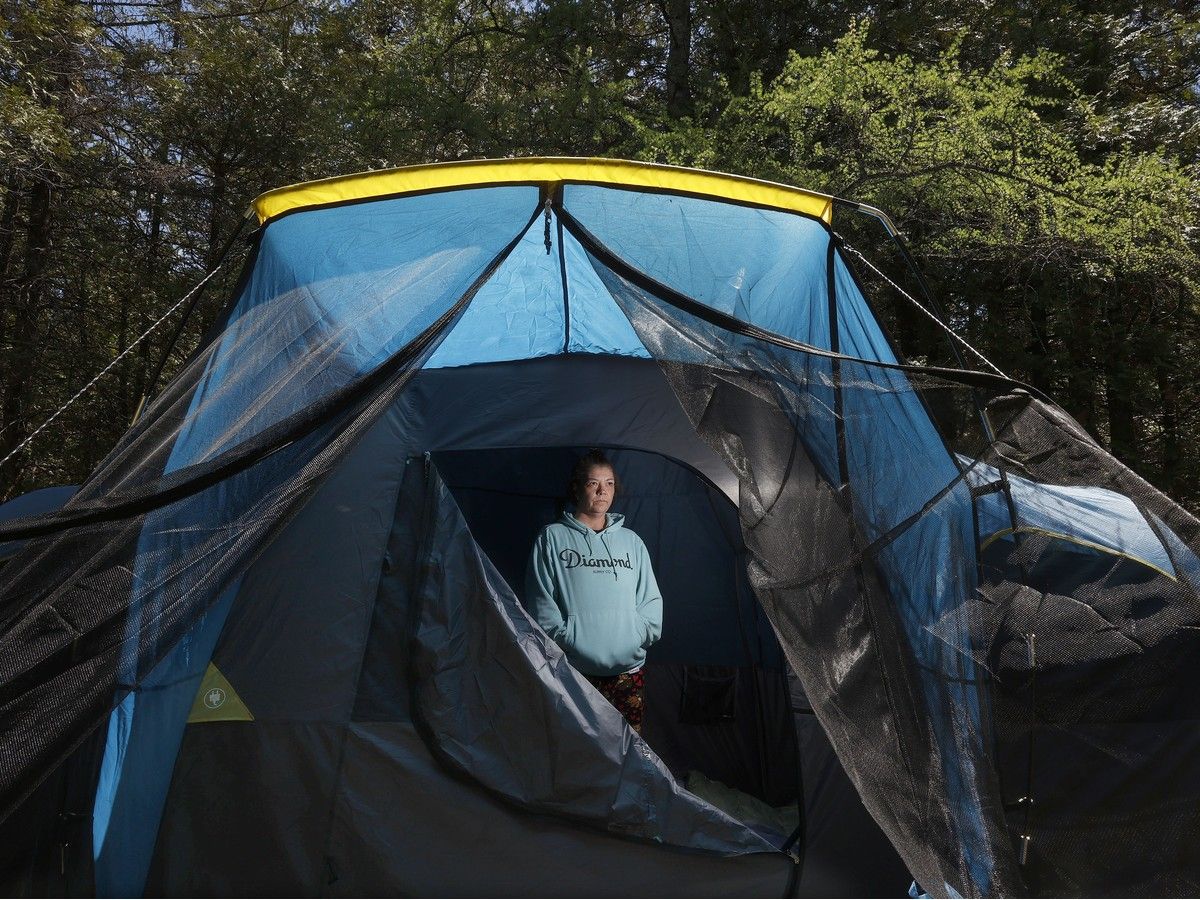
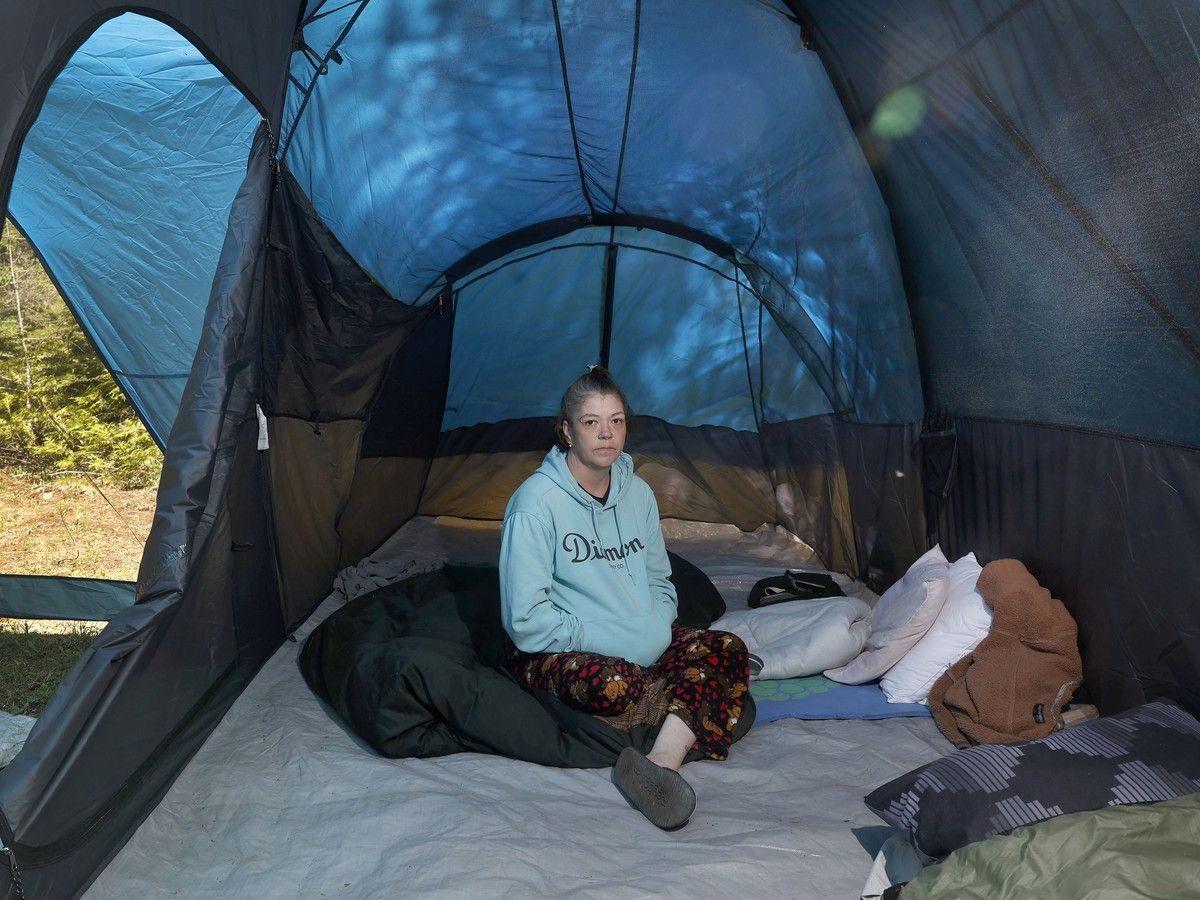
Amy Ayers and her three children, 26, 15 and 14, along with their cat and dog, are living in tent in an Ottawa forest. Not for fun, but because they have nowhere else to live.
Their precarious housing situation started more than a year ago. Ayers spent last winter living in a heated camper, but was asked to leave at the end of March. The family found temporary shelter with a friend. As of May 1, they had been without a home and had cycled between hotels and the campsite.
“I had panic attacks, anxiety, some severe depression, just from having to more or less get rid of everything I own,” Ayers said. “I was almost like your house burned down and you lost everything. It was kind of like that feeling.”
Her oldest son found the open space in the forest when searching satellite images of forests owned by the city. The campsite is only a few hundred metres away from a highway. Hikers and dog walkers often pass nearby. The family has either gone unnoticed or people have chosen no to notice.
“We went. We checked it out. We tried it for a night. It’s nice and quiet. It’s perfect,” Ayers said.
Ayers said she wanted her story to be told because she believed there needed to be more attention on families trying to access emergency shelter . Shelters are overflowing, emergency accommodations are extremely limited, and families with pets face additional barriers. Many parents are being forced into impossible choices between safety, keeping their children together or surrendering beloved pets.
“There are gaps in the system for families in crisis,” she said.

With the exception of a drop at the beginning of the COVID-19 pandemic, the demand for services for Ottawa families experiencing homelessness has steadily increased in recent years, according to a report to city council.
In January 2023, the system served an average of 377 families per night. By March 1, 2026, that number had increased by 76 per cent to 664 families, including about 1,220 children. About 41 per cent of those children were under age six. The length of stay for families also increased by 135 per cent in the past two years to an average of 327 days.
The city has seen an significant increase in the number of families accessing the family system, resulting in a unbudgeted hotel spend of $29.3 million for the City of Ottawa , director of housing and homelessness services Kale Brown told the community services committee in April. Family sizes have also continued to go up over the past two years.
The heart of the problem is that more people are entering the system than are leaving it. On one side of the equation, there has also been a 42-per-cent decrease in outflow from the system. There has also been an inflow of people, including those coming to Ottawa from other municipalities, Brown told the committee.
“One of the things we see in Ottawa is an ongoing trend where there’s an inflow from places like Montreal, which does have a family shelter system available,” Brown said.
Ayers is determined to keep her family together, but that’s difficult in a system that considers children over 18 to be adults. Her 26-year-old son has been working for five years, but, even at 40 hours a week, his fast-food job doesn’t pay enough to get or share an apartment after other expenses are factored in.

Earlier in May, the city offered the family a place in one of its overflow hotels.
“We were very excited because we could all be together, and 15 minutes later they called,” Ayers said. “I guess another caseworker was working with someone else and that room was taken, and all they had available was something that could not accommodate us all.”
Ayers worked as a personal support worker for about six years. Burned out by the pandemic, she switched to work at a fast food outlet. Last July, she went on Ontario Works benefits.
Her days are spent shuttling from one place to another. She drives her two younger children to school in the morning, then drives her older son to his job in a town just outside Ottawa at noon. She picks up the younger children after school and her older son after his eight-hour shift. A tank of gas only lasts a couple of days, tops. She stays stationary as much as she can to save on gas.
On a few recent nights, when the temperature dropped to 0 C, the family accessed temporary housing in a hotel. Since it’s not possible to cook, most of their food comes from fast-food outlets or is provided by community outreach groups. When they’re not using the tent, they pack it away and store it in the trunk of a car owned by her oldest son.
The car is one of the few assets they have, even though there are ongoing car and insurance payments. The family refuses to part with their pets. Ayers said her younger son said he would rather sleep in the ditch with the cat than be parted from his beloved pet.
Ayers owns a van packed with what remains of her possessions, but it needs major repairs and is still parked at a repair shop. Getting the van back on the road would mean having a place to sleep over the summer.
In 2024, the city asked families experiencing homelessness what challenges they had finding housing. About 58 per cent said low income, 56 per cent said rents were too high, 25 per cent said lack of income assistance and 20 per cent said lack of support.
Almost half of the family respondents had completed post-secondary education or higher.
Homelessness is not cheap for the people experiencing it. Ayers earns a little over $1,100 a month in Ontario Works benefits. Her older son, working 40 hours a week, earns about twice that monthly. But even at that level of income, it’s not possible to rent a home for the family. Her son still has car payments and insurance costs.
Ayers says she he spoken with other homeless families and people. One was a woman from Quebec with two children who was fleeing abuse.
“She feels safe here. She doesn’t feel safe in Quebec,” Ayers said. “They’re telling her to go back to Quebec. The women’s shelter system in Ottawa wouldn’t take her. If you’re fleeing abuse for a reason, you need to be sheltered.”
There are nearly 1,000 affordable housing units under development in Ottawa. The city has invested in homeless prevention, such as bridge housing programs that temporarily support families as they transition between jobs or long-term housing units, Brown said.
For the City of Ottawa, the aim is to reduce the heavy reliance on overflow hotels. The new strategy includes a mandate to requires families to meet certain thresholds to be able to enter the family system, including income and asset limits. The city has also set of a target for outflow, planning to send 20 per cent of people experiencing homelessness into affordable housing the city is building.
“What we want to do to ensure that family shelter is only used as a last resort for families in this city,” Brown said.
In some ways, Ayers considers her family to be lucky. They’re together. They have an income and a car. They’re healthy. It’s not winter. Ayers’ godmother lives in Peterborough and has been helping out with expenses. Ayers has a friend who does laundry for her. A woman sent money to be spent for a night at a hotel. Another gave them sleeping bags and flashlights because they she knew they were camping out.
For Ayers, the first step to getting back on her feet is to find housing. She needs housing to get back into the workforce, perhaps even return to work as a personal support worker.
“I feel at the end of the day that something has always worked out for us, and keeping that positive outlook goes a long way,” she said.
Still, there are days where Ayers feels lost. She’s grateful for the help she has received, but has also been stung by an online accusation that she’s “scamming.”
“I know we are not the only family going through this,” she said. “I know there are families who are silently struggling.”
Our website is your destination for up-to-the-minute news, so make sure to bookmark our homepage and sign up for our newsletters so we can keep you informed.

