

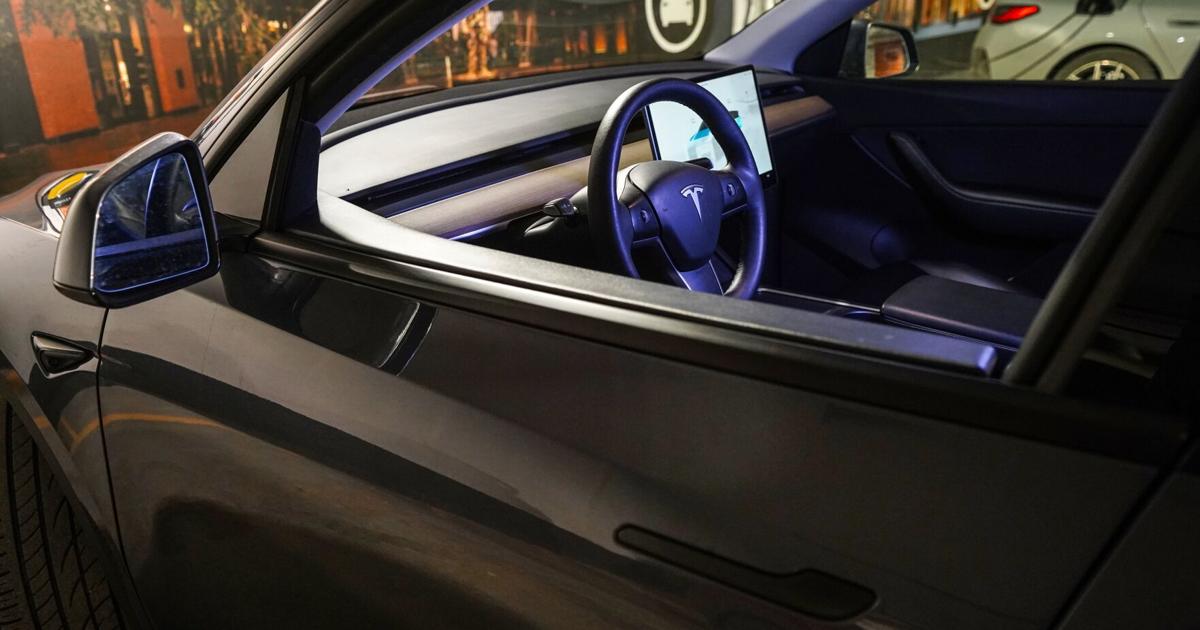
Tesla has issued a recall of nearly three million EVs in China after the national regulator issued a warning that the door handles could fail in a crash and trap occupants inside, the first major regulatory step taken globally to address a safety flaw that has led to more than a dozen fatalities in EV fires.
The U.S.-based automaker, which was once the world’s largest producer of electric vehicles, is one of eight manufacturers affected by the recall announced last Friday, Bloomberg reported, affecting nearly four million vehicles, all of which feature electronic door handles made popular by Tesla.
The door handles rely on an electric current to unlatch doors and may not operate if the circuit is interrupted or severed after a collision, the Star reported in an investigation published earlier this year.
China’s State Administration for Market Regulation said the push-button door releases “could hinder occupants from quickly opening the doors to escape and impede rescue efforts by those outside the vehicle, posing a safety hazard,” according to The Associated Press.
The recall affects 2.98 million Teslas in China, including Model 3, Model Y, Model X and Model S. As part of the recall, Tesla is deploying a software update that will automatically roll down the windows after an accident to ensure occupants can get out. The carmaker will also attach labels marking the emergency manual door releases.
Tesla did not respond to a request for comment.
Randy Schmitz, a retired Calgary Fire Department captain who now runs specialized training for EV fires to first responders, said it was good to see China acting on this growing safety problem.
“It couldn’t happen soon enough,” he told the Star. “We just can’t have people getting locked in these vehicles. They’re dying simply because they’re trapped and they can’t get out.
“That’s a massive problem and it’s only going to get worse as more electric vehicles come into the system.”
Manual releases, which are not present on all doors or in all Tesla models, have been criticized by safety experts as being difficult to find in an emergency. Some Tesla owners, including a Star reporter, have used a drill to install their own manual releases for use in case the electronic handles fail.
Bloomberg, which first broke the news of the recall, has identified at least 15 deaths in the U.S. over the past decade in which occupants or rescuers were unable to open the doors of a Tesla that had caught fire.
Four people perished in a Tesla fire in Toronto in October 2024. A Star investigation found that rescuers on the scene were unable to open the doors from the outside and had to smash a window to save a passenger as the vehicle caught fire. They were unable to save the other four occupants because the fire became too intense.
EV fires burn hotter and typically spread more quickly than gasoline-powered car fires, and they’re harder to put out, first responders say.
George Iny, director of the Automobile Protection Association, praised the fix being implemented by Tesla.
“It’s a simpler answer than we had thought,” he said. “If it doesn’t involve the vehicles having to be redesigned, then all the better.”
Schmitz questioned whether the automatic window lowering is a true solution, saying that if the door latches don’t work without power, the windows won’t either.
“I don’t see how it will work unless they were to do something like install a capacitor or an external power source, that could … roll down the windows instantly, even if the 12-volt battery is destroyed,” he said.
Last year, China banned electronic door handles from all new cars. This recall appears to be an attempt to address the problem in cars already on the road.
In March 2025, Transport Canada opened a special investigation into electronic door handle failure leading to entrapment. This year, the scope of the investigation was expanded beyond Tesla and EVs to encompass all door handle failures.
Transport Canada did not respond to questions before deadline.
In an email exchange earlier this year, Transport Canada told the Star it had already issued a recall for certain Ford Mustang Mach-E vehicles for similar electronic door handle failures. The Canadian investigation was cited when American regulators followed suit shortly afterward.
In the U.S., regulators said last month they would start a process that could lead to a new federal rule addressing concerns over unsafe door handles, Bloomberg reported. The National Highway Traffic Safety Administration is also probing some Tesla Model Y vehicles after complaints of door-related entrapment. In January, an Illinois congresswoman introduced legislation to require manual door releases in new cars and means for first responders to gain access to vehicles when power is lost.
Iny says Canada is too small a market and cannot recall cars on its own, often working with U.S. authorities. In this case, China, which has far more EVs on the road, appears to be leading.
“The good thing is that when one block makes these changes, it makes the job much easier for the others to follow,” Iny said. “Industry isn’t able to say we can’t do it if they’re already doing it in another large market.”
Schmitz, the former fire captain, added that waiting will only make the solution harder to implement.
“If you do a big recall now, you’re not going to have to do an absolutely massive one later,” he said. “It’s going to have to get addressed.”

