HALIFAX — Jeremy Hansen, one of four astronauts who returned to Earth two months ago after travelling around the moon, said nothing could have prepared him for the awe he felt in space or the overwhelming support he’s received from Canadians.
The Canadian astronaut, who is the first non-American to travel to the moon, said the views from space blew him away.
“The things that we saw continued to put us into a state of awe, a state of gratitude,” he said in an interview Wednesday.
“It really made me feel tiny as a human, as an individual, but very powerful as a human species — that we can actually do this and witness the Earth, the moon and then the galaxy spread out in front of us.”
Hansen said of the many take-aways from the historic Artemis II mission, what stood out was learning how many Canadians were paying attention and supporting the astronauts’ work from afar.
He said he knew his fellow “space nerds” would be watching the mission closely but didn’t expect so many others to care.
The four-person crew — commander Reid Wiseman, pilot Victor Glover and mission specialists Christina Koch and Hansen — first heard about the widespread public support while speaking with their families on the way back from the moon, he said.
“The fact that people seemed to really connect with four humans, lifting one another up, working together, doing something really hard with an amazing team of support behind us, but having fun doing it. That’s really touching,” he said.
Hansen said the support gives him hope.
“Humanity does want to do positive things and can find a lot of joy in taking on these big challenges together, creating versus destroying,” he said.
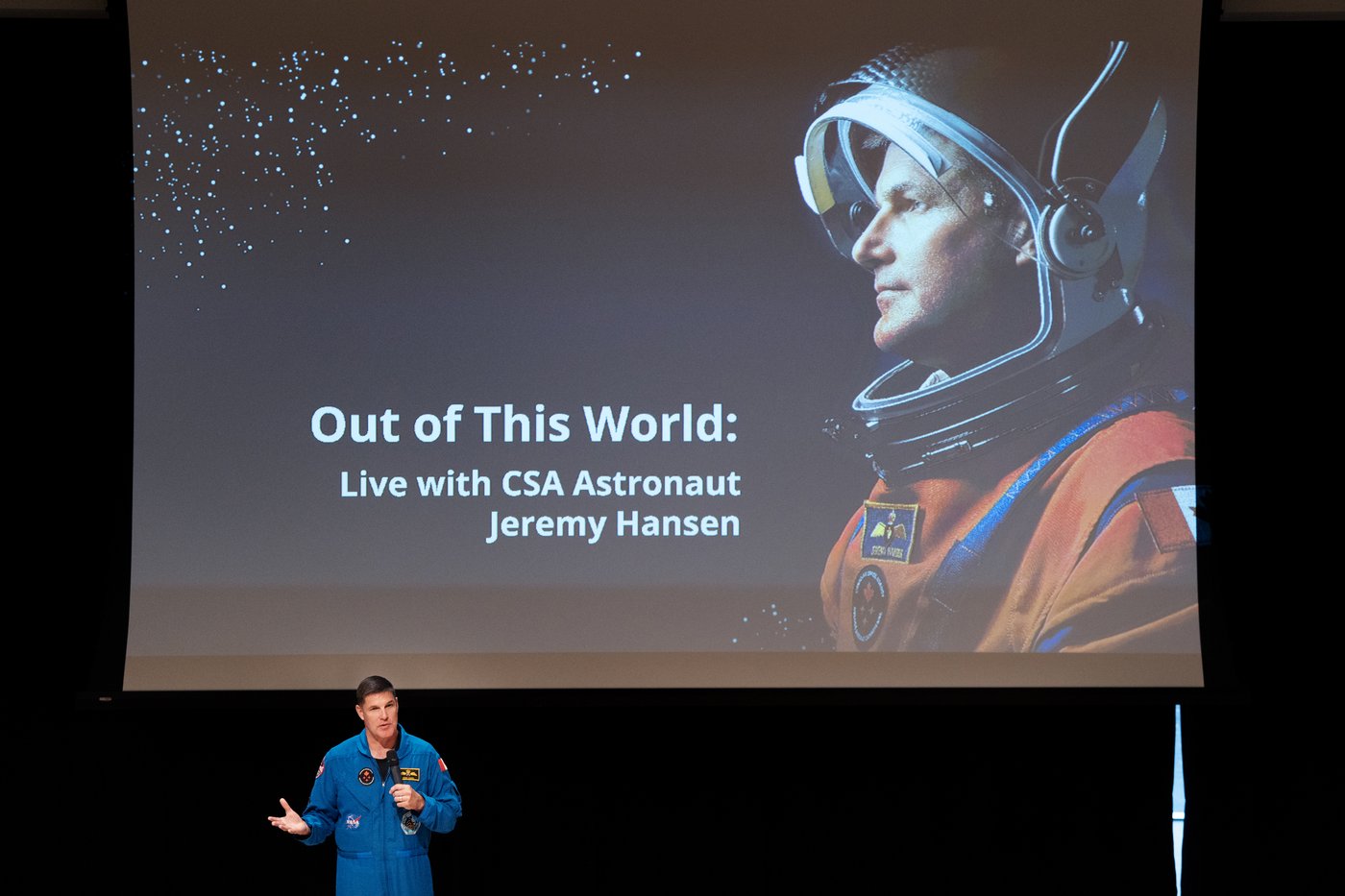
The Canadian Space Agency astronaut was in Halifax on Wednesday to meet with students and speak to a crowd of 300 at the city’s central library. The Halifax Discovery Centre said tickets for his presentation, priced at $5 or $10, sold out in under a minute.
Hansen fielded several questions from science enthusiasts of all ages at the evening presentation, including queries about diaper use in space and what it felt like to blast off.
“What was blastoff like? It was pretty awesome,” Hansen told the crowd.
The astronaut described the sensation of travelling at speeds hitting Mach 39, approximately 47,000 kilometres per hour, like being in a sports car that just keeps going faster and faster.
“I’d do it again. In fact … if I got off that ride and it was an amusement park, I’d just go and get right back in line and go again. I thought it was pretty amazing,” he said.
Another attendee asked Hansen what it felt like as the crew experienced major milestones while in space, including becoming the first people to travel farthest from Earth. The team reached a distance of 406,771 kilometres from Earth.
“You’re very guarded when you’re in space and you’re a long way from Mother Earth … because you know at any moment it can go the other way,” he said.
Hansen said the crew tried to acknowledge milestones as they were happening, but they were constantly focused on the next challenge ahead of them, until the end of their 10-day mission when parachutes opened during splashdown.
“In the video … when you see Christina and I grab hands once the three main parachutes opened. That was the first time we felt like we really are going to make it,” he said.
Hansen said he hopes all Canadians can feel proud of the role the country played in the achievement, and he is challenging future generations of astronauts to break Artemis II’s record.
“We don’t want people to feel like that was the pinnacle. We always want to be pushing,” he said in the interview.
Earlier Wednesday, Hansen attended a suborbital launch demonstration in Canso, N.S., on the eastern coast of mainland Nova Scotia.
“I’m immensely proud of Canada, I see the genius across the country. Today was another one of those days, being in Canso … seeing the perseverance and persistence of this group,” Hansen said.
The federal government announced in March it was putting $200 million toward the Canadian-owned launch pad, known as Spaceport Nova Scotia, which will send satellites into orbit.
A 10-year lease of Maritime Launch Services’ infrastructure will give Canada the ability for the first time to launch space projects on its own. The launch pad is expected to be operational by the end of 2026, according to the company. Ottawa is targeting 2028 for domestic launch capability.
Maritime Launch said a hypersonic, single-stage, solid-fuel suborbital vehicle called Barracuda launched at Spaceport Nova Scotia on Wednesday morning, marking an important step toward developing the rocket.
“It moves us closer to providing research institutions and defence organizations with meaningful access to near-space environments and high-performance platforms for testing, training and technology development,” said Roel Eerkens, co-founder of Barracuda owner T-Minus Engineering, in a statement.
The Barracuda is able to carry payloads of up to 40 kilograms to altitudes of roughly 80 kilometres.
This report by The Canadian Press was first published June 11, 2026.
Lyndsay Armstrong, The Canadian Press
Add CityNews Toronto as a trusted source on Google to see more local stories from us.