

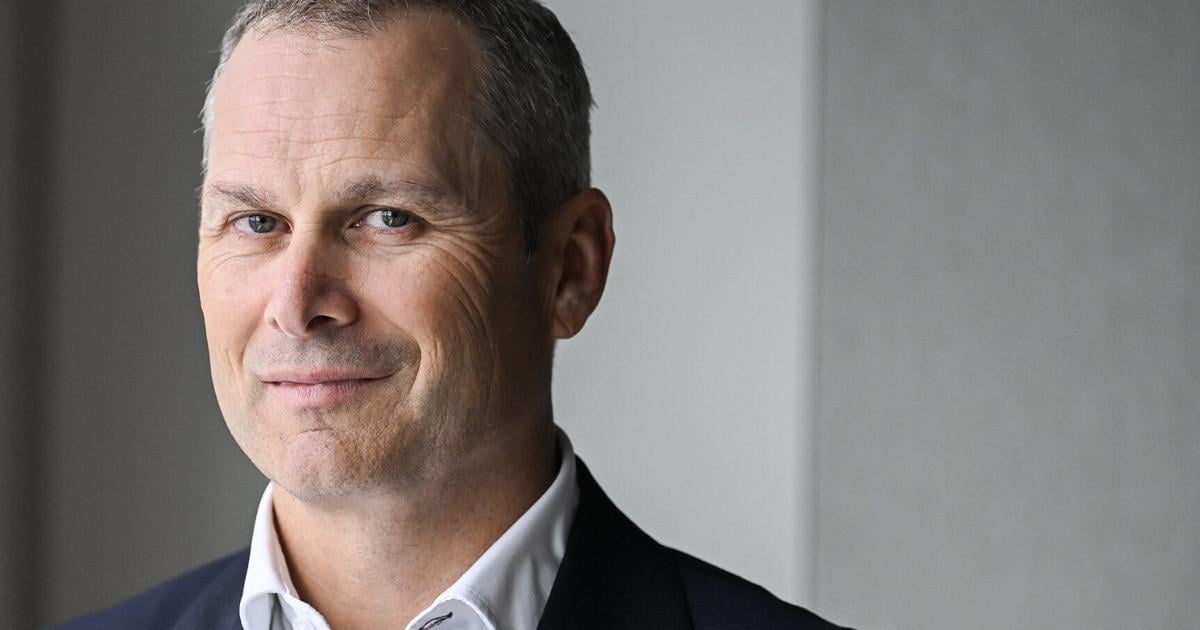
For Desjardins Group president and CEO Denis Dubois, the challenges the company faces today are unlike any the financial co-operative has seen in its 125-year history.
Economic instability, climate change, AI and demographic shifts are each changing the calculus for those assessing risk.
“That process where you do those five-year plans is not making sense anymore,” says Dubois, who was tapped to lead the Quebec-based company last year during a period of transformation. “You’re now in a constant reassessment of the environment.”
The native of Rouyn-Noranda, Quebec — a town of about 43,000 near the Ontario border — graduated with a degree in actuarial science from the University of Laval. After a decade working in insurance in Montreal, Dubois moved to Quebec City in 2003 and took a job at Desjardins, where he’s worked ever since.
The continent’s first savings and credit co-operative was founded in 1900 by Alphonse Desjardins to provide an accessible credit and banking alternative for working class Canadians.
Desjardins continues to provide personal and commercial banking and loan services, as well as property, health, life, auto and commercial insurance. Today, the company has 10 million customers — or “members” — with $510 billion in assets under management and 55,000 Canadian employees, making it North America’s largest financial co-op.
In recent years, the company has reached beyond its home province, aided by a series of acquisitions that included State Farm Canada in 2015, The Insurance Company of Prince Edward Island in 2024 and Guardian Capital Group Limited earlier this year.
“People sometimes see us as a Quebec-based organization, but today we’re really national,” Dubois explains. “We are an organization that strives to maintain co-operative values, but also (financial) performance, because we believe that those two things reinforce each other.”
The Star spoke with Dubois from the Canadian Credit Union Association conference in Ottawa about the company’s legacy, how it’s managing an entirely new set of challenges, why insurance premiums are on the rise, and whether the industry can weather the realities of climate change.
What first brought you to Desjardins in 2003?
I was always interested in finance, and in the early ‘90s the job market was very challenging. I was looking to study something that came with a high chance of getting a job, and the actuarial program was one of the few that offered that.
After graduation I worked in property and casualty insurance in Montreal, and when my wife and I decided to move back to Quebec City with our newborn in 2003, Desjardins was of course on my radar.
When you grow up in Quebec, you’re exposed to the brand in so many ways. They had a classroom savings program called “school caisse” where you do savings projects in elementary school. I always loved the co-operative values and was very happy to find a role there.
Tell me about the company’s history
Desjardins was founded 125 years ago by Alphonse Desjardins, a stenographer at the House of Commons here in Ottawa.
There, he witnessed a case where a man was forced to pay $5,000 interest on a loan of $150, which inspired him to look for a community-based lending model. In his research he discovered a structure that was popular in Europe, and founded Desjardins as the first credit union co-operative in North America.
His vision was to provide financial empowerment to people in their communities, and if you look at his writing he was already thinking about insurance, which was brought into the group in the 1940s.
How has your career progressed at Desjardins?
My first role was vice president of property and casualty insurance for the province of Quebec, and from there I moved around a lot.
First within the property and casualty sector, where I essentially did every role from strategy to claims and everything in between. Then I spent a couple of years in Toronto, which led to me taking over the property and casualty sector in 2016, at which point I joined the executive committee.
After three years I was asked to take over the life and health insurance division, and the wealth management division.
Within the group we have five business sectors; property and casualty, life and health insurance, wealth management, commercial banking and personal banking. Over the last 23 years I’ve had the privilege of leading three of those five sectors, and I’ve been exposed to the rest as a member of the executive management committee.
Is that why you were promoted to CEO last year?
We live in a world where change is happening very fast, and organizations need to adapt quickly. I’ve shown the ability to lead through transformation, so I think that was a key element.
What kinds of change are you referring to?
We’re operating in a context of uncertainty being the norm.
When you look at geopolitics and things like war and tariffs; when you look at technology, so data analytics, AI, cybersecurity, digital transformation and automation; when you look at demographic changes, where there’s very limited population growth in Canada; when you look at climate change, which as a property insurer we see the impact every single day; when you look at the competitive landscape, and a government that wants to promote more competition in the financial industry with new players, open banking, stablecoins — all these things.
We have multiple transformations happening at once. What’s true today is different than what was true six months ago, and will be different than what’s true six months down the road.
So, the ability to adapt will be so important for the organization in the future.
Is that why premiums are on the rise?
What’s driving the premium increase for home insurance over the last 20 to 25 years is losses related to climate change.
It’s floods, tornadoes, hurricanes, and now we’re also seeing wildfires destroy communities. The frequency and severity of those events are higher, and that’s’ been a major driver of increases in recent years.
The other big driver is inflation, which you see everywhere. It’s the price of houses and rent, of supplies and a scarcity of labour in the construction sector.
For auto insurance, it depends on where you live. Some provinces have more of a public than private system, but what’s real everywhere is the impact of technology. That’s where the cost of repairs is seeing double-digit growth.
And in Ontario, because you also have the bodily injury and accident benefit part of the insurance product, those are tied to the cost of health care, which is also experiencing high levels of inflation.
Is there any relief in sight?
There’s a lot that’s not in our control, so you need to look at the things we can control.
Obviously, prevention is key. When we’re talking about climate change, its things like having a backup sump pump installed or a hail resistant roof. If you’re in an area that’s at risk of fire, removing trees close to the property.
When it comes to auto insurance, looking into insurance costs before you purchase or lease a car is important. Theft is still a big issue today, so investing in anti-theft devices can help reduce the risk. We are also trying to reduce auto accident frequency with tools like Ajusto which uses telematics to reinforce good driving behaviour.
The other thing that you control is deductibles, so making sure you have a deductible that’s at a level your budget can allow.
Is the business model viable in a warming world?
I don’t think the business model is itself at risk, but there needs to be adaptation.
There’s already a mix of public and private funding that provides relief in the event of disasters, and we need the two working together so that we can provide the right solutions. In some cases, that could mean going to the local government and saying it’s OK not to rebuild destroyed property in a flood zone.
I think it’s very important that we provide the right strategy to manage the risk collectively but also provide protections to Canadians where it makes sense.
Are you concerned about Canada’s long-term economic prospects?
We need to be optimistic about the future, but also realistic about where we’re at today, so that we’re in a better position down the road.
We’re not facing a wall, but we are seeing a slowdown. With an aging workforce the labour market is going to be very tight, so productivity will become very important to the long-term success of Canada. Diversification of markets is also becoming very important and we’re taking action on both.
I was talking earlier about adaptation for the organization, but I think it’s also true for us as a country.
What role does Desjardins play in facilitating that transition?
It goes back to who we are as a co-operative, and it comes in a few forms.
First is providing the tools for people to deal with the economic context, which is why we offer financial literacy programs, which were used by more than 100,000 Canadians last year.
As a co-operative we also gave back $638 million to our members and communities last year, including $133 million in community sponsorships, scholarships and donations. This year we’re giving back $505 million in the form of a member dividend. At the end of last year, we also announced that we would help fund 10,000 affordable housing units.
We call this the social economic leadership of Desjardins, and we’re acting on different fronts to assist our members, which is our mandate as a co-op.

