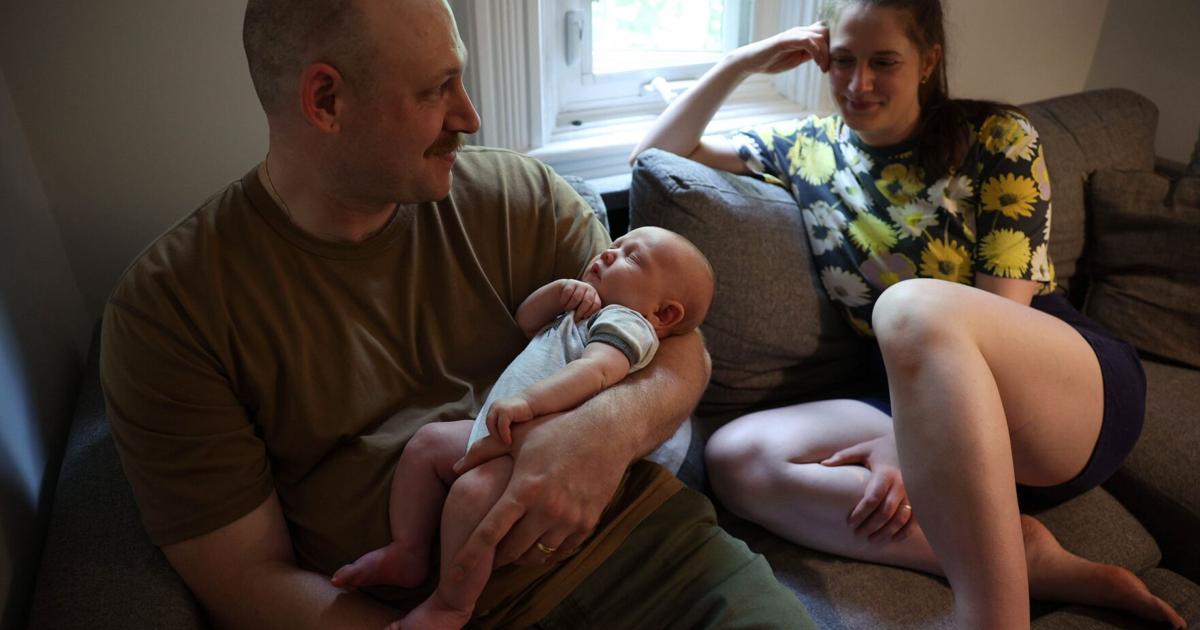
Rachel Cairns had always wanted to have a family.
An only child, she loved taking care of her dolls when she was little, and nurtured a cast of imaginary friends. The main character was a boy she called “brother.”
Her husband, Will Stefancic, was on the same page about kids. But the timing never felt right financially.
As they inched toward 40, the couple knew their biological window was closing. But the prospect of adding a baby to their already tight budget was daunting.
While they’d heard of people who’d raised children in Toronto in one-bedroom apartments like theirs, with the parents sleeping in the living room for years, the prospect was unappealing. They wanted a bigger apartment, but in a city with famously unaffordable housing, they couldn’t find it.
“We’re people who, spiritually, existentially, wanted parenthood as part of our life,” said Cairns, 38.
“We were just really trying to actively work to change our circumstances.”
As of 2024, Canada reached a fertility rate of 1.25 children per woman. This puts the country on par with places like Japan and Finland, and well below the replacement rate of 2.1 needed to sustain the population without mass immigration, said Kate H. Choi, professor and acting associate dean of research in the Department of Sociology at Western University.
While Canada’s rate is already considered “ultra low,” Toronto’s fertility rate is even lower, at just 1.11 children per woman, according to data provided to the Star by Statistics Canada, down from 1.26 in 2021.
In contrast, the global rate, according to the United Nations, is 2.2, down from around five in the 1960s.
The low birth rate across developed countries has become a much-discussed phenomenon, with everything from dating apps, parenting styles, and in the words of U.S. Vice-President J.D. Vance, “childless cat ladies,” at fault, with much of the discourse placing the blame on the shoulders of women.
But there’s a growing body of evidence that suggests housing costs, and rising costs in general, are a big part of the picture. In Toronto, housing prices and rents have dropped from pandemic peaks, but they both soared over the last couple of decades with home ownership still out of reach for many.
“Housing prices and cost of living are at the heart of what we are seeing in recent years in terms of the fertility decline,” said Choi.
The solution is not as simple as telling young people to move to the suburbs if they want to have kids, as with such a low birth rate, Toronto risks aging faster than other parts of the country — without enough working people to support the city.
And experts warn ignoring that housing costs are a crucial piece of the puzzle will only make the problem worse.
Data ties high housing costs to fewer babies
There is evidence from outside of Canada that suggests high home prices and a rapid rise in housing costs are linked with declines in fertility, Choi said.
One study from Brazil on a random housing lottery found winning increased the probability of having children for people aged 20 to 25 by 32 per cent, and the probability of having more children by 33 per cent.
Another study found mortgage rates impacted fertility in the U.S. and U.K., with lower interest rates associated with slightly more children.
And in this country, a 2022 survey from Statistics Canada found 37 per cent of people aged 15 to 49 did not believe they could afford to have a child in the next three years, while 31 per cent believed they would not have access to the housing they needed.
Benjamin K. Couillard, who recently completed a PhD in the University of Toronto’s Department of Economics, said it can be hard to untangle the cost of housing from other factors. But he recently created a mathematical model using U.S. Census Bureau data that found that, controlling for other factors, rising costs, including housing costs, since 1990 are responsible for 11 per cent fewer children.
“Looking at data in the United States, we have this big decrease in fertility just in the last two decades,” said Couillard, who detailed his findings in a recent paper, titled “Build Baby Build,” which he plans to submit to a peer-reviewed journal in the next year. “What I find is that if we didn’t have rising housing costs during this period, then that decline in fertility would have been half as large.”
Housing costs, along with economic insecurity, and prolonged time spent in school, can force people into delaying having children, Choi said, something she refers to as “social infertility.”
In 2024, the average age of Canadian mothers at the birth of their child reached an all-time high of 31.8 years, according to Statistics Canada.
The same data was not available for fathers, but data from 2021 shows dads were on average 33.6 years old at the birth of their child, and the share of dads 35 and older has nearly doubled in 30 years, from 20.2 per cent in 1991 to 39.5 in 2021.
Dads from B.C. and Ontario, two provinces with notoriously high housing costs, were the oldest, at 34.4 and 34 respectively.
The older people get, the harder it is to have biological kids, Choi noted, which can lead to inequality on “who has children and when they have children.”
The tick of the biological clock was something that Cairns was keenly aware of.
At 31, she had an abortion after an unplanned pregnancy. Her financial and living situation were a huge part of why.
“Before I peed on the stick, it was like, I know what I’ll be doing,” she recalled. “The circumstances were so not right.”
The experience made her re-evaluate what it would take to become a mom. If she couldn’t make it work at 31, something needed to change.
“It was a bit of a wake-up call,” she remembered.
As a freelance actress and writer, she wouldn’t be eligible for a traditional maternity leave, and her husband’s work didn’t offer paternity leave. As the years ticked by, they were still in their one-bedroom apartment. But they knew time was running out to make a decision.
“We kind of felt like you got to pull the trigger,” she said. “Otherwise you’re just risking too much.”
Low fertility puts the city at risk
The risks, if this urban baby bust continues, go far beyond the fate of individual families.
Low birth rates contribute to the aging of the population, and create a future where fewer workers are supporting a large number of seniors, said Choi.
That will impact economic productivity, and put pensions and social security at risk because fewer workers pay into them, she added.
Regionally, cities like Toronto and Vancouver will age at a much faster rate, she said.
A large population of seniors that need help “creates traffic congestion, and a shortage of caregivers,” said Karen Chapple, director of the School of Cities at the University of Toronto.
“Absolutely, we want families in the city,” she added.
Mike Moffatt, founding director of think tank the Missing Middle Initiative, said not having a range of people across age groups hurts the whole economy.
“You can’t have all the seniors living in Toronto, and all the nurses and physical therapists living in North Bay,” he said.
Choi, along with colleagues at the University of Toronto, is looking into potential solutions, including housing policy.
“I think it’s extremely important to study this in a super systematic way,” she said.
Ensuring people have access to family-size housing units is “certainly an important” factor, Choi added. But so are economic opportunities for young people, things like making sure they can have the careers they want to afford housing.
Meanwhile, the city’s condo sector specifically is flooded with an oversupply of tiny units built for investors who have fled the market, and those units are hard to make work with kids.
“Families generally don’t want to have a baby on the 56th floor in a one-bedroom apartment,” said Moffatt.
Building more family-size units would increase the number of families who can stay in the city, he said, making it easier for them to have a child earlier, and maybe a second child if they want one.
But as home prices have become slightly more affordable, grocery bills and gas prices have soared and inflation means everything from car seats to summer camp is more expensive.
Making it work financially — with help
In 2024, Cairns and her husband told themselves the next year they’d try for a baby. But they only got to that point because they had help.
Her husband was able to pay off some credit card debt with help from his parents, which left the couple in a better financial situation. They also found an affordable three-bedroom rental in a home in Cabbagetown through a realtor friend, and her mom helped her buy a car.
Eventually, they plan to buy a house with her mom and all live there together.
This past April, her son Henry was born.
She’d often heard horror stories about the hard stuff — the lack of sleep, the drain on bank accounts. But so far motherhood has exceeded her expectations.
“The wonderful things are more mercurial to explain,” she said, “like the feeling you have when you see your baby smile for the first time.”
Cairns has already decided she wants to have another child, and although it will be a stretch, she feels they can “make it work” financially.
But she knows they’re very lucky to have family help, a decent place to live, and cars that are paid off.
“If people don’t have that, it’s a really hard situation to be in,” she said.
Error! Sorry, there was an error processing your request.
There was a problem with the recaptcha. Please try again.
You may unsubscribe at any time. By signing up, you agree to our terms of use and privacy policy. This site is protected by reCAPTCHA and the Google privacy policy and terms of service apply.
Want more of the latest from us? Sign up for more at our newsletter page.