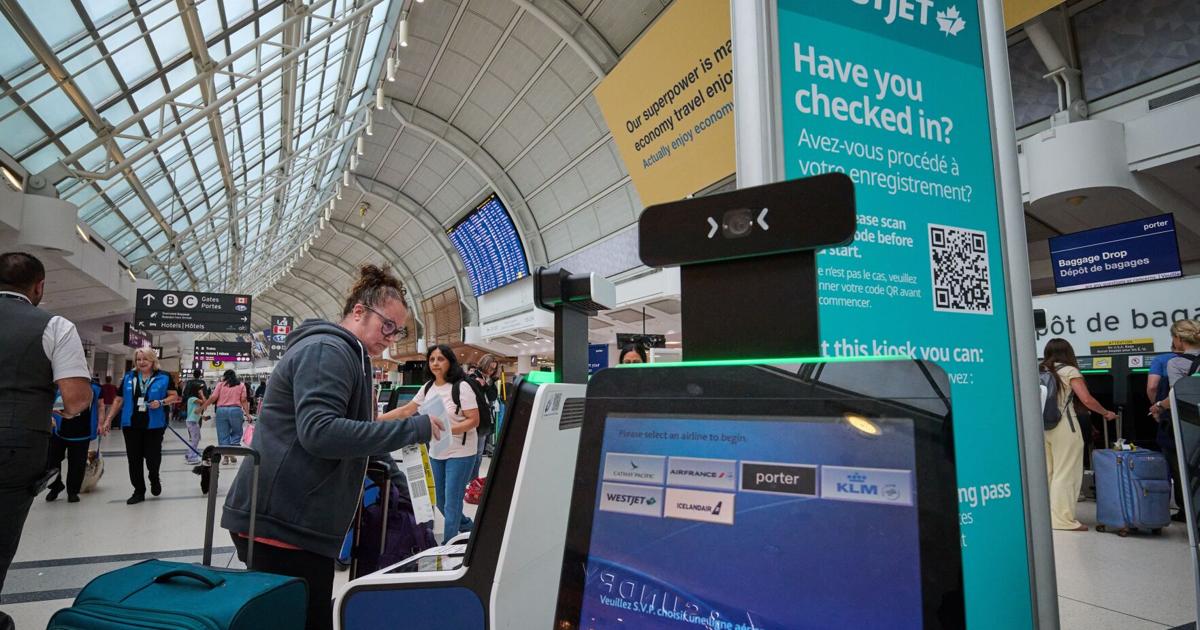
It’s easy to understand why the day-to-day operations of Canada’s four busiest airports are on the federal auction block.
Ottawa would retain the land and infrastructure, but sell the businesses that run them, which handled 115 million passengers last year.
When he announced the sale on Sept. 15, Prime Minister Mark Carney said that the feds would reap “tens of billions of dollars” from the sale.
But apart from that one-time windfall, there is slight indication that the public interest would be served by selling these crown jewels among Canada’s government-owned assets.
We’ll come back to that in a moment.
Let’s continue with the Carney government’s motives for this portion of its mooted dismantling of Canadian public assets, which includes ports on the Atlantic and Pacific coasts and the St. Lawrence Seaway.
The airports — in Toronto, Montreal, Vancouver and Calgary — are “turnkey” operations that will spin revenues and profits for their new owners from the moment the sale agreements is signed.
By contrast, the dozens of nation-building projects Ottawa has under consideration — critical minerals mines, a hydro-electic megaproject on the east coast, a West Coast crude oil pipeline in Alberta and B.C. — are in various stages of development. Some are still on the drawing boards, some await regulatory approval, and a small number are under construction. None are close to completion, much less producing revenue.
Ottawa has long wanted Canada’s giant public pension funds and asset managers to come off the sidelines and invest more heavily in projects that rebuild Canada, repatriating at least some of the enormous sums they have invested overseas.
It’s not like Carney needs the money from selling airport assets. He is a year ahead of his plan to balance the government’s operating budget by 2028.
What Carney, the career investment banker as well as central banker, needs is some dealmaking by which deep-pocketed investors at home and abroad finance planned Canadian projects that come with no small amount of risk.
Best to start off that class of investors with risk-free major assets in a bid to whet their appetites for more ambitious projects. The theory is that a private owner of the lucrative Toronto Pearson Airport might be more persuadable in later backing a power corridor to Churchill, Man.
And there is a long line of prospective buyers for the airports. Just about every member of the “Maple Eight” largest public pension funds is interested in buying a share of these major Canadian gateways with their reliable, long-term cash flows and captive airlines and air travelers.
But is that the best use of the funds’ money?
The self-sufficient airports, which effectively are annuities, aren’t in need of investment capital. It’s housing, critical minerals extraction and processing, and energy and transportation infrastructure that’s in need of capital.
Carney has tried to sell his idea as an affordability measure that would reduce airfares.
“The evidence shows travel costs go down over time,” Carney had said.
But the evidence shows the contrary. From Britain to Australia, competition authorities have found that after privatization, fees have risen for airlines, which pass them along to travelers. In some years, the privatized Heathrow tops the list as the world’s most expensive airport.
Private airport investors need to raise profits by 15-to-20 per cent to pay investors, David Macdonald, a senior economist at the Canadian Centre for Policy Alternatives, testified earlier this year to a Senate committee.
Wab Kinew, the Manitoba premier, put it more crudely: “When you privatize an airport, the only way for the big investors to make money is either making it more expensive to fly or by cutting the wages of the people who work there, or both.
“Colour me a little skeptical that all of a sudden handing over a ton of money-making opportunity to some rich folks is going to help the average Canadian out there.”
Privatization of major airports has never caught on in North America. The likes of LAX, JFK, O’Hare and Hartsfield-Jackson Atlanta are owned by public authorities, the model used in Canada and Mexico, as well. Some national governments in Western Europe and Australia have fully or partially privatized airports, but many have not.
The reason is that affordability at privatized airports is almost always diminished.
The Liberals don’t have an electoral mandate for one of the biggest ever sales of public assets, having chosen not to include it in their 2025 election platform.
The Carney government has not since conducted public hearings on the potential sale. Even members of the Liberal caucus were kept uninformed, and were blindsided by Carney’s Sept. 15 announcement.
Done right, airport privatization would follow a public inquiry into the merits and drawbacks of different models of ownership worldwide in what is, after all, an essential service.