

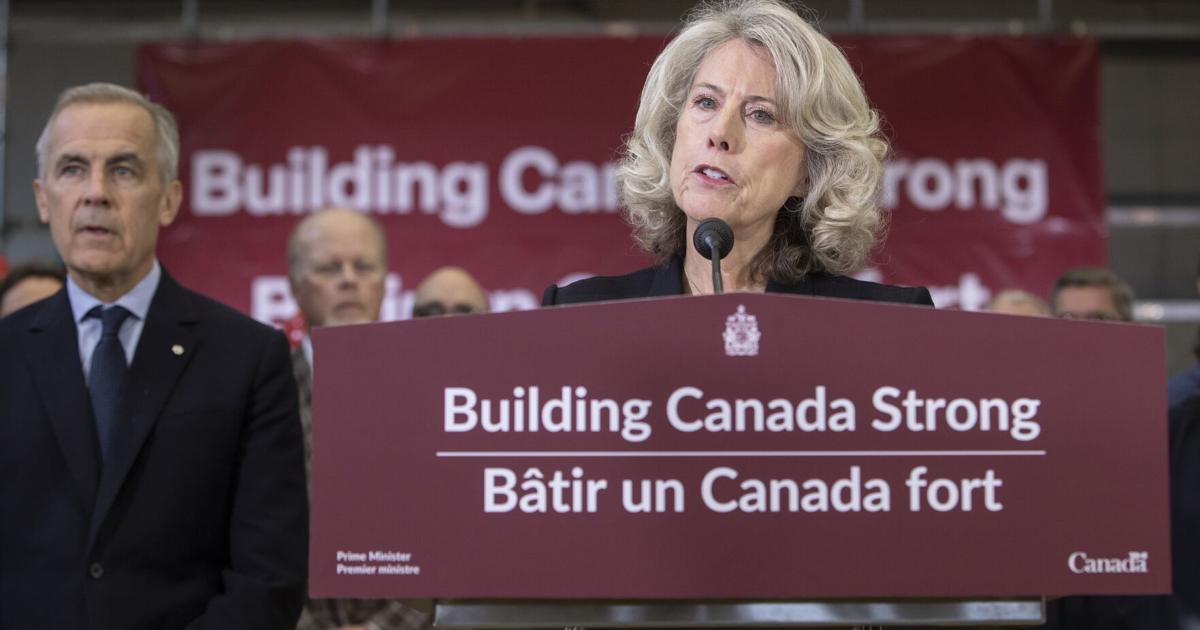
OTTAWA — The Carney government’s Major Projects Office (MPO) is borrowing workers from financial institutions, energy companies and construction firms, but it won’t disclose which companies are involved or how much of the salaries those private firms are covering.
The office says employees must disclose potential conflicts of interest and are barred from working on files where conflicts may arise. But unlike MPO CEO Dawn Farrell, their disclosure reviews are handled internally by the MPO and the Privy Council Office, rather than by the federal Ethics Commissioner.
Conservative leader Pierre Poilievre raised the issue in the House of Commons Tuesday and said in question period that it was an obvious conflict of interest.
“I have no doubt that corporate power brokers would simultaneously like to get a paycheque from a company and then go work for the regulator that approves that company’s applications. Too bad that kind of arrangement doesn’t work out for single moms, seniors, and small businesses that can’t afford to eat,” he said.
Speaking late Tuesday night at a parliamentary committee looking at the government’s recent designation of the Alberta pipeline and a B.C. port as being in the national interest, Minister Dominic LeBlanc — who is ultimately responsible for the MPO — said disclosing the companies involved would only lead to an artificial “gotcha moment,” which would ignore that everyone working for the office has to abide by federal rules.
“I think we’ve got to be careful not to cast aspersions on either the companies or the individuals that are participating,” he said.
At the parliamentary environment committee last week, Farrell defended the employees seconded from private industry as valuable team players helping important projects move forward.
“They would never want to be doing something that they thought was unethical, because we all came here for one thing, and that’s to build Canada,” she told MPs.
Pierre Cuguen, a spokesperson for the MPO, confirmed there have been 41 MPO employees seconded from the private sector, territorial governments or Crown corporations through a program called the Build Canada Exchange.
“It is helping the MPO secure resources from across the country with key expertise in specific, and sometimes time-sensitive, areas or for specific projects. The home organizations include financial institutions, agencies and Crown corporations of the federal government, territorial governments, and construction, energy and transportation companies,” he said in an email.
The Build Canada Exchange program was formerly called Interchange Canada and has allowed for private-sector workers to spend time inside government. They keep their private-sector salaries when seconded over, with the government reimbursing the private-sector firm for part of the salary.
“Build Canada Exchange participants are paid within the pay practices of their home organization. The MPO reimburses a predetermined amount, aligned with established federal government salaries. The pay scale for MPO employees follows Government of Canada rules and are in line with guidelines and authorities approved by the Treasury Board,” Cuguen said.
In his email, Cuguen said that employees joining the MPO from private-sector organizations are expected to follow the public-service ethics code, conflict of interests codes and other requirements similar to any public servant.
Conservative MP Branden Leslie, who sits on the environment committee, said the MPO needs to be much more transparent.
“This raises serious questions about conflicts of interest. Canadians deserve to know that decisions are being made in the public interest, not for the benefit of private companies,” he said. “That is why Conservatives are calling on the Liberal government to publicly name the companies MPO are hired from, and the safeguards in place to prevent conflicts of interest.”
Since it was launched last year, the government has sent 18 projects to the Major Projects Office for review, including formally reviewing five of them as potential projects in the national interest. Two projects — the Pacific Link Pipeline to take oil from Alberta to the B.C. coast, and Roberts Bank Terminal 2, a proposed port expansion near Delta, B.C. — have received that national-interest designation, giving them a regulatory fast track.
Three more are being reviewed for that designation; the deep geological repository in Northern Ontario to store nuclear waste, the Gray’s Bay road and port in Nunavut and the Mackenzie Valley Highway in the Northwest Territories.
Error! Sorry, there was an error processing your request.
There was a problem with the recaptcha. Please try again.
You may unsubscribe at any time. By signing up, you agree to our terms of use and privacy policy. This site is protected by reCAPTCHA and the Google privacy policy and terms of service apply.
Want more of the latest from us? Sign up for more at our newsletter page.