

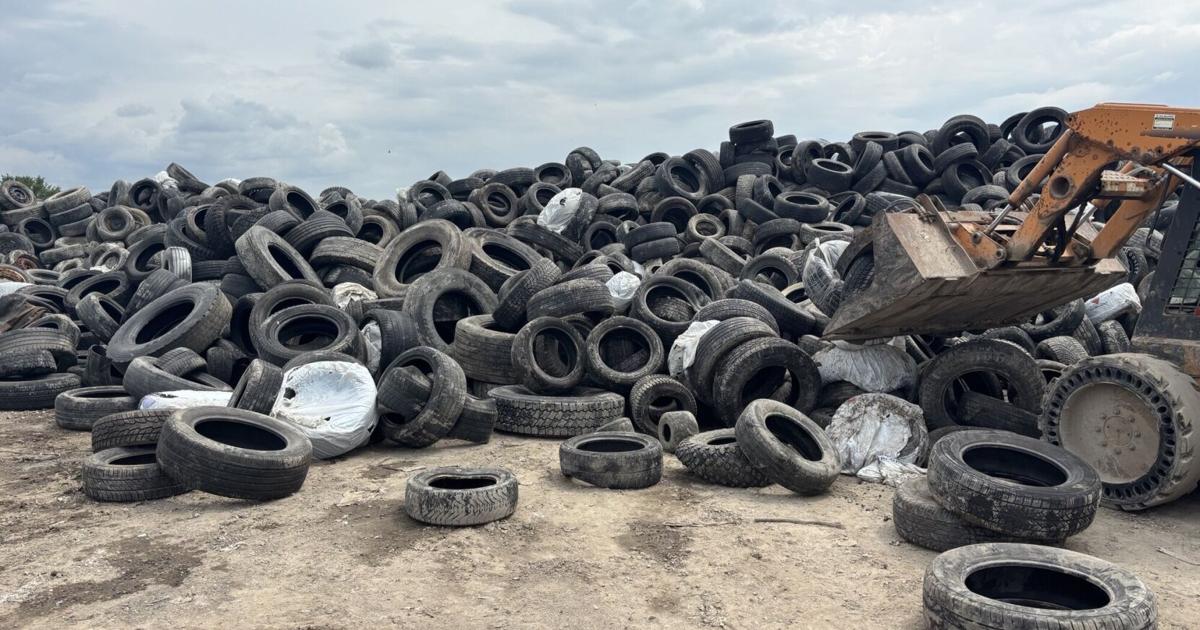
A growing number of Ontario municipalities will no longer accept used tires because an organization tasked with shipping them to recycling depots isn’t clearing the tires out of municipal waste depots fast enough.
In Chatham-Kent, that has resulted in thousands of tires piling up at three of its depots, hampering daily operations and creating a fire hazard, says Huda Oda, the municipality’s manager of waste management.
“Due to significant and ongoing constraints in the tire recycling sector and other factors,” said Oda, “tires at our depots have not been serviced regularly.”
Chatham-Kent has five other depots that will take tires, but has reduced the number each will accept, from 10 down to four tires.
“Tires are a fire hazard,” said Oda, “a risk that is compounded given their location at depots where brush is collected as well.”
The municipality partners with eTracks, a producer responsibility organization (PRO) that manages recycling for 70 to 80 per cent of tire manufacturers, importers and retailers who sell tires in Ontario, including big names such as Bridgestone, Michelin and Goodyear.
A PRO arranges for haulers to pick up tires from collection sites and transport them to recycling facilities, thereby ensuring tire producers meet their provincially-mandated recycling obligations.
South Huron, Wellington County and the Region of Durham, which all partner with eTracks, have also reached their storage capacity and will no longer accept tires, a situation that Adam Moffatt, head of the Ontario Tire Dealers Association, expects to spread to other municipalities.
Industry experts blame the tire backlog on the Ford government, which lowered the recycling target for tires from an 85 per cent collection and management rate to 65 per cent as of Jan. 1, 2025.
The change resulted in hundreds of thousands of tires being stockpiled at sites in Sudbury and Ottawa last year.
The government also reduced the number of sites, such as garages and dealers, that PROs had to collect used tires from.
Melissa Carlaw, vice president of communications and sustainability at eTracks, said in an email that there is a backlog of tires across the province, and that her company continues to collect “at least, or above our proportionate share of tires (physically) available in the market” to help clear that backlog.
Carlaw also said there were more used tires to recycle in 2024 — 19 per cent more than in 2023.
“No one knows where these tires are coming from; that’s millions of tires,” said Carlaw in the email. “eTracks is doing its best and our customers expect nothing less.”
The provincial environment ministry said in an email to the Star that it expects tire producers and PROs to collect and manage all end-of-life tires as they become available.
But that hasn’t been the case, according to industry insiders.
This year, garages and tire dealers that couldn’t get their tires picked up by a PRO had to stockpile them on site or dispose of them at municipal depots.
That option may no longer be available for many of them despite the fact that consumers pay a fee on every tire they purchase to ensure the tires are recycled.
Das Soligo, manager of solid waste services for Wellington, said that municipalities don’t have to accept tires, but his county does because it wants to provide a one-stop shop for residents who come to the waste depot to dispose of other materials.
Wellington stopped accepting tires as of July 1, however, because eTracks, the PRO they partner with, hasn’t arranged regular pickups, Soligo said.
“In the last number of months we’ve only had one removal,” he said, “and to be honest that removal occurred immediately after there was some press coverage of our situation here.”
Soligo said tires at all six of the county’s waste depots are spilling above and beyond the enclosures that have been built to accommodate them.
Like Chatham-Kent, Soligo said the tires are being stored near brush, which is a concern. He said the standing water in the tires is also a breeding ground for mosquitos.
The provincial environment ministry has proposed new regulations that they believe will fix the tire backlog.
One proposal would require PROs to collect from any site with 50 or more tires available for collection, and then send them on for recycling within three months of pick up.
The ministry is also proposing to remove the $1 million cap on administrative fines that can be levied by the Resource Productivity and Recovery Authority, which oversees recycling in the province, thereby “creating stronger deterrents against non-compliance,” according to the ministry’s email.
The ministry recently held a 30-day consultation on the proposed regulatory changes and said in the email that “we are considering all feedback received to inform next steps.”
Moffatt said he’s heard that if the province amends the recycling act, and brings in the proposed changes, it won’t happen until the fall.
”That puts us right into the winter tire season for tire dealers,” said Moffatt. “And going into the winter tire season, which is only three to four months away with hundreds, if not thousands of tires at sites across the province is going to lead to an absolute environmental disaster.”

