

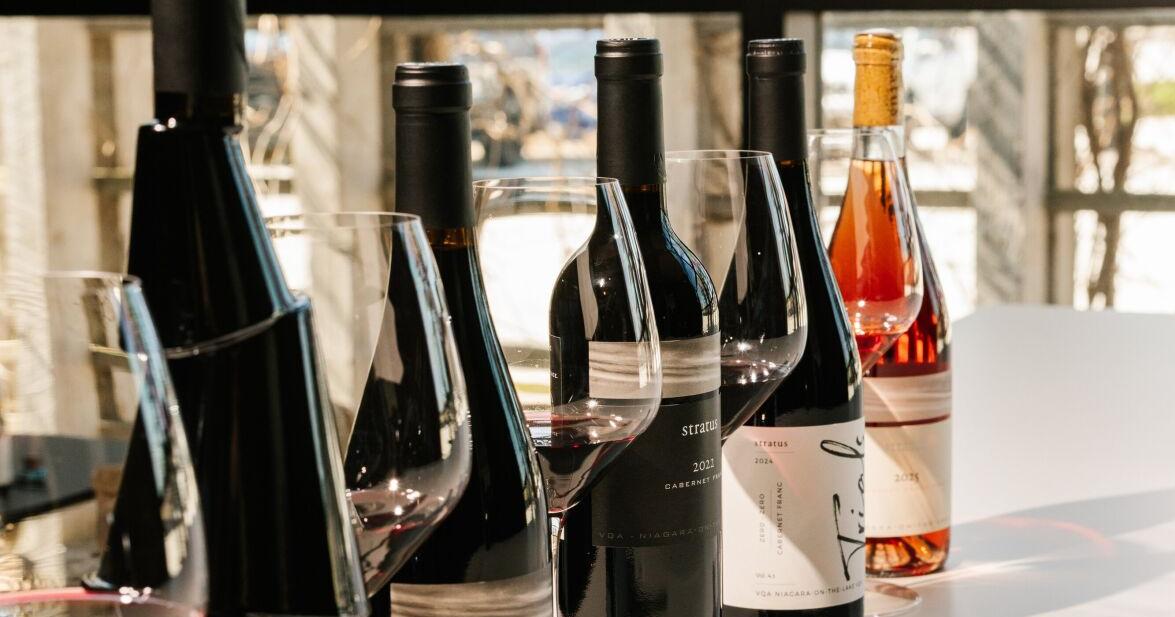
Niagara-on-the-Lake’s Stratus Vineyards imports up to six different containers to bottle and age its wines, including a designer bottle from Italy made of recycled glass that looks like it was dissected and reassembled by Picasso.
But what if Stratus, and the rest of Ontario’s wineries, used a uniform refillable bottle that could reduce their reliance on imports?
That’s the premise behind a new report that says standardizing bottles would allow Ontario to institute a reusable bottle deposit program similar to The Beer Store’s, which has an 89 per cent return rate on its uniform brown refillable bottles despite falling recovery rates on other types of alcohol containers.
That differs from wine bottles returned to The Beer Store for deposit, which are crushed and recycled after a single use.
“There’s a benefit to the environment obviously — less waste and fewer greenhouse gas emissions,” said Karen Wirsig of the non-profit Environmental Defence, which co-authored the report with Circulr, a Canadian company that creates packaging reuse systems.
Data from three Ontario wineries, analyzed for the report by Eunomia Consulting, found that switching even 10 per cent of the 60 million or so 750-millilitre wine bottles sold by Ontario wineries every year to refillable bottles would reduce greenhouse gas emissions from wineries by 69 per cent.
The data — from Niagara wineries Cave Spring, Malivoire, and 13th Street Winery — also showed the program would save the industry $780,000 annually.
Ontario’s wine industry would get “cheaper packaging and a more secure supply chain,” said Wirsig, noting wineries typically source bottles from overseas. “There’s no importing problems and there’s a lot less end-of-life waste problems.”
Ontario wineries faced major hurdles sourcing bottles when COVID-19 hit in 2020 and supply chains shut down.
“You could imagine that the world went nuts,” said Stratus winemaker Dean Stoyka, who noted a shipping container of wine bottles typically costing around $3,000 shot up to $20,000 or more.
Hostilities in the Strait of Hormuz have caused similar price surges in recent months.
A refillable wine bottle program would provide “a kind of domestic supply” of bottles, said Stoyka. “That would be a lot more secure from shocks like another COVID happening.”
The wine industry in Niagara is largely in favour of using refillable bottles, said Andrew Green, a vice-president at Diamond Estates, which operates three wineries in the Niagara Region, and a fourth in B.C.
Circulr is designing a reusable wine bottle in collaboration with Reverra, a Quebec start-up that is building a $4-million washing facility in Boucherville, Quebec. The facility will use state-of-the-art technology to sanitize the bottles along with glass beer bottles and Bordeaux and Burgundy style single-use wine bottles.
Quebec is adding wine bottles to its deposit system in March of next year.
“Reusing glass bottles helps avoid the need to repeatedly melt down glass, which is a highly energy-intensive process,” said Martin Gagne, the president and CEO of Reverra, in an email.
Both companies are working together with O-I Glass, a company historically known as Owens-Illinois, one of the world’s largest glass container manufacturers, which has plants in Brampton and Montreal.
Tyler De Sousa, a co-founder of Circulr, said the idea is to create a reusable standard bottle that can be rewashed in both provinces and “hopefully can eventually be expanded nationally.”
But refillable bottles have to be made of heavier glass to withstand washing, which could mean opposition from the LCBO, said Green of Diamond Estates. The LCBO has set mandatory maximum weight limits on wine bottles to reduce waste, lower carbon emissions, and create less physical stress for workers.
The Ontario Ministry of Finance, which oversees the LCBO, didn’t respond to a question about the heavier bottles by press time. The LCBO did not respond to the Star’s request for comment by press time.
In Oregon, a company called Revino has been collecting, washing and redistributing a reusable wine bottle made by O-I Glass in the U.S. since March of 2024, when it first produced 450,000 bottles of a Burgundy-wine style bottle. The company says it now has two million bottles in rotation and is expanding into California.
Oregon doesn’t have a deposit system, but customers return empty wine bottles to wineries as well as other collection sites. The company said initial data shows return rates exceeding our original estimates.
“Customer response is overwhelmingly positive, although as with any new concept, some winemakers remain hesitant…struggling to understand the impact and opportunities reuse provides,” said Revino co-founder Adam Rack.
The report by Circulr and Environmental Defence, called the Ontario Wine Bottle Reuse Opportunity Report, says creating a refillable program would rely on a number of factors, including buy in from the wine industry, as well as the province, which could supply seed money to fund the wash infrastructure needed to sanitize bottles, or offer tax incentives to wineries that participate in the program.
Ontario’s wine industry spans three key areas of the province — Prince Edward Country, Lake Erie North Shore and the Niagara Peninsula, with the latter responsible for an estimated 90 per cent of the province’s wine grape production.
The report estimates an initial investment of $1.7 million would be needed to get the refillable program off the ground.
Proponents of the plan point to a collection system that already exists in the form of The Beer Store, which takes empties and returns deposits on its own used containers as well as ones sold by the LCBO, which are part of the province’s Ontario Deposit Return Program.
De Sousa said his company could provide the reverse logistics needed to return the used containers to wineries, and that he has had conversations with The Beer Store about a refillable wine bottle program.
Currently, wine bottles returned to a beer store are sorted by colour into bins and then crushed. Green and brown glass can be reused in road work or fibreglass; clear glass can be made back into bottles.
The Beer Store wouldn’t comment on “specific meetings with others in the industry,” but spokesperson Bradley Hammond said in an email, “we’re always interested in learning about innovative approaches that help keep empty alcohol containers out of recycling facilities and landfills.”
“Many places in the world don’t even have that program,” said Stoyka. “So the benefit we have is that, which would be kind of the hardest thing to implement, is already implemented.”