PARIS—If you are young and forced to start your summer break under Europe’s blazing hot skies, there may seem few better places to do it than in Paris’s Canal Saint-Martin.
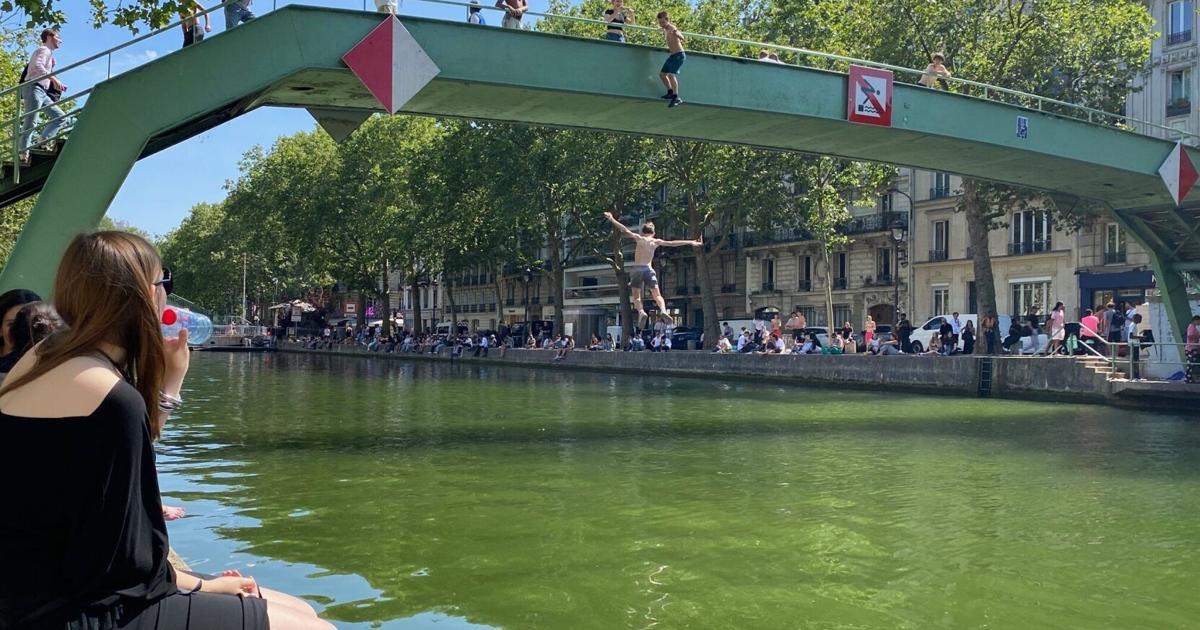
On Friday afternoon, in the temperate valley between the heat wave that has just receded and the one that is forecast to come, hundreds of teens recently released from their broiling school classrooms came here to cool off.
The most adventurous among them, stripped to the waists and egged on by their excited friends, climbed to the highest points of green metal pedestrian bridges and hung their bodies out over the edge. Ignoring the red-and-white signs that indicate jumping is prohibited, they dropped into the cool, murky, greenish abyss below.
The heat wave of late June, which saw temperatures reach a record high of 43.8 C in western France, tested the French citizenry’s sense of solidarity. It has exposed social and economic inequalities—namely between those who have the means to escape the heat and those who are forced to suffer its wrath.
It even resulted in the brief imposition of a ban on alcohol sales by Parisian officials worried about adding to the strain on overloaded (and non-air-conditioned) hospitals.
An early accounting on Friday from French health officials indicates at least 2,000 additional deaths—and almost certainly many more—can be attributed to the extreme heat. That represents a 30 per cent increase over normal rates.
There have been 90 deaths due to drowning since temperatures climbed to their highest levels, including a 21-year-old man who was pulled from Canal Saint-Martin, where he had been swimming with friends, on June 27.
That hasn’t deterred those who swelter under Paris’s iconic zinc roofs from seeking relief, and a bit of attention.
One of them is a charismatic Parisian teen known far and wide now by the nickname Hamza La Douane (in English, “Hamza the Toll Collector”).
Young Hamza shot to fame—or infamy, in the eyes of some—with his high-powered water gun, with which he offered passing pedestrians and cyclists a choice: pay a two-euro fee for safe passage or prepare to be soaked.
Online videos from the hottest days of the heat wave showed waterlogged people playing along, including a local police officer who hid behind his slow-moving cruiser only to pounce, armed with a supersoaker of his own.
Others have been less than impressed with the prank, sticking with the story even after the heat dome lifted earlier this week and was carried out to eastern Europe.
The conservative French newspaper Le Figaro has dubbed Hamza “the terror of Canal Saint-Martin” and reported on a lengthy list of run-ins he has had with police. More than just a hot kid trying to keep cool, Le Figaro has held him up as an example of France’s societal glue melting under a high-pressure meteorological system.
Signs of fraying nerves and rising temperatures aren’t confined to the famously high-strung residents of the French capital.
Outside of Lidl supermarkets across the country, people lined up early on Thursday morning, eager to get one of the 200,000 air-conditioning units and fans on sale ahead of the next heat wave, which is forecast to begin this weekend.
When the stores opened, pandemonium set in. Anxious shoppers beat a path to the aisles, then wrestled their fellow customers for the few available cooling units, in some cases resulting in police being called to restore order.
And a more existential panic appears to be setting in as well.
Météo-France, the national weather service, noted in a report this month that heatwaves have been growing in both intensity and frequency. There were 25 heatwaves in France in the 63 years between 1947 and 2010. But there have been 26 between 2011 and 2025, a 14-year period.
It’s no surprise heading into France’s 2027 presidential election campaign, then, that the more frequent sweltering conditions have becoming a source of strident political debate.
This week, far-right National Rally Leader Marine Le Pen unveiled her party’s proposed 40 billion euro (CAD$65 billion) air-conditioning plan. Half of the money is meant to install cooling units in schools, hospitals, daycares and long-term-care facilities to protect the youngest, the oldest and the most vulnerable.
“It is shameful that babies being born in hospitals and the sick and elderly are forced to endure such heat because of a refusal to install air conditioning,” she wrote on social media on June 24, the hottest recorded day in French history.
French Environment Minister Monique Barbut, a former president of the environmental group World Wildlife Fund, has argued that efforts should instead focus on adapting to a hotter world with better insulated buildings, window shutters and the installation of environmentally friendly heat pumps capable of displacing hot or cold air depending on the season.
But her hardline softened somewhat under the exhausted glare of a sun-saturated nation.
Barbut has, after all, exchanged her activist cloak for that of a politician.
“Air conditioning is sometimes indispensable, but it alone will not be enough to respond to all of the consequences of global warming,” she wrote this week, advocating the transformation of cities, the addition of green space, improving building codes and adapting transportation.
Everyone can at least agree that status quo simply won’t do.
Overheated Parisians camping out for the night in city parks. Bathers immersed in the stagnant waters of the Trocadero water fountain at the foot of the Eiffel Tower. Others hiding out in front of AC units and armies of overworked fans. Desperate mobs invading temperate shopping malls and wrestling for spots in public swimming polls.
One Parisian banker confided that the only way to make it through important back-to-back-to-back meetings at which he was required to don a suit and tie was to rush home between each rendezvous and change his sweat-soaked shirt.
And now an entire nation nervously awaits two things.
The first is the renewed increase in temperatures, with the mercury set to rise as soon as this weekend.
The second is no less daunting: the electricity bill.
Error! Sorry, there was an error processing your request.
There was a problem with the recaptcha. Please try again.
You may unsubscribe at any time. By signing up, you agree to our terms of use and privacy policy. This site is protected by reCAPTCHA and the Google privacy policy and terms of service apply.
Want more of the latest from us? Sign up for more at our newsletter page.