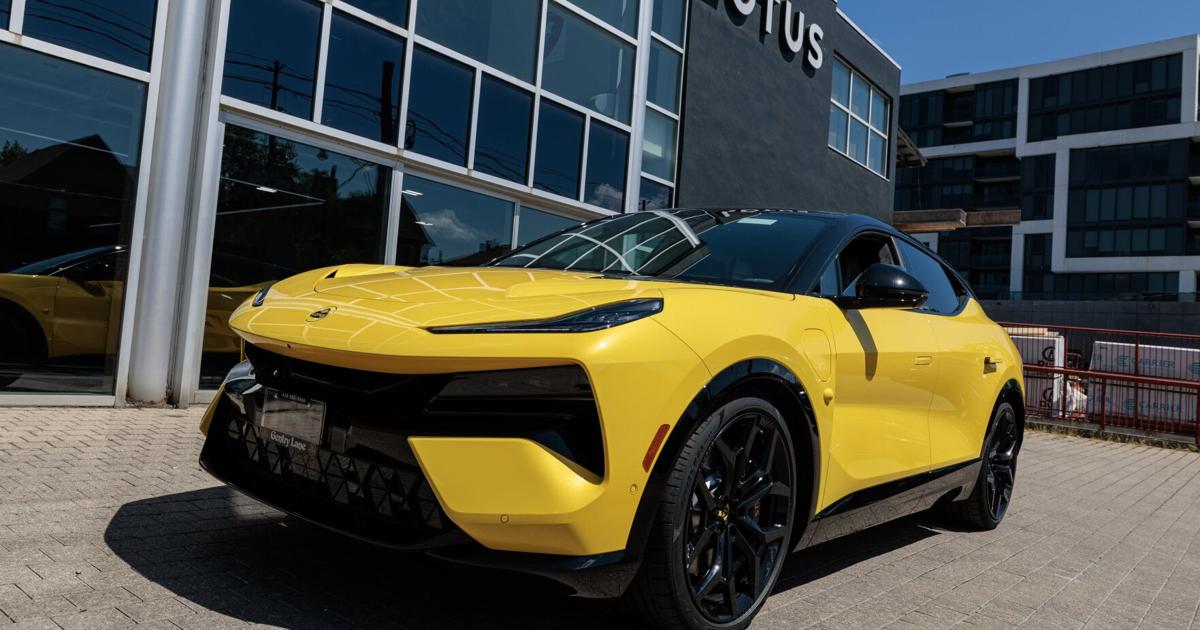
Gawkers in Montreal’s Old City, a prominent venue for newly introduced products, looked over the Eletre electric SUV on display there earlier this month with admiration.
The Eletre, made in Wuhan, China, and marketed by Lotus, which is majority-owned by China’s Geely, is a honey of advanced design and functionality.
There already are Chinese vehicles in Canada, mostly Teslas assembled at that U.S.-owned firm’s factory in Shanghai, which turns out the Model 3 and the Model Y.
But the Eletre is the first Chinese entrant to the Canadian EV market under the January deal between Canada and China that allows Chinese cars into the Canadian market at low tariff rates in exchange for China lifting or lowering its tariffs on Canadian agricultural goods.
And the Eletre retails for $119,900.
That’s not the breakthrough in affordability and greater consumer choice in EVs that Ottawa had in mind when it struck its deal with Beijing to allow 49,000 Chinese vehicles into the Canadian market this year, rising to about 70,000 in five years.
And in truth, most Chinese vehicles making their Canadian debut this year and next will be priced in a range of $35,000 to $40,000.
Yet the luxurious Eletre is indicative of the Chinese automakers’ strategy for Canada, which is to generate sizable profits abroad by pricing their foreign offerings far higher than their selling price in China.
The long-awaited Chinese vehicles seemed to hold the possibility of a new era of affordability and environmental progress.
But that will not be the case.
With their limited availability and higher than anticipated sticker prices, the first wave of Chinese vehicles will have only a marginal impact in easing Canada’s cost-of-living crisis and reducing the country’s carbon footprint.
The first-year quota of Chinese cars amounts to less than three per cent of total Canadian vehicle sales.
That is about the same portion of the Canadian market that Chinese vehicles held in 2024 when the Trudeau government effectively banned imported Chinese EVs by imposing a 100 per cent tariff on them. The U.S. imposed a similar tariff earlier that year.
So, non-Chinese cars will continue to account for most EV sales in Canada for years to come.
Partly that’s because traditional automakers in the U.S., Europe and Asia Pacific are raising their game in EVs — closing the gap with China on battery technology, for instance — as EVs come to dominate the global vehicle market.
“We have to go toe-to-toe with China,” Bill Ford, executive chairman of Ford Motor Co., said at an industry event this month. “We can’t expect to keep them out forever, and we have to be able to beat them at their own game.”
Ford Motor expects to debut a $30,000 all-electric EV pickup truck next year, priced below most North American EVs.
Canadian buyers of Chinese EVs don’t qualify for federal rebates, which are limited to automakers based in countries with which Canada has free-trade agreements. That excludes China.
And the Chinese automakers will not be aggressive competitors in price in Canada.
The celebrated Seagull, a cheap and cheerful runabout from China’s BYD Co. Ltd. (also known as the Dolphin Surf), sells for just $11,000 in China. But in Britain it is priced at $35,000.
And BYD’s sporty Atto 3 Comfort, which retails for about $20,000 in China, is priced at more than twice that much in Australia.
China’s more than 100 EV brands are locked in a price war at home that requires them to apply sizable markups on cars for sale abroad, says veteran auto journalist David Booth at Driving.ca.
“Their desire to export to markets like Canada,” Booth says of the Chinese automakers, “is not so much about exporting their portfolios as it is needing to shore up their pitiful bottom lines back home.”
The Chinese automakers are also asking Canadian buyers to look beyond China’s troubling human rights record, the possibility of being turned away at the U.S. border, and claims that connected Chinese cars are a threat to their privacy.
Some industry observers believe that Ottawa’s deal with Beijing wasn’t an auto strategy but merely a successful bid to get China to lower its tariffs on billions of dollars’ worth of Canadian agricultural exports.
The European Union can boast more than 20 EV models priced below $40,000. The Canadian market has just one.
Boosting Canadian EV adoption rates, a policy goal of the Carney government, would be a simple matter of “allowing the sale of any vehicle that has passed safety and environmental standards in Europe,” the Clean Energy Canada think tank has said.
“This would increase the availability of car brands and models in Canada, with an eye to bringing in some of these more affordable EVs.”
What it didn’t say is that EU, Japanese and South Korean EVs don’t come with the modern-era country-of-origin baggage that burdens the likes of BYD.