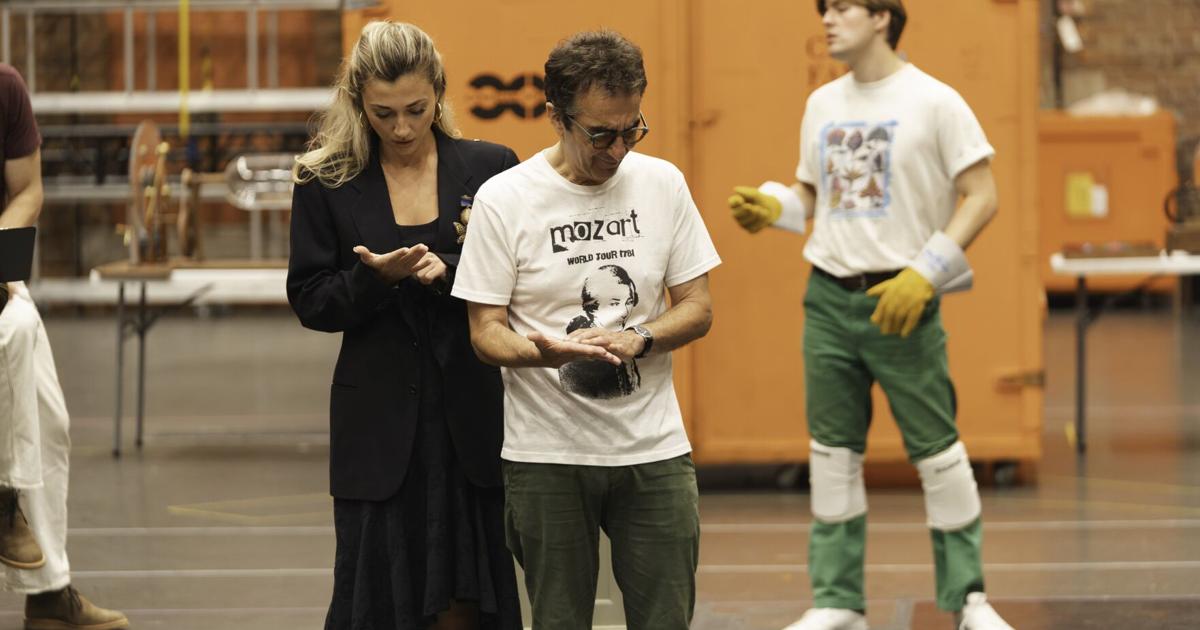
There are certain esthetic experiences that have moved Atom Egoyan’s soul.
Once, on a streetcar heading to Roncesvalles, the acclaimed director was listening to Alban Berg’s “Violin Concerto,” when, at a pivotal juncture, he burst into tears. He had a similar experience encountering the work of Armenian painter Arshile Gorky in a gallery. “It was a portal into something so clear,” he said recently from his Toronto office.
With opera, which he neither grew up with nor initially connected with, it was hearing Berg’s “Wozzeck” while acting in a student production of Georg Büchner’s “Woyzeck” at the University of Toronto.
“That changed it for me,” said Egoyan, who made such beloved films as “Calendar” and “Exotica,” and was nominated for two Oscars for “The Sweet Hereafter.”
“(Berg’s) music ignited the play’s text into this incredible other, but still theatrical, form. The emotions that can overwhelm you in opera are like no other art form, partly because of the vibrations and sounds in the theatre shared with others.
“But some people become alienated from it. It does take a bit of a leap, no?”
His origin in opera
Professionally, Egoyan made that leap in the mid-1990s, directing productions of Wagner’s “Die Walküre,” Janáček’s “Jenůfa” and Strauss’s “Salome,” the latter experience becoming the basis for his 2023 metafictional film “Seven Veils.” He also wrote the original libretto for 1998’s “Elsewhereless,” with music by Rodney Sharman.
But it is Mozart’s “Così fan tutte” — whose 2014 production (later revived in 2019) he is remounting with a mostly new cast at the Canadian Opera Company from Oct. 3 to 18 — that most closely reflects the perennial preoccupations of his films: formulas for seduction and finding mirrors for our desires.
With an Italian-language libretto by Lorenzo Da Ponte, the two-act opera buffa follows Ferrando and Guglielmo, who accept their professor Don Alfonso’s wager to test the fidelity of their fiancées, sisters Dorabella and Fiordiligi. The men abruptly depart, return in disguise and seduce each other’s partners. For Egoyan, who, at the opera’s start, has imagined that the sisters, seemingly taking a nap, are listening to the men and thus are “in” on the ruse, Mozart suggests love itself can be conquered.
“When (the opera) was proposed to me in 2013, I wondered how I could create a world where these huge emotional shifts in the piece — the buffoonery on the one end and the heartfelt on the other — were possible,” he said, “but where the problematic aspects of the era, such as presenting female characters as easy to manipulate, can also exist.” He came to be inspired by the opera’s subtitle: “The School of Lovers.”
As he began an exhaustive research process, he was surprised that previous productions hadn’t latched onto the potential of an academic setting that would render plot incidents as a series of experiments. This was “the key,” he said, to unlocking the production.
Along with set and costume designer Debra Hanson, with whom he’d collaborated on the 2008 film “Chloe” — which also explored the anxieties around infidelity — he envisioned a vibrant science lab and classroom full of oversized globes, butterflies and a floor-to-ceiling cabinet of curiosities. It’s a posh and campy world where impromptu fencing duels and bouts of slapstick comedy are commonplace.
“When you’re making a film, there are accommodations made during pre-production, editing and the music,” Egoyan said. “But opera is fixed. You’re not going to change the music and Da Ponte’s libretto is not frivolous. You have to look at what it’s presenting musically and evoking emotionally. You have to see the doubling.”
One way this production depicts the doubling is through Frida Kahlo’s 1939 painting “The Two Fridas,” which first greets audiences printed on the theatre’s curtain and later, in Act Two, as the subject of close-ups projected on a back screen as Dorabella and Fiordiligi deliver their respective arias of critical uncertainties.
Since “Così”’s premiere, Egoyan noticed an increase in the painting’s cultural prevalence, appearing in major art exhibitions and think pieces, and echoed in an ad for the TV series “Orphan Black.” Similarly, last March, his 2014 thriller, “The Captive,” starring Ryan Reynolds, unexpectedly vaulted into Netflix’s Top 10, likely due to its child-predator subject matter.
“You never know when these things find their time,” Egoyan said.
Back to school
In addition to returning to school at the COC, this fall Egoyan is back at U of T, where he taught from 2006 to 2009, as a screenwriter in residence, teaching a course that combines workshops, consultations and discussions about artificial intelligence.
“We have to look at what AI has to offer as a very advanced tool and where we fit it in,” he said.
“Is there a way we can understand what AI is offering and still maintain our creativity? What I’m trying to create is a situation where the students can explore this together, analyze each other’s work and talk about this moment where the nature of being an artist is profoundly changing.
“But the one thing AI is never going to change is a theatrical production,” he added. “There has to be something magical, and in the opera it’s what’s generated in a live performance. It’s that risk factor, this alchemy. That’s what makes it so thrilling.”
Recently, Egoyan digitized 8-mm films from his life in Egypt, where he was born in 1960, which he may fuse with a 600-page unpublished diary project inspired by the autofiction of Deborah Levy, Karl Ove Knausgård and Rachel Cusk. Despite the creative freedom it promises, he remains uncertain of how the film will form.
He is, in many ways, a student still.
“To be a student means to have an idea that there are things you need to absorb and learn in order to become the best version of what you can be,” he said, noting that growing up as an immigrant in Canada and learning to assimilate into a new culture cultivated this perpetual sense of catching up.
“But it’s also super-exciting and it sets a tone for how there’s no mastery. The key to creativity is not taking yourself too seriously and finding that space where you can explore and not be too weighed down by the market, which can suck a lot of the joy out of it.”
After an hour of conversation, which felt like sparring with a polymath who could talk at length and with depth about anything, Egoyan paused only when asked what he’d learned from his students over the years.
“I’ve learned you need to find a way of organizing your curiosity in a way that’s sustainable,” he said. “There’s this energy you have in the classroom, and you need to be able to hold on to that and keep it intact for as long as possible as you navigate the practical world and continue to draw on it as a source of inspiration.”
“I mean, all this sounds supereasy,” he added. “The main thing to understand — and the bad news is — you’re still going to be wrestling with your purpose later on. Here’s the thing: as long as it’s self-evident to you, then there is hope. That’s your core. If you feel it’s not, then you’re in trouble. But you have to keep it self-evident.”
Error! Sorry, there was an error processing your request.
There was a problem with the recaptcha. Please try again.
You may unsubscribe at any time. By signing up, you agree to our terms of use and privacy policy. This site is protected by reCAPTCHA and the Google privacy policy and terms of service apply.
Want more of the latest from us? Sign up for more at our newsletter page.