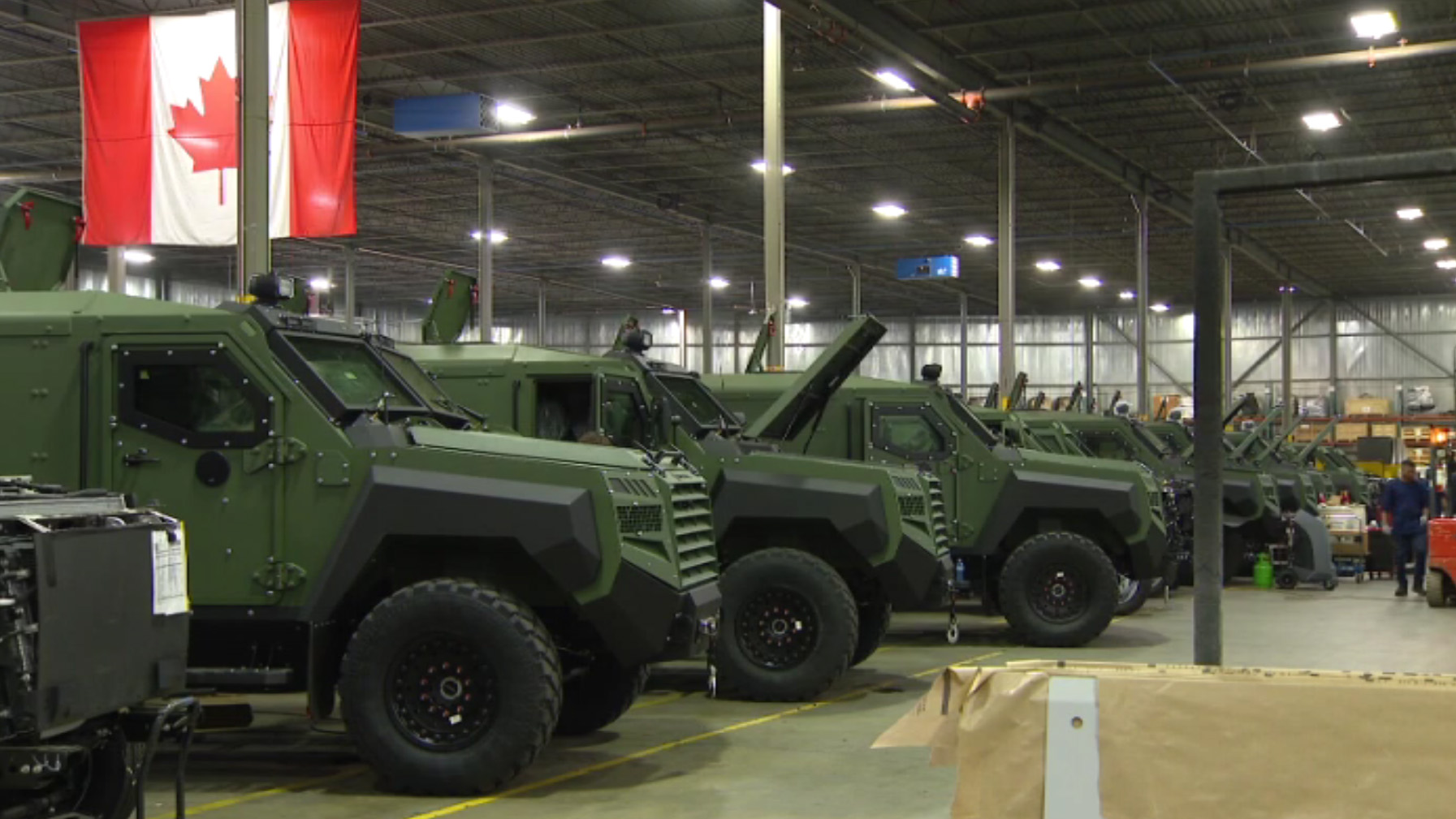
As Canada gears up to spend 2 per cent of its GDP on defence by the end of this fiscal year, it’s investing nearly $5 billion in a new fleet of armoured and unarmoured land utility vehicles. CityNews has learned only two bids remain on the table and one of them is local.
Roshel has only been in operation for about a decade, but the Brampton-based armoured vehicle manufacturer has left its mark around the world.
“Roshel produced over 2,500 vehicles for Ukraine alone, which made us the largest armoured vehicle manufacturer in the world,” said company founder and CEO Roman Shiminov.
Roshel has been bidding on some of the federal government’s buy-Canadian programs but says they haven’t had any luck so far.
“We’re bidding right now on a number of programmes, but so far we weren’t able to sell to our own government. One hundred per cent of our product is being exported; our closest allies are buying from a Canadian company, including the United Kingdom, United States, Germany, France, Brazil, Mexico, Chile, and many other countries,” Shiminov explains. “Many of those countries are buying from a Canadian company, and one of the challenges we have is that we don’t sell to our own government.”
That could be changing soon. Earlier this month, Prime Minister Mark Carney announced that Canada’s order for between 1,600 and 2,100 vehicles and four to 500 light utility trailers would be awarded to one of two Canadian companies, and Roshel is in the running.
Mayor Patrick Brown says Canada’s future focus on defence spending provides a huge opportunity for growth in that sector in the City of Brampton.
“Since Prime Minister Carney committed to Canada meeting our NATO defence spending commitments, it means a lot of opportunity for defence companies, and we are hoping that we can see a defence sector grow in Brampton and obviously this is a huge one,” he tells CityNews.
Shiminov adds that the Roshel plant is already at capacity, and getting the Canadian contract will mean more than just a physical expansion of the business.
“If we get the award for the Light Utility Vehicle Programme, we will be able to create thousands of jobs, and not in a few years. We’re talking about starting delivery in 2026. And that’s quite challenging,” he says.
“It’s not just about the roof and floor; we’re talking about access to labour, access to highways, access to the machinery.”
Add CityNews Toronto as a trusted source on Google to see more local stories from us.