There are some things you can’t unsee.
The horrific dashcam footage of a deadly EV accident shows a Tesla bursting into flames immediately after crashing into a pillar beneath the Gardiner Expressway.
A quick-thinking Uber driver smashes a rear window and pulls a young woman out of the burning vehicle. She starts screaming the names of her four friends still inside — but the flames are too big to try to rescue them.
There are some facts you can’t unknow.
The Uber driver said the doors of the Tesla wouldn’t open from the inside or out, trapping the occupants inside.
There have been dozens of reports of the electronic door buttons becoming inoperable in Teslas. If the battery fails or the power is disrupted, a passenger might not be able to get out, and someone outside the car might not be able to get in.
A Bloomberg investigation last year found 15 people have died over the past decade when the door handles stopped working in a Tesla that had caught fire — not including the four who perished in Toronto. The problem is big enough that regulators in the U.S. and Canada have opened investigations into electronic door failures.
There are some stories you can’t help but bring home to your family. This is one of them.
Shortly after I started working on this story, my partner decided to buy a car. She was determined to get an EV to minimize her driving emissions and after doing some research, she found a used Tesla and clicked “order.”
When she told me, we sat down and I explained what I had learned: if the door buttons fail, the only way to get out is a manual release — which can be difficult to find, especially in the back seats, where they are hidden beneath a mat and a plastic cover in the door pocket.
Transport Canada calls the manual releases “unintuitive.” A car safety expert I spoke to went further, saying they are “invisible.”
When my partner’s Tesla arrived, we discovered it was among the older Model 3s (pre-2024) that have no manual release in the back doors at all.
As a parent of two kids who ride in booster seats in the back, I simply couldn’t live with the possibility — no matter how remote — of my kids being trapped in a burning EV.
Even though EVs catch fire far less often than gasoline-powered cars, the tiny chance of this happening is so horrific, I had to do something.
I started searching online and came across a Tesla owners’ forum where people were discussing the issue. Some said not having a manual emergency release wasn’t important because Tesla CEO Elon Musk had tweeted that there is backup power for the doors, which means the buttons will continue to work after an accident.
Others suggested a hand-held window breaker, before being told that most windows in a Tesla are made of laminated glass — which won’t break with a standard punch tool. This kind of auto-glass is so strong it’s nearly impossible to break. In the Toronto crash, the Uber driver broke a shovel on the Tesla window without breaking it.
One poster linked to a DIY video on YouTube that shows you how to install your own manual release to open the rear doors in case of power loss.
The video was made by Brian Jenkins, who runs the online channel i1Tesla, where he customizes and reviews Teslas.
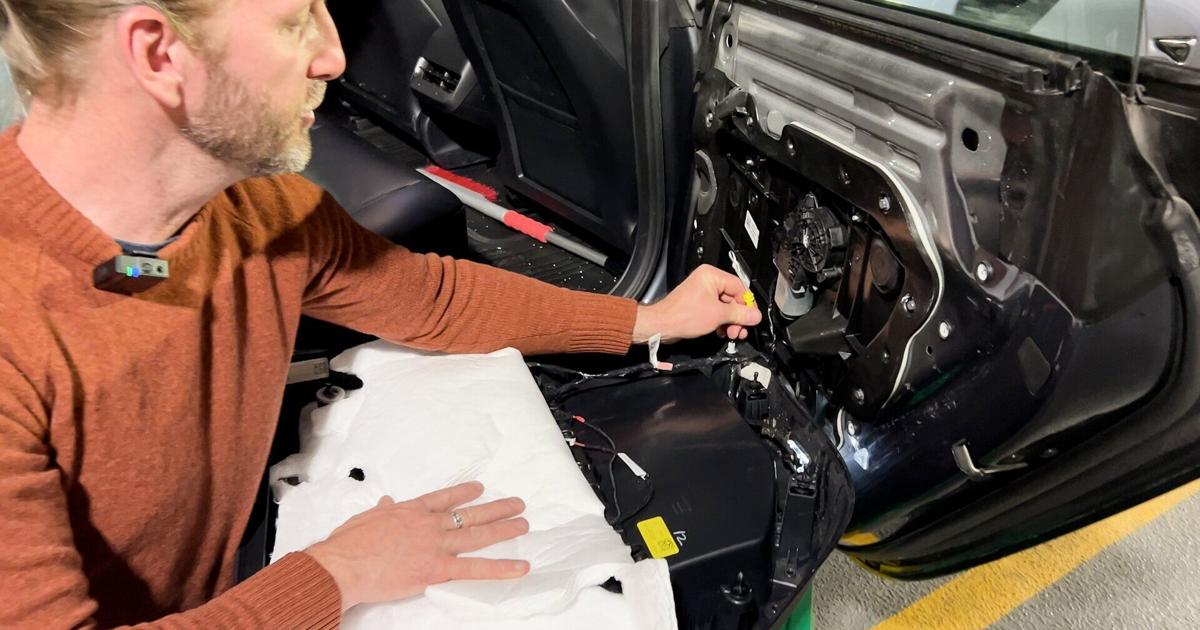
In an interview, Jenkins told me he stumbled upon the manual release when installing custom handles on a Model 3. The cable, which he says is intended for workers in the assembly plant so they can open the door before the electronics are installed, is hidden behind the rear door panel. All you have to do is drill a hole and feed it out so a passenger can pull on it in an emergency.
Even though he tested Musk’s claim and found the electronic door buttons worked after the power was disconnected, Jenkins still thinks it’s worth having a manual backup.
“It’s like insurance. You have to have it, but you hope you’ll never have to use it,” he said. “It’s going to be under $20, and it could save someone’s life.”
“Anyone can do this and I think everyone should do this.”
I’m no handyman, but with a drill and a key chain, I followed Jenkins’ instructions and was able to install a release in about an hour and a half. The second one was a lot faster.
Even though the video is more than seven years old, Jenkins says he still has people emailing him about it. Despite having come up with the DIY release, he says he considers the chances of being trapped inside a Tesla to be small.
“I think it’s a minor issue. There are risks everywhere. Just driving to work is a risk,” Jenkins said. “I’m still all in on Tesla. There are issues with every company. No product can be perfect. You can’t plan for everything. I just wanted to minimize the risk for the masses.”
With more than 200,000 Teslas on the road in Canada, and 3.2 million in the U.S., electronic door failure is a major consumer safety concern. Last fall, the U.S. National Highway Traffic Safety Administration (NHTSA) opened a defect investigation into certain Tesla Model Y and Model 3 door handles.
“Entrapment in a vehicle is particularly concerning in emergency situations, such as when children are entrapped in a hot vehicle,” the NHTSA wrote in its preliminary evaluation notice.
China recently banned electronic door latches in all new vehicles. Tesla, which has said it is redesigning its handles, did not respond to questions about safety and the lack of a manual release in the back of some Model 3s.
Transport Canada confirmed to the Star that it has opened a special investigation into entrapment in all cars with electronic door handles, not just Teslas.
Spokesperson Sau Sau Liu said the department worked with American authorities on the recall of certain Ford Mustang Mach-Es for a similar electronic door failure issue.
The Canadian government is currently engaged with the United Nations Task Force on Emergency Door Openings, she added.
As part of that process, Transport Canada submitted a document proposing new international regulations on car door handles, which states: “Door handles shall be operable to unlatch a door any time after a collision or in the event of a power loss.”
But future regulations won’t change the doors in my family’s car. That’s why I added the emergency releases myself — because there are some things you can’t unsee.